
For aquarium owners who are away for a weekend or need regular daily portions, a battery-powered automatic feeder such as the Eheim Twin or the Fish Mate series is the usual choice, while a slow-release vacation block from Zoo Med suits short trips, and simple manual tools such as feeding rings or tubes suit hobbyists who prefer to feed by hand. The right feeder depends on what you feed (flakes, pellets, granules or frozen food), how long you will be away, how many tanks you keep, and how much you trust a machine with your fish. This guide compares the main types and explains what to look for, using the makers’ stated features and what reviewers commonly report.
Our top picks


As an Amazon Associate we earn from qualifying purchases at no extra cost to you.
At a Glance: Fish Feeders Compared
| Type or model | Best for | Key stated features | Limits |
|---|---|---|---|
| Eheim automatic feeder (Twin and similar) | Reliable daily dosing | Programmable feeding times, battery-powered, drum design, maker lists food compatibility | Premium tier, needs dry food |
| Fish Mate feeder (F14 and similar) | Multiple meals per day on a budget | Programmable meals, battery-powered, removable drum according to the maker | Can clump with humid flakes |
| Zoo Med vacation feeder block | Short absences | Slow-dissolving block that releases food over several days, according to the maker | Can cloud water, not suited to all species |
| Hygger or similar WiFi/app feeders | Tech-friendly users who want remote control | Smartphone control and scheduling according to makers | Requires a stable connection and battery or power |
| Feeding ring or tube | Manual feeding of floating food | Confines food to one area to limit spread | No automation |
| Pond or large tank feeders | Outdoor ponds and big setups | Larger hoppers and weather protection | Not for small aquariums |
Why Use an Automatic Feeder
An automatic feeder dispenses a measured portion of food at set times. That helps with consistency, which many aquarists link to steadier water quality because feeding too much at once leads to uneaten food and waste. It also covers short trips, though it is not a substitute for a person who can check the tank. Most fish tolerate a few days without food, so for very short absences many keepers choose to skip feeding rather than risk an overfeed from a malfunctioning device.
Types of Fish Feeders
Rotating drum feeders
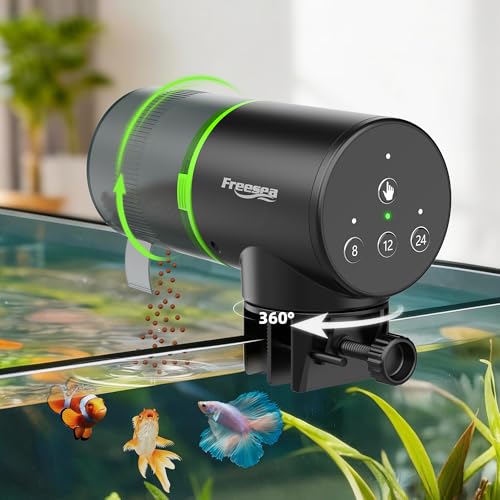
These have a drum divided into compartments. A motor turns the drum and drops a portion into the tank. The Eheim and Fish Mate models fall into this group. They suit flakes, pellets and granules, though humid air near the tank can cause food to clump and jam the drum. Reviewers often advise mounting the feeder where it will not get splashed and using a drying aid such as the desiccant the maker may supply.
Vacation blocks
A vacation feeder block, such as those made by Zoo Med, dissolves slowly in the water and releases food over several days. The maker states the block is intended for short absences. These are inexpensive and need no power, but they can cloud the water and may not suit sensitive species or small tanks. Test any block before you leave rather than trying it for the first time on a trip.
App-controlled feeders
Some feeders connect to a smartphone for scheduling and remote control. They give flexibility, though they depend on a stable connection and a reliable power source. They also add another device to maintain and update.
Manual aids
Feeding rings keep floating food together so it does not spread across the surface, and feeding tubes help place sinking food near bottom dwellers. These are simple, cheap and useful if you feed by hand.
What to Look For
- Food compatibility. Check the maker’s list. Many feeders handle flakes and small pellets well but struggle with large or sticky foods. Frozen or live food generally needs manual feeding.
- Number of meals. If your fish need several small meals a day, pick a feeder that offers multiple programmable feedings.
- Portion control. Look for adjustable portion size. Overfeeding is a common cause of water-quality problems.
- Power source. Battery-powered units work during an outage, but batteries need replacing; plug-in units rely on mains power. Read the manual for the correct battery type.
- Moisture protection. Look for a design that limits humidity from the tank reaching the food.
- Mounting. Check that the feeder fits your tank rim or lid, and that it can be positioned so food drops where the fish can reach it.
Trial Run Before You Travel
Whichever feeder you choose, set it up and run it for at least a week before you leave. Watch how much food it drops, whether fish take it all within a few minutes and whether water clarity changes. Adjust portion size so there is no leftover food. This is the most useful step you can take to avoid problems while you are away. If you will be gone for a long time, ask a reliable person to check on the tank, the filter and the heater, since a feeder does not replace regular monitoring.
Species and Tank Considerations
Different species have different feeding needs. Surface feeders take floating flakes, mid-water fish prefer slowly sinking pellets, and bottom dwellers need sinking tablets or wafers. A drum feeder that drops flakes at one spot may not reach shy or bottom-dwelling species. Herbivores and some specialist fish benefit from fresh vegetables, which an automatic feeder cannot provide. If you keep sensitive or young fish, speak with a knowledgeable aquarium store or a vet experienced with fish about feeding schedules.
Budget Tiers
Budget tier
Vacation blocks and basic manual aids belong here. They suit short trips and casual use, but results are less predictable.
Mid-range tier
Fish Mate and similar programmable drum feeders sit here by typical retail positioning. They offer multiple meals per day and adjustable portions, a good fit for most home aquariums.
Premium tier
Eheim feeders and app-connected models sit in the higher tier. Reviewers often cite sturdier build and more consistent dosing, though the gains depend on how well you maintain the unit.
Pick X If… Decision Table
| If you want… | Pick | Why |
|---|---|---|
| Precise, repeatable daily meals | Eheim automatic feeder | Programmable times and drum design |
| Several meals a day without overspending | Fish Mate | Programmable meals in a simple format |
| Cover a weekend with no power | Zoo Med vacation block | Slow-dissolving, no battery |
| Remote scheduling from your phone | App-controlled feeder | Smartphone control according to the makers |
| To feed by hand but limit spread | Feeding ring or tube | Keeps food in one area |
| A pond or large outdoor setup | Pond feeder | Bigger hopper and weather protection |
Alternatives
- A trusted helper. A friend who checks the tank and feeds a premeasured portion gives you eyes on the fish.
- Pre-portioned feeding packs. Weekly pill boxes with one portion per day make hand feeding foolproof for a helper.
- Skipping meals. Healthy adult fish can usually go a few days without food; ask an experienced aquarist about your species.
Care and Safety
Keep the feeder dry, refill it with fresh food, and clean the drum regularly to prevent mold and clumping. Never put wet food into a drum feeder. Keep electronics and batteries away from water, and follow the manual when changing batteries. Use only the adapter the maker lists for plug-in models. If you notice cloudy water, uneaten food or sick fish, stop using the feeder, remove leftover food and ask a fish-experienced vet or your local aquarium store for help.
How Much Should You Feed?
A common guideline from aquarium experts is to offer only as much as the fish eat in a couple of minutes, once or twice a day, though needs differ by species and age. Fry and young fish often need smaller, more frequent meals, while many adult fish do well on one meal a day. An automatic feeder removes the temptation to overfeed, but only if portions are set correctly. Start with a small portion and increase gradually, watching for leftovers on the bottom or in the filter intake.
Uneaten food breaks down and adds ammonia and nitrate to the tank, which can stress fish and fuel algae. If you see leftovers after the feeder runs, reduce the portion or the number of meals. Regular water testing and routine water changes remain important whatever feeder you use.
Also consider noise and light. A motorized feeder can make a soft sound each time it runs, which some fish learn to associate with food and may gather near the outlet. That can be useful, but in a community tank it can lead to faster fish crowding out shy ones. Positioning the outlet near a spot that also has cover helps. If your tank has a lid, make sure the feeder mounts securely without leaving gaps where fish could jump out.
Frequently Asked Questions
Are automatic fish feeders reliable?
Many work well when properly set up and tested, but they can jam, run out of batteries or clump food in humid conditions. Run a trial for a week before relying on one.
How long can fish go without food?
Many healthy adult fish tolerate several days without food, but tolerance depends on species, age and tank conditions. For longer absences, use a tested feeder or ask a helper, and consult an experienced aquarist about your fish.
Can I use any food in an automatic feeder?
Check the maker’s list. Flakes, granules and small pellets are usually fine, but sticky, large or frozen foods generally are not.
Do vacation feeder blocks work?
The maker says they release food slowly over several days, but they can cloud the water and are not suited to all species. Test one in advance and avoid them in small or sensitive tanks.
How do I stop food from clumping in the feeder?
Keep the feeder away from splashes and humidity, use fresh dry food, and clean the drum regularly. Some makers supply a desiccant or advise a particular mounting position.
Where should I mount the feeder?
Mount it at the rim or lid, with the outlet positioned so food drops where fish can reach it and away from the filter outflow. Follow the maker’s instructions for your tank type.
FAQ
How Much Should You Feed?
Are automatic fish feeders reliable?
How long can fish go without food?
Can I use any food in an automatic feeder?
Do vacation feeder blocks work?
How do I stop food from clumping in the feeder?
Where should I mount the feeder?
More from Amazon
Programs that pair well with the guide above. Offers and eligibility are set by Amazon and may change.
Free shipping on eligible items, Prime Video and more. Eligible new members can start with a free trial.
Start a Prime free trialAudiobooks and podcasts to listen to on the go. Eligible new members can start with a free trial.
Try Audible freeAd-free music streaming. Eligible new subscribers can start with a free trial.
Try Music Unlimited freeA free business account with business pricing and bulk-buying tools for work, shop or home office.
Create a business accountAs an Amazon Associate we earn from qualifying purchases.







