Key takeaways
- Warping: thin pans can buckle when exposed to sudden temperature changes, such as a hot pan under cold water. Let pans cool first.
- Cleaning: hand wash unless the maker says dishwasher-safe. Soak stuck-on food rather than scraping with metal.
- Liners: parchment or a silicone mat protects the surface and eases cleanup. Check the liner’s temperature rating against your oven setting.
- Oven temperature: check the maker’s limit, particularly for coated pans.
- Stacking: store with paper between coated pans to prevent scratches.
- Replacement: retire pans with flaking coatings or deep scratches.
For most kitchens, a heavy-gauge rimmed half sheet pan in natural aluminum, such as the Nordic Ware Natural Aluminum Commercial Baker’s Half Sheet, is the best all-round baking sheet, while an aluminized steel option such as USA Pan suits bakers who want a coating and a slightly sturdier build. Cookie sheets without sides suit bakers who mostly make cookies and want easy sliding, and a nonstick set suits anyone who dislikes parchment. If you buy only one, make it a half sheet pan that fits your oven.
Our top picks



As an Amazon Associate we earn from qualifying purchases at no extra cost to you.
Baking Sheets at a Glance
| Product | Material | Best for | Key stated points | Limits |
|---|---|---|---|---|
| Nordic Ware Natural Aluminum Commercial Baker’s Half Sheet | Natural aluminum | Everyday roasting and cookies | The maker lists a rimmed half sheet in uncoated aluminum with a rolled edge | Hand wash per the maker; can discolour; food can stick without liner |
| USA Pan Half Sheet | Aluminized steel with silicone coating | Even browning and release | The maker lists US-made aluminized steel and a corrugated surface | Premium tier; hand wash recommended |
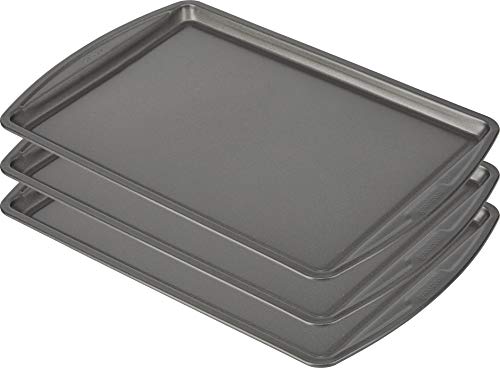
| Wilton Recipe Right | Steel with nonstick coating | Budget starter sheets | The maker lists a basic nonstick option | Thinner steel can warp |
| Calphalon Classic Nonstick | Steel with nonstick coating | Easy cleanup | The maker describes a nonstick sheet in its bakeware range | Dark finish browns faster |
| Cookie sheet (no rim or one-sided rim) | Aluminum or steel | Sliding cookies off | Open edges allow air flow | Not suited to juices or roasting |
Rimmed Sheet Pan vs Cookie Sheet
A rimmed sheet pan, often called a half sheet or jelly roll pan, has raised sides on all four edges. It contains juices and oil, so it works for roasting vegetables, sheet-pan dinners and baking. A cookie sheet has little or no rim, which makes it easier to slide cookies off and allows heat to circulate, but it is less versatile. Many cooks prefer a rimmed pan for everything, using parchment to slide cookies away.
Size: What Is a Half Sheet?
A half sheet pan is a commercial-kitchen size that is roughly 18 by 13 inches, and many home ovens are designed to take it. A quarter sheet is about half that and suits toaster ovens and small batches. A full sheet is too large for most home ovens. Always measure your oven rack width, because some wall ovens and compact ovens cannot take a half sheet. Check the maker’s stated outer dimensions for the exact pan.
Material and Finish
Natural Aluminum
Aluminum conducts heat quickly and evenly, and it resists rust. Nordic Ware’s Naturals pans have long been a staple for this reason. The finish dulls with use, which is cosmetic, and acidic or salty foods can discolour bare aluminum. The maker advises hand washing, and not using the dishwasher because detergent can damage the surface.
Aluminized Steel
This is steel coated with an aluminum-silicon alloy, giving a sturdier pan with good heat spread. USA Pan builds its sheets from it and adds a silicone-based nonstick layer. Reviewers often note that these pans resist warping and release food well.
Nonstick-Coated Steel
Wilton and Calphalon sell nonstick-coated steel sheets. Release is easy, but dark finishes brown faster, so some bakers lower the oven temperature slightly or shorten the time. Avoid metal utensils, high heat beyond the maker’s limit, and abrasive scrubbers.
Stainless Steel
Stainless sheets are non-reactive and durable but conduct heat less evenly than aluminum, so edges may brown before centers. They are less common for baking and better as roasting pans.
Models Worth Knowing
Nordic Ware Natural Aluminum Commercial Baker’s Half Sheet
This is a long-running favourite for its simple, durable build. The maker lists an aluminum pan with a rolled, reinforced edge to help resist warping. It works for cookies, roasted vegetables and sheet cakes. It is mid-range in price, and reviewers recommend using parchment for sticky foods.
USA Pan Half Sheet
USA Pan’s half sheet is the premium pick of many bakers. The maker states the pan is made in the United States from aluminized steel with a silicone coating, with corrugations to help air flow. Reviewers report good release and strong resistance to warping.
Wilton Recipe Right
This budget line is useful for someone setting up a first kitchen. It is nonstick, light, and inexpensive, but thinner steel can bend when hot, so avoid sudden temperature changes.
Calphalon Classic Nonstick
Calphalon is a mid-range alternative if you want a coated pan in a larger bakeware set. Its dark finish absorbs heat, so watch bake times closely.
Care, Warping and Safety Notes
- Warping: thin pans can buckle when exposed to sudden temperature changes, such as a hot pan under cold water. Let pans cool first.
- Cleaning: hand wash unless the maker says dishwasher-safe. Soak stuck-on food rather than scraping with metal.
- Liners: parchment or a silicone mat protects the surface and eases cleanup. Check the liner’s temperature rating against your oven setting.
- Oven temperature: check the maker’s limit, particularly for coated pans.
- Stacking: store with paper between coated pans to prevent scratches.
- Replacement: retire pans with flaking coatings or deep scratches.
Budget Tiers
- Budget: Wilton and similar basic coated pans.
- Mid-range: Nordic Ware Natural Aluminum, Calphalon.
- Premium: USA Pan and other heavy-gauge steel options.
Pick X If… Decision Table
| Pick this | If you want… |
|---|---|
| Nordic Ware Natural Aluminum half sheet | A simple, durable workhorse for roasting and baking |
| USA Pan half sheet | A coated, sturdy pan with strong warp resistance |
| Wilton Recipe Right | Cheap sheets for a first kitchen |
| Calphalon Classic Nonstick | Easy release and matching pans |
| A quarter sheet | Small ovens, toaster ovens and small batches |
Alternatives
- Silicone baking mats: sit on top of any sheet and reduce sticking without parchment.
- Perforated pans: allow air under the food for crisping, popular for pizza and fries.
- Cast iron griddle: a heavy option for searing and baking in the oven.
Practical Buying Considerations
Buy at least two of the same sheet if you bake in volume. Matching pans cook evenly at the same time, and you can rotate them between racks halfway through. Many bakers swap the top and bottom pans and turn them front to back for even browning, since most home ovens have hot spots.
Consider the rim. A rolled, reinforced edge adds stiffness and gives a better grip, while a thin flat rim bends more easily. A pan with a slight lip on one side only, as many cookie sheets have, helps you slide parchment off, but gives up the ability to contain juices.
Look at the surface finish. Smooth surfaces are easy to wipe, while textured or ridged surfaces can improve airflow and release. A light finish bakes gently, whereas a dark finish speeds browning, so choose to suit your recipes. Many cooks keep one light-coloured pan for cookies and one dark pan for roasting and crisping.
For roasting, pair the sheet with a wire rack that the maker says fits inside the pan. This lifts food above the surface so air flows around it, which helps with crisp bacon, chicken wings and fries. Check the rack’s stated oven-safe rating, and avoid mixing materials that can react, such as an uncoated aluminum pan with acidic marinades. When in doubt, line the pan. Finally, allow for storage: sheets stack flat in a narrow cabinet or stand upright in a rack, which saves space in a small kitchen.
Frequently Asked Questions
What size baking sheet should I buy?
Most home cooks use a half sheet, about 18 by 13 inches. Measure your oven first, and consider a quarter sheet for toaster ovens or small batches.
Why do baking sheets warp?
Metal expands unevenly when it heats quickly or cools suddenly, which can cause a pan to buckle. Heavy-gauge pans with reinforced rims resist warping better, and letting pans cool before washing helps.
Should I use parchment paper on a baking sheet?
It is optional but helpful. Parchment protects the pan, makes cleanup easier and helps release sticky foods. Check its temperature rating against your oven setting.
Is aluminum safe for baking?
Aluminum bakeware is widely used. Acidic foods can react with bare aluminum and discolour it, so line the pan for tomato or citrus dishes. Follow the maker’s instructions.
Can I put baking sheets in the dishwasher?
Only if the maker says so. Many aluminum and coated sheets are labelled hand wash only, as dishwasher detergent can dull the surface.
Do dark baking sheets cook differently?
Yes. Dark pans absorb more heat and brown faster, so cookies can darken on the bottom. Light-coloured pans give gentler, more even results.