
Mattress topper best lists usually rank by softness, which is the least durable thing about a topper. Material class, foam density and thickness predict how a layer performs in year three, and those three numbers are what separate a lasting upgrade from a flattened sheet of foam under your hips.
As an Amazon Associate we earn from qualifying purchases.
Our top picks


As an Amazon Associate we earn from qualifying purchases at no extra cost to you.
By Daniel Foster
🛒 Best Price Today on Amazon
Prime members get fast, free shipping on everything above, plus member-only deals. New members get a 30-day free trial — cancel anytime.
Start 30-Day Prime Free Trial →See Today’s Amazon DealsJudging Which Mattress Topper Best Fits Your Bed
Every topper belongs to one of four material families, and each fails in a predictable way. Choosing the family first, then the specification within it, produces better results than comparing individual products across categories that behave nothing alike. Deciding which mattress topper best fits a bed starts with that family, not with a brand name.
Thickness, Density and the Firmness Change
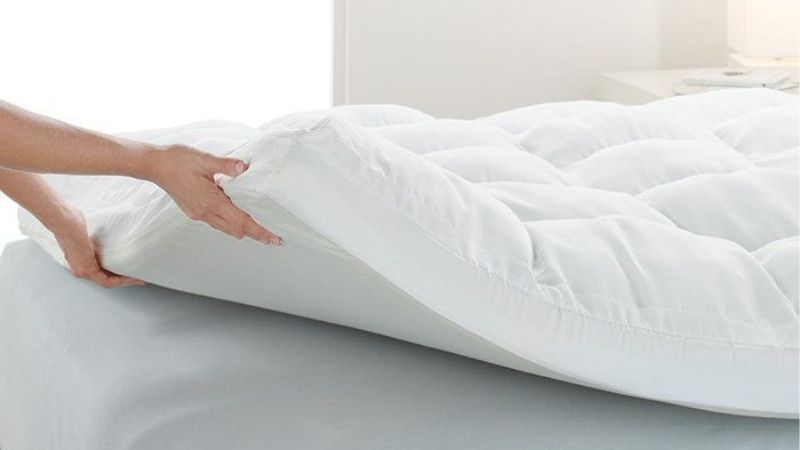
Depth options run 2, 3 and 4 in (5, 7.6 and 10 cm). Under three inches you get surface softening only; at three inches the firmness of the bed underneath measurably changes; at four inches the topper begins to dominate the feel entirely, for better or worse.
Density, measured in lb/ft3, decides longevity. Higher density memory foam resists the permanent impression that forms under the hips, which is where every foam layer fails first. A denser 2 in layer will routinely outlive a soft 4 in one under the same sleeper. A thick low-density topper will always underperform a thinner dense one over a multi-year horizon.
The Four Material Families
Memory foam contours slowly and isolates motion but retains heat. Latex responds instantly and breathes well but costs more and weighs more. Feather and down beds add loft with airflow but compress nightly and need shaking out. Wool regulates temperature but softens rather than cushions.
Match the family to the complaint. A bed that is too firm points to memory foam or latex; a bed that feels harsh but supportive points to a feather bed or wool; a bed that sleeps hot rules out solid memory foam almost automatically. Matching the complaint to the material is how the mattress topper best suited to your room gets identified quickly.
Space and Fit: Depth, Sheets and Bed Height
Toppers are sized to US mattress dimensions, so measure your bed rather than trusting an old label: Queen is 60 x 80 in (152 x 203 cm) and King is 76 x 80 in (193 x 203 cm). Deep or pillow-top mattresses often measure larger than expected.
Adding 3-4 in (7.6-10 cm) means deep-pocket sheets rated for the total height, and it raises the mattress surface enough to matter with a tall bed frame or a low ceiling in an attic room. Check the finished height before ordering, not after. Bunk beds and platform frames with side rails are the usual places this goes wrong.
Certifications, Care and Expected Lifespan
CertiPUR-US applies to foam content and emissions; natural latex products often carry their own organic certifications. Expect 24-48 hours of expansion and mild off-gassing on compressed foam, which clears faster with the room ventilated.
Foam and latex cannot be washed, so a removable cover or a protector is not optional in practice. Realistic lifespans run three to five years for mid-density foam, longer for latex, and shorter for fibre-filled products that compress with every night of use. Warranty terms in this category are short, so durability comes from the specification rather than the paperwork.
Top Picks: Six Toppers Across Four Materials
The selection below deliberately spans material families rather than repeating six versions of the same foam. Each entry lists a genuine limitation, and every figure comes from manufacturer documentation combined with long-term owner reports rather than in-house testing. Availability changes by size, and pricing across these tiers moves often enough to check before ordering.
| Model | Material | Thickness | Heat behaviour | Expected life |
|---|---|---|---|---|
| TEMPUR-Topper Supreme | Memory foam | 3 in / 7.6 cm | Warm | Long |
| Subrtex Gel Memory Foam | Gel memory foam | 3 in / 7.6 cm | Moderate | Medium |
| Best Price Mattress Ventilated | Memory foam | 3 in / 7.6 cm | Moderate | Medium |
| LUCID Bamboo Charcoal | Memory foam | 2 in / 5 cm | Moderate | Short-medium |
| Novilla Gel Memory Foam | Gel memory foam | 3 in / 7.6 cm | Moderate | Medium |
| Puredown Feather Bed | Feather and down | 2-3 in / 5-7.6 cm | Cool | Medium |
TEMPUR-Topper Supreme – The Density Benchmark
Three inches of the same high-density formulation used in the brand’s mattresses, with a washable cover. Density is the reason it belongs at the top of a durability-first ranking: it holds its shape under load far longer than commodity foam at the same thickness.
It is the most expensive option here by a wide margin, and it sleeps warm because dense memory foam restricts airflow by design. Buyers who want a cooler surface or a faster response are paying premium money for the wrong characteristic. For a hot sleeper, the mattress topper best matched to the problem is latex or a feather bed.
Subrtex Gel Memory Foam – Mid-Tier Value
A 3 in (7.6 cm) gel-infused layer available in all standard sizes, sitting in the middle of the market on both price and performance. It softens a firm bed convincingly and the gel infusion takes the edge off the heat retention that plain memory foam produces.
Density is mid-range rather than premium, so expect gradual compression under the hips after a few years of nightly use. There is no strap system on most versions, so pair it with a deep-pocket fitted sheet to keep it aligned with the mattress.
Best Price Mattress Ventilated – Airflow Through the Foam
Perforations through the full 3 in (7.6 cm) depth give convection a path that a solid slab does not have, which measurably reduces trapped warmth. For a hot sleeper who still wants the memory foam feel, ventilation is a more effective feature than gel marketing.
The ventilation holes also mean slightly less material overall, so it feels marginally less substantial than an unventilated topper of equal thickness. It ships compressed and needs a full 48 hours to reach shape, longer than average in a cool room.
LUCID Bamboo Charcoal – Thin Layer, Odour Control
Two inches of memory foam infused with bamboo charcoal, aimed at surface softening and odour absorption rather than pressure relief. On a bed that is only slightly too firm, two inches is often the correct answer and avoids raising the surface height noticeably.
Two inches will not rescue a genuinely hard mattress, and the charcoal infusion does not change the fundamental heat behaviour of memory foam. It is also the shortest-lived option here under a heavier sleeper, since there is less material to compress.
Novilla Gel Memory Foam – Straightforward and Widely Sized
A conventional 3 in (7.6 cm) gel memory foam layer, CertiPUR-US certified and stocked in every common size including Twin XL for dorm beds. Nothing here is unusual, which is the point: it does the standard job at a predictable price.
Because it competes on price, the density sits below the premium tier and the cover, where included, is thin. Owners who want the layer to survive five years of nightly use should look at the denser options rather than this one.
Puredown Feather Bed – Loft Without Foam
A baffled feather and down layer that adds 2-3 in (5-7.6 cm) of loft while allowing air to move freely, so it is the coolest option on this list. For sleepers who dislike the sinking sensation of foam entirely, this is the alternative that works.
It compresses every night and needs shaking out to redistribute the fill, which some owners find tedious. Feathers can also work through the shell over time, and anyone with a down sensitivity should choose wool or foam instead of this construction.
Installation, Maintenance and Replacement Timing
Material choice sets the ceiling on performance, but handling determines whether you reach it. Three practical areas cover almost every complaint people report months after buying a topper they were initially satisfied with.
Expansion, Odour and the First Week
Compressed foam arrives dense and cold and needs 24-48 hours unwrapped and flat to reach full height. Judging comfort on the first night is unreliable, and a topper that feels thinner at one corner has usually evened out by the third day.
Off-gassing smells strongest in the first 24 hours and dissipates with ventilation. Feather beds do not off-gas but arrive compressed in a bag and need a vigorous shake plus a few hours to loft, which is the equivalent break-in step for that material. Neither material reaches its final feel on the first night.
Keeping It Clean Without a Washing Machine
Foam and latex cannot go in a machine and should not be soaked, so spot cleaning with mild detergent and thorough air drying is the only safe method. A washable cover or a protector over the top handles the rest of the maintenance load.
Feather beds are usually machine washable on a gentle cycle in a large-capacity machine, then require full drying with dryer balls to restore loft. Damp fill is the main cause of odour and clumping, so drying time matters more than washing frequency.
Knowing When the Topper Is Finished
Replace it when a body impression stays visible hours after you get up, or when you can feel the mattress characteristics you originally bought it to mask. Rotating the layer head to foot every few months delays that point noticeably.
Working out which mattress topper best serves you is straightforward once the failure mode is clear: foam flattens, feathers compress, latex outlasts both. If the bed underneath has developed its own dip, no topper will correct it and the mattress itself needs replacing. Foam cannot bridge a dip in the support core, and adding depth over one usually deepens the sensation.
See More:
- Best mattress for back aches
- Best toppers for mattress
- Best brewed coffee maker
- Best all-foam mattress
Final Thoughts on Choosing the Mattress Topper Best for You
Start from the material family that matches your complaint, then compare thickness and density inside it. Cross-category comparisons produce confusion because a feather bed and a dense memory foam layer are answering completely different questions about the same bed.
Deciding which mattress topper best fits your situation takes ten minutes once you know what your mattress is doing wrong. Measure the bed and the sheet depth before ordering, and confirm current pricing and available sizes on the listing at the time of purchase.


Write Your Review
No reviews yet. Be the first to share your experience!