
Best all-foam mattress comparisons usually stop at profile height, which tells you almost nothing. Foam density in lb/ft3, the firmness rating on a 1-10 scale and how the layers are stacked decide whether a foam bed still supports your hips in year four or has quietly formed a trench there.
As an Amazon Associate we earn from qualifying purchases.
Our top picks




As an Amazon Associate we earn from qualifying purchases at no extra cost to you.
By Daniel Foster
🛒 Best Price Today on Amazon
Prime members get fast, free shipping on everything above, plus member-only deals. New members get a 30-day free trial — cancel anytime.
Start 30-Day Prime Free Trial →See Today’s Amazon DealsHow to Choose the Best All-Foam Mattress
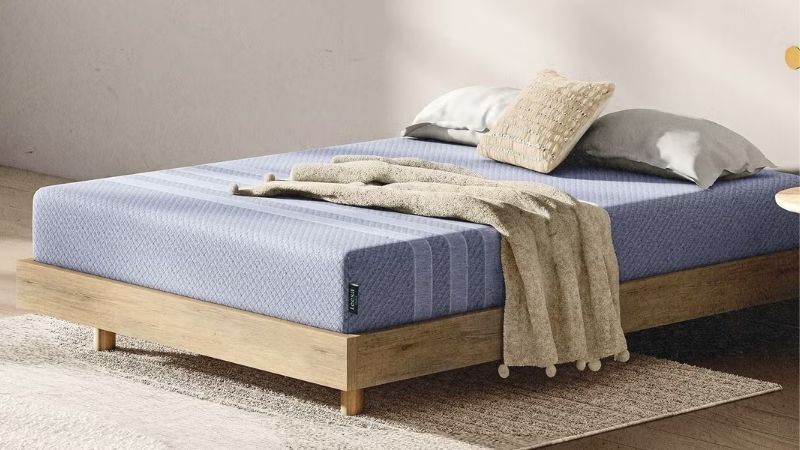
The best all-foam mattress has no coils, so every bit of support comes from the base layer and every bit of comfort from what sits above it. That makes the specification sheet unusually honest here, because there is no spring unit to compensate for thin or soft foam near the bottom.
Firmness Rating, Body Weight and Foam Density
Firmness runs 1 to 10, and most all-foam beds sold online sit between 5 and 7. Side sleepers usually want 4-6, back sleepers 5-7 and stomach sleepers 6-8, but body weight moves that scale: below 130 lb (59 kg) a bed feels firmer than labelled, above 230 lb (104 kg) it feels softer.
Density is the durability number. Comfort foam under about 3 lb/ft3 compresses permanently under the hips within a couple of years, while base foam is usually 1.8-2.5 lb/ft3 and needs to be thick enough to carry the load. Weight capacity on all-foam beds is typically lower than on hybrids, so check the listing.
Layer Stack: What Sits Where
A typical 12 in (30 cm) build runs 2-3 in of comfort foam, 2 in of transition foam and 7-8 in of high-density base. The transition layer is what stops heavier sleepers sinking straight through to the base, and it is the layer most often thinned out on budget models.
Memory foam contours slowly, polyfoam and proprietary blends respond faster, and latex-style foams push back hardest. None of these are better in the abstract; they simply suit different sleeping styles, and combination sleepers who turn frequently are usually happier with a faster-responding surface.
Space and Fit: Room, Frame and Slat Spacing
US sizes run Twin 38 x 75 in (97 x 191 cm), Full 54 x 75 in (137 x 191 cm), Queen 60 x 80 in (152 x 203 cm) and King 76 x 80 in (193 x 203 cm). Measure the room, the doorway and the stairwell turn before ordering, because a compressed box is easy to carry in and impossible to carry back out.
Foam beds need slats no more than about 3 in (7.6 cm) apart or a solid platform. This is the single most common warranty exclusion in the category: foam sags between wide slats, the owner blames the mattress, and the claim is denied. Check the frame before the bed arrives.
Heat, Certifications and Trial Length
Foam insulates by nature, so cooling is a genuine consideration rather than a marketing tier. Gel infusion, open-cell structures, perforations and breathable covers all help at the margin, but no foam bed moves air the way a coil unit does in a warm bedroom. If the room is warm year round, that is a structural argument for coils rather than a reason to pay for cooling claims.
CertiPUR-US certification covers foam content and emissions, and off-gassing typically clears within 24-72 hours with the room ventilated. Trials run 100-365 nights with a 21-30 night break-in requirement; mattress discounts follow federal holidays such as Presidents Day, Memorial Day and Labor Day rather than the electronics calendar.
Top Picks: Six Foam Beds Across the Price Range
Every best all-foam mattress entry below lists a real drawback, and the ranking weighs density and layer structure ahead of surface comfort. Specifications come from manufacturer documentation and aggregated long-term owner reports rather than testing of our own, and pricing in this category changes often enough to be checked at purchase.
| Model | Profile | Firmness (1-10) | Foam type | Best suited to |
|---|---|---|---|---|
| Zinus Green Tea Memory Foam | 12 in / 30 cm | 6-7 | Memory foam | Budget main beds |
| Novilla Bliss Gel Memory Foam | 12 in / 30 cm | 5-6 | Gel memory foam | Side sleepers |
| Lucid Gel Memory Foam | 10 in / 25 cm | 6 | Gel memory foam | Guest rooms |
| Vibe Gel Memory Foam | 12 in / 30 cm | 6 | Gel memory foam | Mid-weight sleepers |
| Amazon Basics Memory Foam | 10 in / 25 cm | 6-7 | Memory foam | Occasional use |
| Best Price Mattress Memory Foam | 12 in / 30 cm | 5-6 | Memory foam | Plusher surface preference |
Zinus Green Tea Memory Foam – The Volume Benchmark
A 12 in (30 cm) stack of memory foam over high-density base, CertiPUR-US certified and backed by a 10-year warranty. It has been in the market long enough that the failure pattern is well documented, which is genuinely useful information when the alternative is an unknown brand launched last quarter.
The comfort layer is softer than the 6-7 rating suggests for the first few months and firms up as it settles. Owners above roughly 230 lb (104 kg) consistently report reaching the base layer sooner, so heavier sleepers should treat this as a guest bed rather than a decade-long main mattress.
Novilla Bliss Gel Memory Foam – Plusher Surface, Sensible Base
Twelve inches with a gel-infused comfort layer that sits nearer 5-6, which is the range side sleepers usually need for hip and shoulder pressure. The egg-crate style transition layer adds a little airflow between the comfort and base layers, which matters on an all-foam build.
Because it runs softer, back and stomach sleepers may find the hips settle too low over a full night. The cover is thin and not especially durable, so a proper mattress protector is close to mandatory rather than optional on this one.
Lucid Gel Memory Foam – Thin Profile, Fast Setup
The 10 in (25 cm) build is lighter to move and cheaper to ship, with gel-infused memory foam over a firm base. For a spare room, a teenager’s bed or a rental property, the reduced profile is a practical advantage rather than a compromise.
Ten inches leaves less material to distribute load, so it firms up noticeably under heavier bodies and the base becomes perceptible sooner. There is also less transition foam here than on the 12 in models, which is exactly where budget builds usually save money. Shipping weight on a product page is a rough but useful clue to how much foam is actually inside.
Vibe Gel Memory Foam – Middle of the Road, Done Properly
A conventional 12 in (30 cm) gel memory foam bed at a mid-tier price with a 10-year warranty and CertiPUR-US certification. Nothing about it is unusual, which is the point when the goal is a predictable foam bed rather than an experiment in a new material.
Heat retention is moderate rather than solved; gel infusion slows the build-up without removing it. The cover is not removable for washing, so cleaning is limited to spot treatment, and a protector is the only realistic way to keep it serviceable long term.
Amazon Basics Memory Foam – Cheapest Way Into Foam
A 10 in (25 cm) memory foam bed at the lowest price point here, CertiPUR-US certified and shipped compressed. As a bed for a guest room used a dozen nights a year, or a temporary mattress between moves, it does the job without pretending to be more.
Density is at the low end, so nightly use compresses the comfort layer faster than any other option on this list. Treat it as a two to three year mattress in daily service, and do not expect the warranty period to reflect its realistic working life.
Best Price Mattress Memory Foam – Softer Feel at 12 Inches
Twelve inches with a plusher comfort layer, aimed at sleepers who find most online foam beds too firm out of the box. The extra profile gives the softer top something substantial underneath, which is what separates it from thinner soft-topped models.
The trade-off is edge support, which is weak enough that sitting on the perimeter compresses it sharply. Anyone who shares the bed and sleeps near the edge will notice the usable sleeping surface is smaller than the stated dimensions suggest.
Durability, Setup and Long-Term Ownership
The best all-foam mattress does not fail dramatically. They develop a shallow depression under the heaviest part of the body, the owner adjusts sleeping position without noticing, and the back complaints start eighteen months later. Knowing the sequence is what makes a foam purchase last.
Body Impressions and Rotation
Impressions form under the hips and shoulders where load concentrates, and low-density comfort foam collapses there fastest. Most warranties define a defect as a permanent sag of roughly 0.75-1.5 in measured with the bed unloaded, so read that threshold before assuming a dip qualifies.
All-foam beds are not flippable, but rotating head to foot every three to six months redistributes the load and delays impression formation measurably. It takes five minutes and is the cheapest maintenance available on any mattress you own.
Expansion, Off-Gassing and the First Weeks
A compressed bed needs 24-72 hours to reach full loft, and it will feel firmer and denser during that window. Judging comfort on night one is unreliable, which is precisely why brands write a 21-30 night break-in requirement into their trial terms.
Off-gassing smells strongest in the first day and clears with ventilation. If the bed will be in a small or poorly ventilated room, unbox it in the morning with a window open rather than at bedtime, and give it a full day before making it up with bedding.
Heat Management in a Warm Room
Foam holds body heat because it has no internal airflow, and no infusion changes that fundamentally. Breathable cotton or linen sheets, a mattress protector with a vapour-permeable membrane and a slatted rather than solid base all make a measurable difference in a warm bedroom.
If heat is already a known problem, a hybrid with a coil unit is the structural answer rather than a foam bed with cooling claims. Choosing the best all-foam mattress makes sense when motion isolation and contouring matter more than airflow does.
See More:
- Best mattress for back aches
- Best toppers for mattress
- Mattress topper best
- Best brewed coffee maker
Final Thoughts on the Best All-Foam Mattress
Set your firmness number from weight and sleep position, confirm the comfort foam density and the transition layer, and check the slat spacing on your frame. Those three checks eliminate most of the beds that generate complaints six months after delivery.
The best all-foam mattress for most people is a 12 in build with a genuine transition layer, a long trial and a frame underneath that actually supports it. Measure your room and bed base before ordering, and confirm current pricing and firmness ratings on the listing at purchase.


Write Your Review
No reviews yet. Be the first to share your experience!