Violin strings divide almost entirely along one line: what the core is made of. Steel core strings are bright, loud, cheap and extremely stable in pitch, which is why they dominate student outfits and fiddle playing. Synthetic core strings — usually a nylon or composite multifilament — are warmer, more complex and far closer to the gut strings classical repertoire was written for, at the cost of a longer settling period and a higher price. Neither is objectively better; they are answers to different questions.
What trips beginners up is that changing strings on a violin is not like changing them on a guitar. There is no truss rod and no bridge screw, but there is a bridge held in place only by string tension and a soundpost standing inside the body under that same tension. Remove all four strings at once and the bridge falls, the post can shift, and suddenly the instrument sounds wrong for reasons that have nothing to do with the new strings. Change them one at a time. This guide covers student and step-up sets across both core types.
Our top picks




As an Amazon Associate we earn from qualifying purchases at no extra cost to you.
Quick Comparison
| Product | Best For | Standout Feature | Watch Out For |
|---|---|---|---|
| D’Addario Prelude 4/4 Set | The student standard | Warm steel core with excellent bow response | Less tonal depth than synthetic core sets |
| 8-Piece Steel Set (G-D-A-E) | Households with several violins | Two full sets covering multiple sizes | Bright, thin tone compared with premium sets |
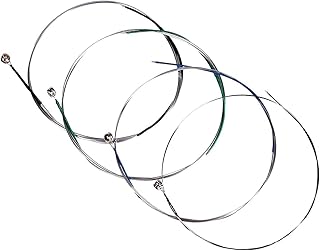
| Universal Steel Ball-End Set | Spare strings in the case | Ball-end design fits common fine tuners | Basic materials wear and dull quickly |
| Fansjoy Universal Steel Set | Practice and student use | Nickel-plated ball ends across sizes | Bright top end can sound harsh under the ear |
| 8-Piece Set with Cloths | Best value multi-pack | Two sets supplied with cleaning cloths | Entry-level tone; not a step-up option |
| Thomastik Dominant Set | Serious students moving up | Synthetic core with rich, flexible tone | Needs several days to settle in pitch |
How to Choose
- Core material sets the character: Steel is bright, loud and stable. Synthetic is warmer and more complex, closer to what classical repertoire expects, and takes longer to settle.
- Match the string size to the violin: A 4/4 set on a 3/4 instrument leaves too much winding at the peg and can affect tension. Buy sets marked for your size or explicitly universal.
- Ball end or loop end: Fine tuners generally take ball ends; some E-string adjusters need loops. Check what your tailpiece uses before ordering.
- Change one string at a time: Removing all four drops the bridge and risks the soundpost shifting. Replace individually and check the bridge stays upright and square.
- Expect a settling period: New strings stretch. Steel settles within a day; synthetic core sets can take the better part of a week before they hold pitch reliably.
Top Picks Reviewed
Best Student Set: D’Addario Prelude 4/4
Prelude is what most teachers put on a student violin, and for good reason. The solid steel core holds pitch through temperature changes and rough handling, the bow response is forgiving for players still developing contact-point control, and the tone is warm enough not to be shrill under the ear.
It will not give you the tonal depth of a synthetic core set. As a student progresses into more expressive repertoire, they will start to want more colour than these can produce.
Best for Multiple Instruments: 8-Piece Steel Set
Two complete G-D-A-E sets that fit sizes from quarter through full, which suits a family or a teaching studio where several violins need restringing at different times.
The tone is bright and somewhat thin. These are practice strings for keeping instruments playable, not a tonal upgrade.
Best Spare Set: Universal Steel Ball-End
The single most useful thing to keep in a violin case is a spare E string, because it is the one that snaps. This universal ball-end set covers all four across common sizes and fits standard fine tuners.
Materials are basic and the tone dulls faster than premium sets. As emergency spares, that is exactly the right compromise.
Best Everyday Practice Set: Fansjoy Universal Steel
A synthetic steel core with nickel-plated ball ends, sized for 4/4 and 3/4 violins. Stable tuning and consistent response make it a reasonable choice for daily practice where durability matters more than nuance.
The top end is bright, which can sound harsh directly under the player’s left ear even when it projects fine across a room.
Best Value Multi-Pack: 8-Piece Set with Cleaning Cloths
Two full sets plus cloths at a low price, covering sizes down to quarter. For a school, a teacher, or a household where strings break regularly, the maths is straightforward.
These are entry-level strings and sound like it. They keep instruments playing; they do not improve them.
Best Step-Up: Thomastik-Infeld Dominant
Dominant has been the default synthetic core set in classical playing for decades. The tone is noticeably richer and more flexible than steel, with a responsiveness that rewards good bow control and reveals bad bow control just as clearly.
They take days to stop stretching, and they cost several times what a student steel set does. On a cheap violin the improvement is real but limited by the instrument.
Frequently Asked Questions
How often should violin strings be changed?
Roughly every six to twelve months for a student practising regularly, sooner if the tone has gone dull, the winding is unravelling, or the strings will no longer hold pitch reliably.
Can I change all four strings at once?
You should not. Full tension loss lets the bridge fall and can allow the soundpost to move, which changes the instrument’s sound and requires a luthier to correct. Change them one at a time.
Steel core or synthetic core?
Steel for durability, stability, volume and fiddle styles. Synthetic for warmth, tonal complexity and classical repertoire. Most students start on steel and move to synthetic as their bow control develops.
Why do new strings keep going flat?
They are still stretching. Steel settles within a day or two; synthetic cores can take most of a week. Retune frequently during that period and they will stabilise.
Final Thoughts
Pick steel if you want stability and volume, synthetic if you want warmth and expression, and always keep a spare E in the case. Change strings one at a time, watch the bridge stays upright and square to the top, and give new sets time to settle before judging them. Strings are the cheapest way to change how a violin sounds, and the easiest to get wrong in the fitting.