Two digital pianos can share an identical spec sheet — 88 keys, hammer action, built-in speakers, sustain pedal — and feel like different instruments under the hands. The reason is that “hammer action” describes a category, not a standard. Some mechanisms use a genuine pivoting weight that resists on the way down and returns under gravity. Others use a counterweight with a spring assist that feels convincing at moderate velocity and gives itself away when you try to play very softly.
Sound is similarly slippery. A piano sample can be beautiful in isolation and disappointing through 10-watt speakers in a carpeted room, and the same board can sound superb on headphones. So the useful way to compare these instruments is in three layers: what the key bed does mechanically, how many notes the engine can hold at once, and whether the amplification is good enough to hear it. This comparison is for players who want to understand what they are paying for rather than count features on a box.
Our top picks




As an Amazon Associate we earn from qualifying purchases at no extra cost to you.
Quick Comparison
| Product | Best For | Standout Feature | Watch Out For |
|---|---|---|---|
| Yamaha P71 | Most convincing key action | Graded hammer bed heavier in the bass register | Minimal onboard controls and basic pedal |
| 88-Key Hammer Desk Piano | Rooms that double as offices | Closes into a desk with a three-pedal unit | Furniture format restricts placement |
| Weighted 88-Key with Wireless | Practising along to backing tracks | Dual 15W speakers with MP3 and wireless input | Wireless audio adds noticeable latency |
| STRICH SDP-120 | Balanced sound and features | Two 15W drivers with USB-MIDI connectivity | Heavier than a slim stage piano |
| Progressive Hammer Desk Piano | Beginners needing everything included | Stand, pedal, adapter and headphone mode supplied | Voice library is small compared to rivals |
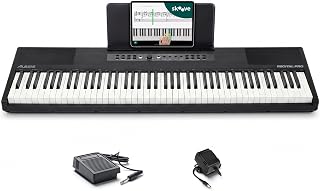
| Alesis Recital Pro | Learners moving toward intermediate | Lesson mode with a full hammer-action bed | Sample set is less refined than Yamaha’s |
How to Choose
- Test the quietest dynamic: Any action feels fine when you hit it hard. The mechanism reveals itself at pianissimo, where a cheap bed either fails to sound the note or jumps straight to mezzo forte.
- Graded weighting matters: On an acoustic, bass hammers are heavier than treble ones. A digital piano that replicates that gradient builds the correct finger strength across the keyboard.
- Polyphony is a sustain issue: Held pedal passages stack notes plus their release samples. Low polyphony causes earlier notes to vanish from the tail, which sounds like a mistake you did not make.
- Speakers versus headphones: Built-in drivers under about 20 watts flatter nothing. Judge the sample through headphones and treat the speakers as a convenience.
- Decide on permanence: Furniture and desk designs sound better and stay set up. Slab pianos travel to lessons and rehearsals. Pick before you compare anything else.
Top Picks Reviewed
Best Key Action: Yamaha P71
The Graded Hammer Standard bed is the benchmark in this price range because it behaves correctly at low velocity. Playing a phrase quietly produces an actual quiet note rather than a stubborn silence followed by a thump, which is what lets you practise dynamics rather than just accuracy.
Yamaha strips everything else back. The control panel is minimal and the supplied footswitch cannot do half-damper pedalling, so budget for a continuous pedal if you are working through classical repertoire.
Best Dual-Purpose Design: 88-Key Hammer Desk Piano
The hinged wooden top closes over the keys and the instrument becomes a desk, which is the only honest solution when a piano has to share a small room with work. Three pedals underneath mean sostenuto and soft-pedal technique are available, not just sustain.
You cannot move it easily or angle it into a corner. Decide on placement before assembly, because relocating it later is a genuine project.
Best for Play-Along Practice: Weighted 88-Key with Wireless
Dual 15-watt drivers give this more headroom than most slab pianos, and MP3 playback plus wireless input means backing tracks come through the same speakers you are playing over. For learning songs by ear that is a real workflow advantage.
Wireless audio introduces latency. It is fine for listening to a track while you play, and unusable if you try to route your own piano sound through it.
Best Balanced Package: STRICH SDP-120
A hammer-action 88-key bed, two 15-watt speakers, a sustain pedal and USB-MIDI covers home practice and computer recording without gaps. The action is firm enough to be useful and the amplification is loud enough to hear over a room.
All that speaker and chassis adds weight. It is transportable rather than portable, and a slim stage piano is easier to carry to a lesson.
Best Complete Starter: Progressive Hammer Desk Piano
Sheet music stand, pedal, power adapter, headphone mode and USB-MIDI arrive together, so nothing blocks a first practice session. The progressive hammer bed gives a beginner the resistance needed to build proper finger strength from the start.
The voice library is limited compared with feature-heavy rivals. If you want hundreds of tones to play with, this is not the board.
Best for Progressing Players: Alesis Recital Pro
A full hammer-action bed with a lesson mode that splits the keyboard into two identical halves, which is exactly what a teacher sitting alongside a student needs. Twenty-watt speakers give it more presence than most slab pianos manage.
The piano samples are competent rather than exceptional. Next to a Yamaha the tone is a little flatter through the middle register, particularly at quiet dynamics.
Frequently Asked Questions
What is the difference between weighted and hammer action?
Weighted usually means added mass or spring resistance. Hammer action uses a pivoting weighted lever that mimics an acoustic mechanism, giving you resistance on the way down and a genuine return. Only the latter builds acoustic-ready technique.
How much polyphony is enough?
Sixty-four notes covers most pop and beginner classical work. Once you sustain dense passages, 128 or more prevents earlier notes being dropped when the engine runs out of voices.
Do built-in speakers matter if I use headphones?
Less than you would think. Headphones bypass the speakers entirely and usually reveal much more detail. If you always practise privately, put your money into the action rather than the amplification.
Can I connect a digital piano to a computer?
Yes, via USB-MIDI on all of these. That lets you drive virtual instruments, record performances into notation software, and use learning apps that listen to what you play.
Final Thoughts
Judge the key bed at your quietest dynamic, check that polyphony will survive your pedalling, and listen through headphones before blaming the sample for what the speakers are doing. A digital piano with an honest hammer action and a decent pedal will still be useful years after the extra voices and connectivity features stop mattering to you.