Key takeaways
- For a pedalboard: choose a pedal-style receiver with a metal chassis, a standard 9V-compatible power input, and a through output if you need a tuner or silent cable fallback. The Relay G10SII, WL-50, and GLX-D+ fit this use particularly well.
- For direct amplifier connection: a rotating plug-in receiver is convenient, but check that it does not collide with the amplifier’s input jack, handle, or control panel.
- For long sets: prioritize at least seven hours of rated battery life, then reduce that estimate for age, cold temperatures, and time spent powered on between songs.
- For crowded venues: favor systems with strong channel management or dual-band operation, and keep the receiver away from Wi-Fi access points, USB hubs, and metal obstructions.
- For active or passive instruments: nearly all guitar wireless systems use a standard 1/4-inch connection, but unusually recessed jacks, angled plates, active electronics, or onboard preamps can affect physical fit and battery drain.
The best guitar wireless systems for most players are the Line 6 Relay G10SII for low-latency everyday use, the Boss WL-50 for pedalboards, and the Shure GLX-D+ Guitar Pedal System when interference management and touring flexibility matter most.
Our top picks
 JOYO 5.8GHz Wireless Guitar System Transmitter and
- 5.8GHz Clear & Stable Sound with Low Latency:…
- Portable Charging Case with 18-Hour Total Playtime: Up…
- Stable Wireless Transmission: 65-100ft in open areas
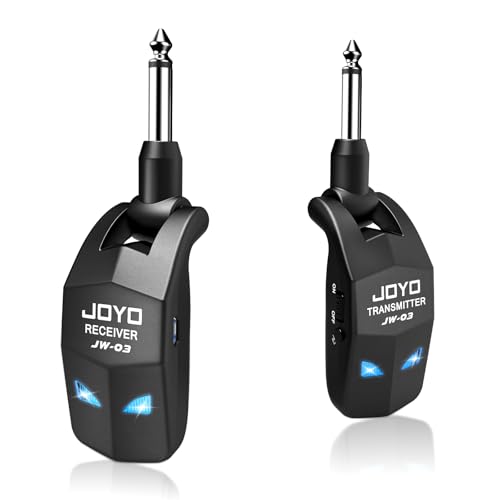 JOYO 2.4GHz Wireless Guitar System Rechargeable Transmitter
- 2.4GHz CLEAR QUALITY SIGNAL: Reliable wireless system delivers…
- DUAL USB CHARGING: Built-in rechargeable batteries provide up…
- 220° ROTATABLE PLUG
 Flatsons 5.8GHz Wireless Guitar System–Low Latency
- 5.8GHz Anti-Interference & Crystal-Clear Audio: Tired of dropouts…
- Ultra-Low 5.58ms Latency & 100ft+ Wireless Range: Blazing-fast…
- 6+ Hours Playtime & Smart Auto-Sleep: Built-in rechargeable…
| Product | Key specs | |
|---|---|---|
| JOYO 5.8GHz Wireless Guitar System Transmitter and | 5.8GHz Clear & Stable Sound with Low Latency:… Portable Charging Case with 18-Hour Total Playtime: Up… Stable Wireless Transmission: 65-100ft in open areas | Check price |
| JOYO 2.4GHz Wireless Guitar System Rechargeable Transmitter | 2.4GHz CLEAR QUALITY SIGNAL: Reliable wireless system delivers… DUAL USB CHARGING: Built-in rechargeable batteries provide up… 220° ROTATABLE PLUG | Check price |
| Flatsons 5.8GHz Wireless Guitar System–Low Latency | 5.8GHz Anti-Interference & Crystal-Clear Audio: Tired of dropouts… Ultra-Low 5.58ms Latency & 100ft+ Wireless Range: Blazing-fast… 6+ Hours Playtime & Smart Auto-Sleep: Built-in rechargeable… | Check price |
 Xvive AC58 Wireless Guitar System with Charging Xvive AC58 Wireless Guitar System with Charging | AC58 includes the A58 Guitar Wireless System and… Reliable: 5.8 GHz true diversity wireless system, high-resolution… Sound Quality: High-resolution 24-bit/48kHz audio over a wide… | Check price |
As an Amazon Associate we earn from qualifying purchases at no extra cost to you.
Best guitar wireless systems at a glance
A good choice depends less on the longest advertised range than on how the system behaves around Wi-Fi routers, crowded venues, pedalboards, and long rehearsals. The figures below are manufacturer-stated or commonly published specifications; practical range varies with walls, antenna placement, and local radio traffic.
| System | Typical range | Latency | Battery life | Receiver format | Best suited to |
|---|---|---|---|---|---|
| Line 6 Relay G10SII | Up to 40 m / 130 ft | Under 1.5 ms | Up to 7 hours | Pedal-style receiver | Most pedalboards and regular gigging |
| Boss WL-50 | Up to 20 m / 65 ft | About 2.3 ms | Up to 12 hours | Pedal-style receiver | Players who want cable-tone options and simple charging |
| Shure GLX-D+ Guitar Pedal System | Up to about 30 m / 100 ft | About 4.8 ms | Up to 12 hours | Pedal-style receiver | Busy venues and more demanding wireless setups |
| Sennheiser XSW-D Instrument Base Set | Up to 75 m / 250 ft line of sight | Under 4 ms | Up to 5 hours | Compact receiver | Simple guitar-to-amp systems and multi-instrument use |
| NUX B-5RC | Up to about 30 m / 100 ft | About 2.5 ms | Up to 9 hours | Compact plug-in receiver | Home practice, rehearsals, and moderate gigging |
| Xvive U2 | Up to 70 m / 230 ft line of sight | Under 6 ms | About 5 hours | Compact plug-in receiver | Budget-conscious players and basic stage use |
Our picks by playing situation
Best overall: Line 6 Relay G10SII
The Relay G10SII is an easy recommendation for players who want a pedalboard-friendly system without making wireless setup a major project. Its sub-1.5 ms latency is effectively imperceptible in normal playing, and its receiver provides a standard pedal-style footprint, a robust metal enclosure, and outputs suitable for an amplifier or pedalboard chain.
The transmitter charges when docked in the receiver and can run for up to seven hours. That is enough for most rehearsals and ordinary shows, but players performing long festival days should keep a charging cable or spare solution available. The automatic sleep function helps preserve battery life when the transmitter is left idle.
Choose it when reliability, pedalboard integration, and low latency matter more than maximum runtime. Its main limitation is that a compact rechargeable transmitter is not the same as a replaceable-battery professional rack system.
Best for pedalboards with tone flexibility: Boss WL-50
The Boss WL-50 is particularly useful for guitarists who care about how a wireless link changes the feel or brightness of a rig. Its receiver includes cable-tone simulation options, allowing the player to approximate the high-frequency loading of a traditional guitar cable. That can be helpful with bright single-coil pickups or a rig that normally uses a long cable.
The transmitter docks into the receiver for charging and offers up to roughly 12 hours of operation. The practical range is shorter than the Line 6 and Sennheiser figures, but 20 metres is ample for most club stages. Its pedal-style design also makes it easier to secure than a receiver dangling from an amplifier input.
Pick the WL-50 if cable-tone control and long transmitter runtime are more important than maximum distance.
Best for interference-conscious setups: Shure GLX-D+ Guitar Pedal System
The GLX-D+ uses dual-band 2.4 GHz and 5.8 GHz operation, giving the system more flexibility than a single-band design when the local radio environment is crowded. It is not immune to interference—no system using shared spectrum is—but the additional band and Shure’s link-management approach can make it a stronger choice for venues filled with wireless equipment and Wi-Fi traffic.
The transmitter provides up to about 12 hours of battery life, while the pedal receiver is designed for normal board integration. Latency is higher than the Relay G10SII but remains low enough for typical electric-guitar playing. This is the sensible upgrade for players who have experienced dropouts with inexpensive 2.4 GHz systems.
Best for a simple guitar-to-amp connection: Sennheiser XSW-D Instrument Base Set
The XSW-D Instrument Base Set is a compact, button-operated system that avoids the learning curve of a larger pedal or rack receiver. Its advertised line-of-sight range is generous, and the transmitter and receiver can be paired quickly. It works well when the receiver plugs directly into an amplifier, powered speaker, or another instrument input.
Its five-hour battery rating is the main ownership consideration. A player who rehearses several times a week or performs multiple sets should charge it before every outing and carry a backup cable. The receiver is less naturally integrated into a pedalboard than the Line 6 or Boss designs, although short patch cables or hook-and-loop mounting can solve that problem.
Best lower-cost option: Xvive U2
The Xvive U2 is widely used because it delivers the basic wireless experience at a lower general market price than professional pedal and rack systems. Its transmitter and receiver rotate to accommodate different instrument and amplifier jacks, and the system offers multiple selectable channels.
Its approximately five-hour battery rating and higher quoted latency make it better for casual playing, rehearsals, and modest stage work than for demanding touring schedules. Treat the range specification as an outdoor, unobstructed maximum rather than a guarantee inside a crowded venue.
How to choose between 2.4 GHz systems
- For a pedalboard: choose a pedal-style receiver with a metal chassis, a standard 9V-compatible power input, and a through output if you need a tuner or silent cable fallback. The Relay G10SII, WL-50, and GLX-D+ fit this use particularly well.
- For direct amplifier connection: a rotating plug-in receiver is convenient, but check that it does not collide with the amplifier’s input jack, handle, or control panel.
- For long sets: prioritize at least seven hours of rated battery life, then reduce that estimate for age, cold temperatures, and time spent powered on between songs.
- For crowded venues: favor systems with strong channel management or dual-band operation, and keep the receiver away from Wi-Fi access points, USB hubs, and metal obstructions.
- For active or passive instruments: nearly all guitar wireless systems use a standard 1/4-inch connection, but unusually recessed jacks, angled plates, active electronics, or onboard preamps can affect physical fit and battery drain.
Worked battery calculation: how much runtime do you need?
Suppose a band rehearses for three hours and plays a two-hour show. With setup, soundcheck, and pauses, the transmitter may be powered for seven hours in one day. A system rated for five hours is therefore marginal even if the actual playing time is only five hours. A seven-hour system has little reserve, while a 12-hour system leaves a more useful safety margin.
For a player using wireless four times per week, a 12-hour transmitter does not necessarily last “twice as long” in ownership. Rechargeable batteries lose capacity over time, and the transmitter may be left on in a gig bag. The practical routine is to dock it after every session, inspect the charge indicator before leaving, and carry a normal instrument cable as a no-battery fallback.
Connector design and pedalboard compatibility
Compact transmitters with rotating 1/4-inch plugs are convenient but place mechanical stress on the instrument jack. Avoid letting the guitar hang from the transmitter, especially with a heavy cable or strap movement. A short right-angle adapter may improve clearance, but it adds another connection that can loosen or create noise.
Pedal receivers are easier to secure and usually offer a more useful output arrangement. Before buying, measure the available board space: many pedal receivers occupy roughly the footprint of a medium effects pedal, but their antenna, charging dock, or side-mounted connectors may require extra clearance. Confirm whether your pedalboard power supply provides the required voltage and polarity instead of assuming every 9V-style socket is compatible.
Durability, maintenance, and common mistakes
- Clean 1/4-inch plugs periodically with an appropriate electronics contact cleaner and a lint-free cloth; dirt on the plug can sound like a faulty radio link.
- Do not store a transmitter fully discharged for months. Recharge it periodically, and replace the system when battery capacity has deteriorated enough to threaten a set.
- Keep the receiver’s line of sight as open as practical. A body, amplifier chassis, or metal rack between transmitter and receiver can reduce reliable range.
- Do not judge a system by an empty-room distance test alone. Test it with the lighting, Wi-Fi equipment, and stage layout used at the actual venue.
- Leave a cable in the gig bag. Wireless systems can lose charge, suffer connector damage, or encounter local interference at exactly the wrong time.
Final verdict
Choose the Line 6 Relay G10SII for the best balance of low latency, pedalboard usability, and range. Choose the Boss WL-50 if long battery life and cable-tone options are central to your rig. Choose the Shure GLX-D+ Guitar Pedal System for more capable interference management. The Sennheiser XSW-D suits simple direct-to-amp setups, while the NUX B-5RC and Xvive U2 are sensible lower-cost choices when moderate range and shorter battery life are acceptable.