Playing an out-of-tune guitar does something worse than sounding bad — it teaches your ear the wrong intervals. Beginners who practise for months on a guitar that is a quarter tone flat build a reference pitch that is simply incorrect, and it takes real work to undo. A clip-on tuner costs less than a set of strings and removes the problem entirely, which makes it the highest-return purchase in the whole accessory category.
The differences between tuners are smaller than the marketing suggests but they are not zero. Clip-on units read string vibration through a piezo sensor in the clamp, so they ignore room noise and work on a loud stage where a microphone-based tuner would fail. Chromatic models detect any pitch, which you need for drop tunings and for instruments that are not guitars. Screen brightness, rotation and battery type decide whether the thing is pleasant to use. Here is how the practical options compare for bedroom players, stage use and multi-instrument households.
Our top picks


As an Amazon Associate we earn from qualifying purchases at no extra cost to you.
Quick Comparison
| Product | Best For | Standout Feature | Watch Out For |
|---|---|---|---|
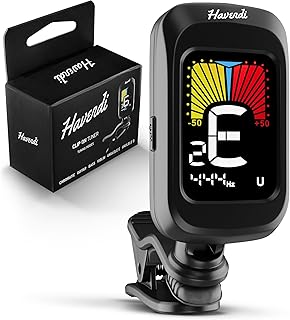
| HAVENDI Clip-On Tuner | Multi-instrument households | Colour LCD on a 360-degree rotating mount | Clamp is bulky on slim headstocks |
| Donner DT-2 | Everyday practice | Reliable chromatic reading at a low price | Small display is harder to read in bright light |
| Ulumac Aroma 3-in-1 | Practising with a metronome | Tuner, metronome and tone generator in one | Not a clip-on; needs placing within reach |
| New bee Rechargeable Tuner | Players tired of coin cells | USB rechargeable with a colour screen | Needs charging before long trips |
| Fender FCT-2 | Stage and rehearsal use | Fast, stable tracking on a firm clamp | Fewer extra modes than rivals |
| Snark ST-2 | Acoustic and electric switching | Reads through the clip or a built-in mic | Ball joint loosens with heavy use over time |
How to Choose
- Chromatic is worth insisting on: A guitar-only tuner cannot help you reach drop D, open G or a capo’d reference. Chromatic units read any pitch and work on ukulele, bass and violin too.
- Piezo clip beats microphone: Vibration sensing works in a noisy room, at a rehearsal, or while a drummer is warming up. Microphone tuning fails exactly when you need it most.
- Screen visibility and rotation: A display you can angle toward your eyes while playing seated is the difference between glancing and craning. Colour screens are easier to read at a glance than single-colour LEDs.
- Power source: Coin cells die without warning; rechargeable units need remembering. Pick the failure mode you can live with and keep a spare battery in the case either way.
- Clamp fit and finish safety: Padded jaws protect nitrocellulose and gloss finishes. Check the clamp opening if your headstock is unusually thick or thin.
Top Picks Reviewed
Best for Multiple Instruments: HAVENDI Clip-On Tuner
Presets for guitar, bass, violin and ukulele mean one tuner covers a household where several instruments live. The colour LCD on a fully rotating mount can be angled to almost any viewing position, which matters when the tuner is on a bass headstock two feet from your face.
The clamp body is chunky. On a slim classical or ukulele headstock it can feel like it is overhanging, though the padding keeps it from marking the finish.
Best Budget Chromatic: Donner DT-2
The DT-2 does the essential job well: fast chromatic detection, a stable readout and enough accuracy that your open chords ring true. For a practice-room tuner that lives clipped to the headstock permanently, it is hard to justify spending more.
The display is small and washes out in direct sunlight or under stage lighting. Indoors it is perfectly legible.
Best Practice Tool: Ulumac Aroma 3-in-1
Combining a chromatic tuner, a metronome and a tone generator addresses the two things beginners most need and least use. Practising to a click is what fixes timing, and having it in the same pocket-sized device as the tuner means it actually gets switched on.
It is not a clip-on, so it needs somewhere to sit within reach and eyeline. On a music stand that is fine; standing up with a strap it is less convenient.
Best Rechargeable: New bee Clip-On Tuner
Rechargeable power removes the most annoying failure in the category — reaching for the tuner before a gig and finding the coin cell flat. A bright colour screen on a 360-degree rotating head keeps it readable in any position.
The tradeoff is that you cannot fix a dead battery in ten seconds with a spare from your case. Charge it the night before anything important.
Best for Stage Use: Fender FCT-2
Tracking speed is the thing that matters between songs, and the FCT-2 locks onto a pitch quickly and stays stable rather than dithering around the target. The clamp holds firmly enough that it will not shift when you knock the headstock.
It is deliberately plain — no metronome, no tone generator. If you want a multi-tool, this is not it.
Most Versatile Sensing: Snark ST-2
Being able to read via the clip on an electric and via the built-in microphone on something you cannot clamp makes this useful in more situations than a clip-only design. Full chromatic range covers alternate tunings without menu diving.
The ball joint that makes the head so adjustable is also the part that wears. After heavy use it can start drooping, which is annoying rather than fatal.
Frequently Asked Questions
Are clip-on tuners accurate enough?
For playing and recording, yes. Most read to within a cent or two, which is far tighter than the tuning drift caused by temperature, string age and how hard you fret. Pedal tuners are more precise but not meaningfully more useful.
Should I tune before or after warming up?
Both. Strings stretch and the neck settles as the guitar comes up to room temperature, so tune when you start and check again after a few minutes of playing. New strings need retuning constantly for the first day.
Can I use a guitar tuner on a ukulele or violin?
If it is chromatic, yes. It will simply report the nearest note name and how far off you are, which is all you need. Guitar-only tuners that name strings E, A, D, G, B and E will confuse you.
Why does my guitar sound out of tune even after tuning?
Usually intonation. If open strings are perfect but chords go sour above the fifth fret, the bridge saddles need adjusting. Old strings and excessive fretting pressure cause the same symptom.
Final Thoughts
Buy a chromatic clip-on, leave it attached to the headstock, and use it every single time you pick the guitar up. If you also struggle with timing, the tuner and metronome combination is the version that will change your playing most. Anything beyond that is refinement, and none of it matters as much as the habit itself.