Keyboard height is a posture problem disguised as an accessory purchase. Sit too low and your wrists bend upward to reach the keys, which is the fastest route to tendon pain in the forearm. Sit too high and your shoulders lift and stay lifted through an hour of practice. The target is simple: forearms roughly parallel to the floor, wrists straight, elbows a shade above key height. A stand that cannot reach that position for the person using it is the wrong stand, no matter how solid it is.
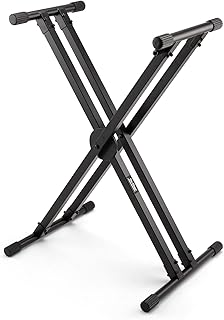
The second issue is load. A weighted 88-key digital piano can be twelve kilograms or more, and it moves when you play forcefully. A stand that flexes under that turns every fortissimo passage into a wobble. Double-X designs spread the load across four contact points and are the most stable of the folding types; Z-frames put the weight forward and free up knee room; single-X designs are lighter and less rigid. This guide compares practical options for home practice, teaching and transport.
Our top picks




As an Amazon Associate we earn from qualifying purchases at no extra cost to you.
Quick Comparison
| Product | Best For | Standout Feature | Watch Out For |
|---|---|---|---|
| Double-X Stand and Bench Set | Complete home practice setup | Heavy-duty frame with a matching bench included | Bench padding is basic for long sessions |
| Portable Double-X Stand | Moving between rooms or venues | Folds flat while fitting 54 to 88-key boards | Lighter tubing flexes under heavy pianos |
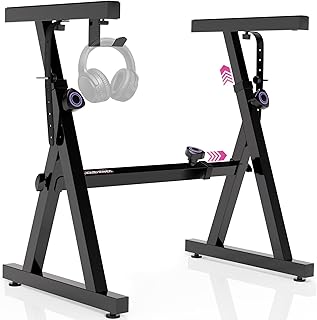
| Liquid Stands Z-Style | Knee clearance while seated | Z geometry keeps the leg area open | Larger floor footprint than an X-frame |
| On-Stage KS8291XX ERGO-LOK | Heavy weighted pianos | Lok-Tight construction that resists flexing | Heavier to carry than budget frames |
| Liquid Stands Stand and Bench | Buyers who need seating too | Adjustable stand paired with a height-set stool | Two items to assemble and store |
| Liquid Stands Collapsible | Storing the keyboard away daily | Folds down small for cupboard storage | Repeated folding loosens fittings over time |
How to Choose
- Set height by your body: Aim for forearms level and wrists straight when seated. Check the stand’s adjustment range covers that height for the actual player, including children.
- Check the weight rating: A hammer-action 88-key board is far heavier than a synth. Confirm the stand is rated above your instrument’s weight, not merely close to it.
- X-frame versus Z-frame: Double-X frames are compact and stable; Z-frames give better knee clearance and a more open seated position but occupy more floor.
- Look for locking straps: Straps or brackets that hold the keyboard to the arms prevent it sliding forward, which matters most with sloped-bottom instruments.
- Bench height is not optional: A dining chair is usually too low and has a back that pushes you forward. A proper bench sets hip height correctly and lets you lean into the keyboard.
Top Picks Reviewed
Best Complete Setup: Double-X Stand and Bench Set
Buying the stand and bench together guarantees the two heights work with each other, which is the part people get wrong when they assemble a setup piecemeal. The double-X frame is rigid enough for a weighted board, and the locking straps stop the instrument creeping forward during heavy playing.
The bench padding is thin. For an hour of practice it is fine; for a long teaching day you will want something thicker.
Best for Transport: Portable Double-X Stand
Folding flat and covering the full 54 to 88-key range makes this the practical choice when the keyboard travels to rehearsals, church or a friend’s house. Setup takes under a minute once you know the height you want.
The lighter tubing shows under a heavy hammer-action piano. It holds, but there is more sway than a reinforced frame when you dig in.
Best Seated Comfort: Liquid Stands Z-Style
The Z geometry puts the support behind and below rather than crossing under your knees, so you can sit close and centred without your legs hitting the frame. For players who practise for long stretches that clearance is worth the extra floor space.
It occupies more area than an X-frame and is less convenient to store in a small room.
Most Rigid: On-Stage KS8291XX ERGO-LOK
The Lok-Tight construction is the reason this is a rehearsal-room staple. Under a heavy weighted piano it stays genuinely still, with none of the lateral creep that cheap X-frames develop after a few months of use.
That rigidity comes from more metal, so it is heavier to carry and takes longer to fold than lightweight alternatives.
Best Value Pairing: Liquid Stands Stand and Bench
An adjustable stand fitting 54 to 88-key instruments supplied with a stool, covering both purchases at once for a beginner setting up a first practice corner.
Two separate items means two assemblies and two things to store. Neither is difficult, but it is not a single-box solution.
Best for Small Spaces: Liquid Stands Collapsible
If the keyboard lives in a cupboard between sessions, a stand that folds down genuinely small is what makes daily practice viable rather than a chore.
Frequent folding works the joints. Check the wing bolts and fittings periodically and retighten them before they develop play.
Frequently Asked Questions
What height should my keyboard be?
Roughly 70 to 75 centimetres from the floor to the top of the white keys for most adults, adjusted so your forearms are level and wrists straight when seated. Children need considerably lower.
Will a cheap stand hold a weighted 88-key piano?
Some will, but check the stated load rating rather than assuming. Weighted boards are heavy and the flex under playing pressure is the real test, not static weight.
Do I need a bench or can I use a chair?
A bench is better. Dining chairs are usually too low and their backs encourage slouching. Correct hip height lets you use arm weight properly instead of pressing from the fingers.
X-frame or Z-frame?
X-frames fold smaller and cost less. Z-frames give more knee room and a more comfortable seated position at the cost of floor space. Both are stable when properly rated.
Final Thoughts
Set the height for the player, confirm the frame is rated well above your keyboard’s weight, and buy the bench at the same time so the two work together. Good posture is not a luxury for pianists — it is what allows you to practise for an hour without pain, which is ultimately what determines how fast you improve.