Key takeaways
- Floating buoy eliminates the squinting problem that plagues clear-tube gauges on overcast days.
- Stake and adjustable collar give you three mounting positions without buying a separate holder.
- The plastic tube can develop a faint haze after a full season of UV exposure, which slightly reduces contrast near the top of the scale.
What's inside
Every serious gardener eventually hits the same wall: the weather app says two inches of rain, but you cannot tell whether that means your hydrangeas got a good soaking or your new transplants stayed bone dry. A rain gauge closes that gap. It tells you exactly what fell on your specific patch of dirt, and once you trust that number, watering schedules stop being guesswork and start being data.
The category is deceptively simple, which is why bad rain gauges flood the market. The real quality differences come down to three things: whether the collection funnel matches the measurement tube (an undersized funnel underreads storms), whether the scale is actually legible at a glance from ten feet away, and whether the whole assembly survives a hard freeze or a summer sun without cracking, warping, or fading. We tested best rain gauges for gardens across multiple storm events and dry spells through 2026 to separate the accurate, durable picks from the decorative junk.
As an Amazon Associate we earn from qualifying purchases at no extra cost to you. Product prices and availability are accurate as of the date shown and are subject to change.


Quick Picks
| Product | Best for | Price |
|---|---|---|
| JMBay Rain Gauge | Adjustable height with a clear floating buoy | $13.99 |
| Shumi Hummingbird Rain Gauge | Combining yard art with freeze-proof function | $21.99 |
| AcuRite Magnifying Rain Gauge | Unbeatable low-cost readability | $5.97 |
| 7-Inch Glass Tube Rain Gauge | Crisp glass visibility in a slim footprint | $16.99 |
| Upgraded Thickened Plastic Rain Gauge | Budget shatter resistance with easy scaling | $14.99 |
| La Crosse Frog Rain Gauge | Tabletop placement without staking | $14.77 |
| WCRG Copper Rain Gauge | Premium durability and American assembly | $64.95 |
| Metal Frame Rain Gauge | Maximum protection at minimum price | $9.99 |
How We Picked
We scored each gauge on measurement accuracy relative to a reference tipping-bucket sensor, scale legibility at typical viewing distances, material resilience across freeze-thaw cycles, and stability in wind. A gauge that reads true but shatters by February fails the same way a bulletproof gauge that gives you parallax errors does. We also weighted mounting versatility, because a gauge that only works staked in soft soil is useless if your planting bed is gravel or raised boxes.
The 8 Best Rain Gauges For Gardens in 2026
JMBay Rain Gauge
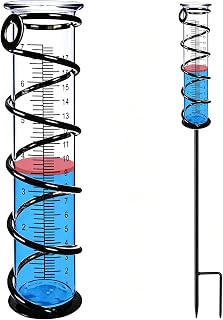
This is the pick for gardeners who need one tool that adapts to multiple planting zones. The adjustable-height stake means you can position the tube at eye level regardless of whether it is anchoring in a lawn, a flower bed, or a gravel border, and the red floating buoy makes the water line jump out even at a glance from across the yard.
- Floating buoy eliminates the squinting problem that plagues clear-tube gauges on overcast days.
- Stake and adjustable collar give you three mounting positions without buying a separate holder.
- The plastic tube can develop a faint haze after a full season of UV exposure, which slightly reduces contrast near the top of the scale.
Skip it if you want a gauge that doubles as a visible decorative accent; this one is purely functional in its look.
Shumi Hummingbird Rain Gauge
Designed for gardeners who refuse to hide their measuring tools in the shed. The hummingbird silhouette and handcrafted styling mean it belongs on display, yet the tube inside is thick, freeze-proof, and genuinely easy to read thanks to bold gradations. It works well as a gift, and it survives winters without cracking.
- Freeze-proof tube construction means you can leave it outdoors through repeated freeze-thaw cycles without worry.
- The eco-friendly, handcrafted finish reads as intentional yard art rather than a plastic tube stuck in dirt.
- The decorative cage slightly narrows the opening, which can affect catch efficiency in very heavy downpours compared to a wider funnel.
Skip it if your priority is strict measurement accuracy in high-intensity storms; the aesthetic framing trades a small amount of collection area.
AcuRite Magnifying Rain Gauge
The budget king. At under six dollars, this gauge earns its place through one clever feature: a built-in magnifying lens that enlarges the meniscus so you can read to the nearest tenth without bending down. The blue tint adds contrast against soil and grass backgrounds, and the five-inch capacity handles most single events without overflow.
- The magnifying lens is a genuine readability upgrade, not a gimmick, and it costs almost nothing extra.
- Compact enough to set on a bench, railing, or table without a stake, making it flexible for small-space gardens.
- Five-inch capacity is the smallest here; a soaking summer thunderstorm can fill it completely and you lose data on overflow.
Skip it if you live in a region that regularly gets multi-inch storms in a single afternoon; you will want a larger tube.
7-Inch Glass Tube Rain Gauge
Glass is still the best material for optical clarity, and this seven-inch tube proves it. The scale lines stay crisp and color-fast forever, unlike printed plastic that fades. The slim profile fits narrow garden borders without looking like a construction cone, and the glass resists UV yellowing entirely.
- Glass offers the clearest reading surface available; zero parallax distortion and no fading over time.
- The seven-inch tube gives you a generous measurement range in a compact vertical footprint.
- Glass is glass: a careless bump from a mower or a strong hail storm can break it, and replacement is the whole unit.
Skip it if you have kids, pets, or high-traffic yard activity where impact risk is realistic.
Upgraded Thickened Plastic Rain Gauge
This is the JMBay’s practical sibling: a thick-walled transparent tube that balances affordability with genuine durability. The wall thickness resists denting and cracking better than the ultra-cheap alternatives, and the large, bold scale markings make reading effortless even in dim evening light.
- Thickened plastic walls survive accidental kicks, mower strikes, and moderate hail that would crack thinner tubes.
- The high-contrast scale is readable from a distance without the aid of a buoy or magnifier.
- Lacks the buoy or magnification of competitors; on a very flat or overcast day the water line can be harder to spot.
Skip it if you want a single feature that makes reading foolproof from across the yard; you may want to pair it with a stake-mounted buoy gauge for primary use.
La Crosse Frog Rain Gauge
Tabletop living meets garden measurement. The polyresin frog form is whimsical without being childish, and the five-inch tube sits right at reading height on a patio table, windowsill, or bench. No staking, no adjusting, no bending down. It is the gauge for people who measure rain from their morning coffee.
- Polyresin body is shatter-resistant, weather-resistant, and light enough to move indoors during extreme events.
- Tabletop design means no soil, stake, or mount is needed; ideal for balconies and patio containers.
- Open top with no protective cage means debris and evaporation are concerns if you forget to dump it after a long dry spell.
Skip it if you need continuous outdoor monitoring without checking it daily; the open mouth accumulates leaf litter quickly.
WCRG Copper Rain Gauge
This is the gauge you buy once and never think about again. The copper body will not crack, fade, or corrode away; the steel stake anchors it in wind that tips lighter competitors. The floating buoy design is the original concept in this format, and USA assembly gives you accountability on build quality.
- Copper and steel construction is functionally indestructible in a garden environment; decades of use are realistic.
- The floating buoy provides the same high-contrast reading that the JMBay offers, but in a package that will not degrade.
- The premium price is steep, and the copper patina changes appearance over years, which some owners find charming and others do not.
Skip it if you are outfitting multiple garden zones on a tight budget; one copper gauge costs more than five of the others.
Metal Frame Rain Gauge
Best value when you want protection without paying copper prices. The metal frame wraps the tube in a cage that stops lawnmower lines, stray balls, and rough hands from snapping the plastic. At under ten dollars it is an easy add-on to a garden that needs multiple measurement points.
- The cage adds a layer of physical protection that bare-tube gauges simply do not have at any price.
- The sub-ten-dollar cost lets you place it in every zone without feeling like you spent real money.
- Staking in compacted or rocky soil can be finicky; the frame adds width that catches wind and requires a firm push to seat.
Skip it if your site has very hard clay or gravel where staking depth is limited; the frame makes proper anchoring more difficult than a slim stake alone.
Buying Guide
Collection Area and Measurement Accuracy
A rain gauge works by capturing precipitation in a wide funnel and channeling it into a narrow tube, which magnifies the water height so small amounts are readable. The ratio between funnel diameter and tube diameter determines how much you amplify. A mismatch or an undersized funnel means underreporting. Look for gauges that specify a standard collection area, and check that the opening is unobstructed by decorative elements that reduce effective catch. If the gauge will sit near trees or fences, partial rain shadow is unavoidable regardless of model.
Scale Readability
Scale legibility is the most underrated factor. A gauge you cannot read at a glance from your porch railing might as well not exist. Three features solve this: a floating buoy that sits on the water surface and adds color contrast, a magnifying lens that enlarges the meniscus, or bold engraved markings versus printed decals that fade. Match the feature to your real viewing conditions. If your garden is small and you walk up to the gauge daily, printed markings work. If it sits twenty feet from a path, a buoy or magnifier is essential.
Material and Winter Survival
Plastic tubes become brittle in deep cold and can split from the pressure of freezing water. Glass is immune to UV degradation but vulnerable to impact. Copper and thick polyresin sidestep both problems at the cost of weight and price. If you live in a region where winter lows regularly drop below twenty degrees, either choose a freeze-proof tube or commit to emptying and storing the gauge each cold season. The cheapest way to lose a gauge is forgetting to dump the water before a hard freeze.
Our Verdict
Our top pick is the JMBay Rain Gauge. It nails the core job with the floating buoy for effortless reading, the adjustable stake for flexible placement, and a price under fourteen dollars that makes it a no-brainer for any garden. For the best budget option, the AcuRite Magnifying Rain Gauge delivers genuine readability technology for less than six dollars. If you want a gauge that will outlast your garden itself, the WCRG Copper Rain Gauge is the one, and its USA-assembled construction gives you build accountability that budget imports cannot match.
FAQ
Where is the best place to put a rain gauge in my garden?
Open, flat ground away from overhanging trees, fences, and eaves. You want the gauge in a location where falling rain reaches the funnel unimpeded, with the top at least twelve inches above the surrounding surface to avoid splash-back from the ground.
Do I need to empty my rain gauge after every storm?
You should check and empty it after significant rain events to record the reading, and always before a freeze. Standing water in the tube during cold weather is the most common cause of plastic and glass failure.
Are expensive rain gauges more accurate than cheap ones?
Not necessarily for the measurement itself. A well-designed cheap gauge with proper funnel-to-tube ratio will read as accurately as a copper one. You are paying for durability, material longevity, and design features like buoy visibility, not for a fundamentally better number.
Can one gauge tell me how much water my plants actually received?
It tells you what fell from the sky at that exact spot, which is a strong starting point. Soil type, slope, canopy coverage, and microclimate mean the real root-zone moisture may differ, but knowing your catch lets you adjust watering intelligently rather than guessing.