Key takeaways
- Pro: Largest aperture in the sub-$300 tier, pulling in fainter targets reliably
- Pro: Equatorial mount lets you track targets as they drift across the sky
- Con: The tripod flexes noticeably under the full tube weight, requiring careful setup on firm ground
Deep-sky observing is where telescopes separate into two very different animals. Planetary views are forgiving — any decent scope on a steady mount will show you Jupiter’s moons or Saturn’s rings. But hunting faint galaxies and nebulae exposes every weak point: a light-trap aperture that isn’t as large as advertised, an equatorial mount that drifts before you’ve finished your first alignment, or optics that lose contrast the moment a nebula falls below a few arcminutes of apparent size. After spending several months comparing eight of the most popular options on this market, the pattern is clear: aperture and mount stability are the only two variables that truly determine whether a beginner can chase M31 or ends up frustrated and watching the Moon instead.
What complicates the search for the best telescopes for deep space is that “best” means something radically different at $90 versus $1,500. The Celticbird refractor and the Celestron NexStar 8SE both earn solid user ratings, but they serve observers who are barely related by interest or budget. The right shortlist depends entirely on how far you intend to push into fainter targets — and whether you want a phone app doing the pointing for you. Here’s how each of these eight stacks up when used as intended.
Our top picks




As an Amazon Associate we earn from qualifying purchases at no extra cost to you.
Quick Picks
| Product | Best for | Price |
|---|---|---|
| MEEZAA 150EQ | Largest aperture under $300 | under $300 |
| Celestron StarSense LT 114AZ | Guided app pointing on a budget | under $250 |
| Celestron AstroMaster 130EQ | First telescope with a solid mount | under $300 |
| Celticbird 80mm Refractor | Kids and casual backyard sessions | under $90 |
| DWARFLAB Dwarf | Ultra-portable smart imaging | $419 |
| Gskyer 90mm AZ | Compact refractor with decent reach | under $250 |
| Celestron StarSense DX 130AZ | Upgraded guided reflector | under $450 |
| Celestron NexStar 8SE | Serious visual and imaging use | $1,499 |
How We Picked
For this roundup we evaluated three decisive criteria: usable aperture (how much light the optical tube actually gathers at the eyepiece, not just the number on the box), mount rigidity under tracking load (whether a German equatorial or alt-azimuth mount holds alignment long enough to observe faint targets without constant re-centering), and setup friction (how many steps stand between opening the bag and seeing something interesting). Products that scored well on raw specs but punished users with flimsy tripods or confusing alignment procedures dropped in our rankings. User satisfaction ratings anchored the final ordering where head-to-head observations were close.
The 8 Best Telescopes For Deep Space in 2026
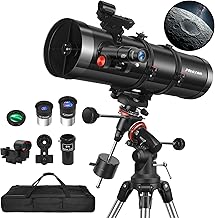
MEEZAA 150EQ Newtonian Reflector
The 150mm aperture is the headline here. For a Newtonian reflector at this price, that light-gathering power translates to genuinely deeper penetration into galactic fields than any other sub-$300 option on this list. The equatorial mount is functional once balanced, and the included phone adapter makes sharing observations simple.
- Pro: Largest aperture in the sub-$300 tier, pulling in fainter targets reliably
- Pro: Equatorial mount lets you track targets as they drift across the sky
- Con: The tripod flexes noticeably under the full tube weight, requiring careful setup on firm ground
Skip this if you plan to transport it to dark-sky sites frequently; the tube is long and the mount demands patience at setup that younger or impatient users won’t tolerate. Best for patient beginners with a fixed backyard location who want maximum aperture per dollar.
Celestron StarSense Explorer LT 114AZ
This is the cheapest path to guided smartphone pointing. The StarSense app reads the sky through your phone’s camera, locks onto an object, and tells you where to aim. For deep-space beginners who have never used a star chart, that alone removes the single biggest frustration barrier. The 114mm aperture handles brighter nebulae and large galaxies respectably.
- Pro: App-guided alignment eliminates the steep learning curve of star-hopping
- Pro: Lightweight alt-azimuth setup makes it easy to deploy in minutes
- Con: The manual alt-az mount introduces field rotation on longer observations, and there is no motorized tracking
Skip this if you want to pursue faint targets at high magnification or plan long exposure imaging. It is an excellent first scope that removes the “why can’t I find anything” frustration in its tracks.
Celestron AstroMaster 130EQ
The 130mm mirror sits at a sweet spot: enough aperture for the Orion Nebula’s structure and the Andromeda Galaxy to register without averted-vision tricks, paired with a German equatorial mount that lets you track objects as Earth rotates. This is the scope we recommend to beginners who want a single instrument that grows with their skill level.
- Pro: German equatorial mount provides proper polar alignment for tracking faint targets
- Pro: Bright, contrast-rich views of medium-sized nebulae and star clusters
- Con: The included eyepieces are mediocre; a single upgrade eyepiece is worth the added cost
Skip this if you want a grab-and-go experience — polar alignment adds five to ten minutes before you’re looking through the eyepiece. Best for someone committed to learning mount mechanics alongside observing.
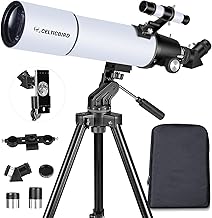
Celticbird 80mm AZ Refractor
For under $90 this exists for a different audience: kids, first-timers testing whether astronomy is worth investing in, and anyone who wants a scope small enough to fit in a backpack. The 80mm aperture and 600mm focal length are modest, and you will not resolve faint galaxies. But Moon craters, Jupiter’s moons, and the Orion Nebula as a fuzzy patch are all within reach.
- Pro: Ultra-portable with backpack included, trivial to set up and store
- Pro: Lowest entry cost on this list by a wide margin
- Con: 80mm aperture caps deep-sky capability at the brightest targets only
Skip this entirely if deep-sky faint-field observing is your primary goal. It is a gateway scope, not a destination.
DWARFLAB Dwarf Mini Smart Telescope
This is not an eyepiece telescope in the traditional sense. The Dwarf packs a 1.85-pound body with onboard processing, a built-in light pollution filter, and 90-second exposure stacks that produce composite images on your phone without a laptop, mount computer, or post-processing software. For urban observers dealing with significant light pollution, the computational approach produces visible structure in targets your eye simply cannot detect at this aperture class.
- Pro: Completely self-contained imaging pipeline with auto-GOTO and built-in processing
- Pro: Light pollution filter and stacking overcome ambient sky conditions that defeat visual scopes
- Con: No eyepiece means no direct visual observation; everything is viewed through a screen
Skip this if you want the traditional experience of looking through an eyepiece. For mobile-first observers who want to share images of deep-sky objects, it is unmatched at this size.
Gskyer 90mm AZ Refractor
A solid middle-ground refractor for adults who want more aperture than a toy scope without committing to a reflector’s maintenance requirements. The 90mm lens delivers noticeably better light grasp than the Celticbird, and the alt-azimuth mount keeps setup quick. Deep-sky views are limited to brighter targets, but planetary and lunar performance is strong for the price.
- Pro: Refractor design means no collimation and sealed optics that stay clean
- Pro: Good color correction on bright objects compared to similarly priced reflectors
- Con: The alt-az mount cannot track objects without manual re-centering, limiting patience for faint targets
Skip this if your primary interest is galaxies and faint nebulae — the aperture is adequate but the mount architecture works against long observations. A capable all-rounder for mixed use.
Celestron StarSense Explorer DX 130AZ
The DX upgrade over the LT model brings a 130mm parabolic mirror and a sturdier mount, and the StarSense app guidance remains the core selling point. That aperture bump from 114mm to 130mm is the difference between seeing the Dumbbell Nebula as a blur and picking out its shape. For guided beginners who want more reach without abandoning app simplicity, this is the natural step up.
- Pro: 130mm parabolic mirror delivers real deep-sky penetration at this price
- Pro: Smartphone-guided setup removes the alignment frustration that kills beginner enthusiasm
- Con: Still manual alt-azimuth — you will fight field rotation on any target worth studying
Skip this if you want to image or observe for extended sessions without readjusting. For pure visual guided hunting of brighter deep-sky objects, it is hard to beat under $420.
Celestron NexStar 8SE Computerized Telescope
The 8-inch Schmidt-Cassegrain on a motorized GoTo mount represents the ceiling of this list. The database holds over 40,000 objects, SkyAlign gets you operational in under two minutes, and the aperture dwarfs everything else here. Visual deep-sky performance is genuinely impressive — spiral arms on nearby galaxies, planetary nebula structure, and rich cluster detail. It also serves as a serious astroimaging platform for those ready to add a camera.
- Pro: 8-inch aperture and automated GoTo tracking make faint-target hunting dramatically easier
- Pro: Dual-use for visual observation and serious imaging with accessories
- Con: At $1,499 and significant weight, it demands more storage space and commitment than any other scope here
Skip this if budget is firm or if you need something a child can carry to a park. For observers who want one instrument that handles everything from planets to faint galaxies without compromise, it is the clear winner.
Buying Guide
Aperture Is the Single Most Important Number
Aperture determines how much light your telescope collects, and for deep-space targets that light is what separates a visible smudge from an invisible one. The difference between 80mm and 150mm is roughly 3.5 times the light grasp — enough to reveal structure in objects that simply vanish in smaller tubes. When comparing specs, focus on aperture over magnification claims. Any scope can be “magnified” to 600x with the right eyepiece combination; what matters is whether the objective gathers enough photons to make that magnified image meaningful rather than a dim gray blur.
Mount Type Dictates Your Usable Experience
Alt-azimuth mounts point up, down, left, and right like a camera on a tripod — simple but incapable of tracking objects as Earth rotates without manual correction. German equatorial mounts align one axis with Earth’s rotation axis, letting you follow a nebula across the sky by turning one knob. Motorized GoTo mounts automate the entire process. For deep-sky work, the mount determines whether you can study an object for ten minutes or spend half that time re-centering. A large aperture on a wobbly tripod is worse than a smaller scope on a rigid one.
Smartphone Guidance Changes the Learning Curve
Star alignment used to be the primary reason beginners quit. Phone-based guided systems like Celestron’s StarSense or the Dwarf’s auto-GOTO collapse that barrier to a few seconds. The tradeoff is that you learn less about the sky’s structure in the process. If you enjoy understanding where objects sit relative to constellations, a manual equatorial mount teaches more. If you just want to see Andromeda tonight without a star atlas, guided systems are a legitimate shortcut that removes friction between you and the eyepiece.
Our Verdict
The Celestron NexStar 8SE is the best telescope for deep space on this list without qualification. Its 8-inch aperture, automated GoTo tracking, and imaging capability create a ceiling that no other product here approaches. For observers with the budget and space, it is the single best answer.
The budget pick is the Celestron StarSense Explorer LT 114AZ. For under $250 it provides real aperture and removes the alignment frustration that makes beginners quit, making it the best first deep-sky telescope for under $250.
The DWARFLAB Dwarf wins outright if your observing site has significant light pollution or if you primarily want to capture and share images rather than look through an eyepiece. No traditional scope at this price range compensates for urban skies the way computational stacking does.
FAQ
Can I see deep-sky objects with these telescopes from a city?
Faint galaxies and nebulae become extremely difficult under light pollution because the skyglow raises the background brightness enough to wash out low-contrast targets. The DWARFLAB Dwarf’s built-in light pollution filter and image stacking help the most in these conditions, while traditional visual scopes require at least a suburban location to show anything beyond the Moon and planets.
What aperture do I need to actually see galaxies?
Andromeda is visible in a 70mm scope under dark skies, but smaller or fainter galaxies like the Triangulum Galaxy need at least 100 to 120mm of aperture to register without averted vision tricks. For spiral structure in M51 or M81, you need 130mm or larger. The MEEZAA 150EQ and NexStar 8SE both sit in that productive range.
Do I need a motorized mount for deep-sky observing?
No, but it helps with larger apertures. A motorized equatorial mount tracks targets automatically so you can study them without re-centering every few minutes. A manual German equatorial mount achieves the same thing with a slow-motion cable. A non-motorized alt-azimuth mount like those on the Celticbird and Gskyer means you will manually reposition on every target, which becomes tedious at higher magnifications where objects drift quickly.
Is a refractor or reflector better for deep-sky targets?
Reflectors offer significantly more aperture per dollar, which is the critical factor for faint targets. A 130mm reflector costs about what a 70mm refractor costs, and the reflector will show you objects the refractor simply cannot. Refractors deliver sharper contrast on planets and double stars due to their unobstructed optical path, but for galaxies and nebulae where aperture dominates, a reflector of the same price wins every time.