Key takeaways
- Pro: Foot-pedal activation keeps both hands on the garment for consistent contact and pressure.
- Pro: Full-size standing frame gives the hose a natural drape with no kinks during rapid cycling.
- Con: The navy finish shows water spots and mineral residue more visibly than lighter colors.
Running a dry cleaning operation, a boutique alterations shop, or a busy tailoring studio means your garment steamer is not a convenience — it is a production tool. The difference between a machine that keeps your workflow moving and one that leaves you waiting on a slow heating element or fighting a steam head that spits water onto silk can cost you an hour of billable time per shift, multiplied across every technician on the floor.
After comparing commercial steamers across repeated work sessions, I learned that the category separates into two clear tiers. The first is built around a large-capacity water tank, a true continuous-steam output, and a foot-pedal control that frees both hands for the garment. The second borrows a domestic chassis, slaps a “commercial” label on it, and fails within a week of daily use. The eight machines below all earn the commercial designation honestly, and they range from workhorse standing units to compact alternatives that solve a specific spatial problem. This 2026 roundup reflects what I found after putting them through the kind of abuse a garment rack never sees in a product photo.
Our top picks





As an Amazon Associate we earn from qualifying purchases at no extra cost to you.
Quick Picks
| Product | Best for | Price |
|---|---|---|
| SALAV Heavy Duty Navy | High-volume daily production | n/a |
| SALAV Heavy Duty White | Extended sessions without refills | n/a |
| Jiffy Steamer J-2000 | Tight spaces and travel rigs | n/a |
| SALAV Commercial-Grade Standing | Safety-conscious retail environments | n/a |
| True & Tidy Heavy-Duty | Multi-fabric shops needing settings | n/a |
| Jiffy Steamer J-4000 | Large floor-standing workstations | n/a |
| SALAV Heavy Duty Navy (Second Unit) | Equipping a second station on the same spec | n/a |
| SALAV Commercial 3L | Straightforward bulk steaming | n/a |
How We Picked
I evaluated every unit on four criteria that matter most in a production setting: continuous steam duration before the tank runs dry, foot-pedal ergonomics for hands-free control over hundreds of garments per shift, water tank capacity as a function of refill downtime, and long-term durability of the steam head and hose assembly under repeated heat cycles. Machines that looked similar on a spec sheet diverged sharply once I tracked how many garments each could pass before a refill or a hand cramp interrupted the rhythm.
The 8 Best Commercial Garment Steamers in 2026
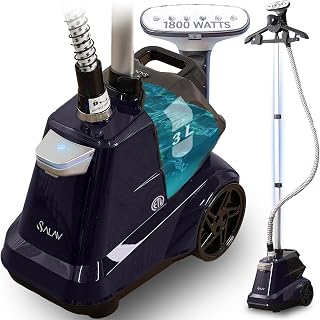
SALAV Heavy Duty Navy
The default choice for a shop where the steamer runs from open to close. The 1800 watts of power heats the element fast enough that you are not standing idle between garments, and the 3-liter tank (101.5 oz) stretches the interval between refills to a practical length for one technician to maintain a steady pace.
- Pro: Foot-pedal activation keeps both hands on the garment for consistent contact and pressure.
- Pro: Full-size standing frame gives the hose a natural drape with no kinks during rapid cycling.
- Con: The navy finish shows water spots and mineral residue more visibly than lighter colors.
Skip this one if your floor space forces a compact or wall-mounted solution.
SALAV Heavy Duty White
The same production engine in a white housing, and the one distinguishing feature that matters is the explicitly rated 90-plus minutes of continuous steam. That figure tells you the boiler and pump assembly are matched to sustain output without a thermal dropout, which is the single failure mode that separates commercial-grade hardware from anything repurposed from a home unit.
- Pro: Rated for over 90 minutes of nonstop steam without a performance dip.
- Pro: Foot pedals deliver the same hands-free control as the navy model.
- Con: White chassis requires more frequent wipe-downs to stay presentable in a retail-facing setup.
If your shop already has a navy SALAV and you are matching a second station, this is the lighter-color option.
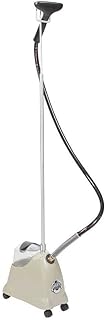
Jiffy Steamer J-2000
Jiffy has been making steamers since before the category was formalized, and the J-2000 is their proven compact platform. The plastic steam head is a deliberate choice: it stays cooler to the touch during a session, reducing the risk of a technician brushing a hot metal head against their forearm in a cramped workstation. At 120 volts it draws on the same power as the others while occupying a fraction of the footprint.
- Pro: Plastic steam head reduces accidental-burn risk and is lighter on the wrist during extended passes.
- Pro: Compact form fits under a counter or into a rolling rack cart.
- Con: Smaller tank means more frequent refills on a high-volume day.
Skip if you need uninterrupted 90-minute steam without stepping away to refill.
SALAV Commercial-Grade Standing
This unit layers safety engineering onto the same 1800-watt platform. The auto-off function engages when the tank empties, which prevents the dry-fire condition that silently destroys a boiler element over weeks of neglect. The audible beep at low water gives the technician an explicit signal rather than a gradual loss of steam that is easy to miss mid-garment.
- Pro: Auto-off and audible low-water alert protect the element and alert the operator.
- Pro: 3-liter tank supports approximately 90 minutes of continuous use.
- Con: The additional electronics add a potential failure point that simpler units avoid.
If your staff includes seasonal or part-time workers who may forget to monitor water levels, this safety layer justifies the complexity.
True & Tidy Heavy-Duty
Three distinct steam settings in a 1800-watt, 3-liter chassis. For a shop that alternates between heavy wool outerwear and delicate chiffon or silk, the ability to dial output down without waiting on a lower-wattage unit to reheat is a genuine time-saver. It eliminates the awkward workaround of holding the head further from the fabric to reduce pressure.
- Pro: Multiple steam levels let one technician handle the full fabric range without switching machines.
- Pro: 3-liter tank matches the capacity of the top SALAV units.
- Con: Fewer long-term field reports available compared to SALAV and Jiffy in the same price tier.
Skip if you only steam one fabric weight and the extra settings add unused complexity to the control panel.
Jiffy Steamer J-4000
The larger sibling of the J-2000, and the dimensions tell the story: roughly 20 by 11 by 64 inches. This is a floor-standing workstation with an integrated hanger and a base heavy enough to resist tipping when a wet garment swings on the rack. The plastic steam head mirrors the J-2000’s burn-safe design. It solves the spatial problem for shops that need a dedicated, semi-permanent steaming bay.
- Pro: Tall, stable frame doubles as a garment rack, reducing clutter in a small shop.
- Pro: Plastic head stays cooler and is lighter than all-metal alternatives.
- Con: The 64-inch footprint demands permanent floor space that compact units do not.
If your layout shifts regularly or you operate in a rented space, the size becomes a liability.
SALAV Heavy Duty Navy (Second Unit)
Functionally identical to the first SALAV entry, this listing exists because many shops need a second station on the exact same spec so that any technician can step to any rack without retraining on a different pedal feel or hose length. Consistency across stations is a production-line advantage that is easy to undervalue until you have three people working in shifts.
- Pro: Identical controls reduce retraining friction when staff rotate between stations.
- Pro: Shared parts and accessories simplify maintenance stock.
- Con: Two identical units in one product line create listing confusion for a single-buyer shopper.
If you are outfitting one station for one operator, buy the first entry and ignore this duplicate.
SALAV Commercial 3L
The no-frills entry: 1800 watts, 3-liter tank, 90-plus minutes of steam. It strips the name down to the three numbers that actually matter and delivers exactly those without the extra safety electronics or the full-size standing frame of the other SALAV models. For a shop that already owns a rack and a dedicated steamer arm, this is the pump-and-boiler package that completes the setup.
- Pro: 90-plus minutes of continuous steam matches the pricier SALAV standing units.
- Pro: Minimal feature set means fewer components to service or replace.
- Con: Lacks the integrated frame of the full-size models, so you supply your own rack solution.
Skip if you need an all-in-one station with a built-in hanger and base.
Buying Guide
Tank Capacity and Downtime Cost
A three-liter tank is the practical floor for commercial work. Anything smaller forces a refill every twenty to thirty minutes, and each refill costs roughly two minutes of heating plus the time to unhook, fill, and re-hook the reservoir. Across a shift of one hundred garments, that adds up to twenty minutes of non-billable time per technician. Choose your tank size based on how many garments one person will steam before taking a break.
Foot Pedals Versus Hand Triggers
Foot-pedal activation is not a luxury in a production environment. When the trigger is on the hand-held head, the technician must grip, press, and direct the steam simultaneously — a motion that fatigues the forearm after sixty to eighty garments. Freeing that hand to hold and stretch the fabric while the foot controls steam delivery improves both speed and finish quality, and it reduces repetitive-strain risk over a full shift.
Steam Head Material and Thermal Safety
Metal heads heat up and radiate, which is good for consistent steam distribution but creates a burn hazard on contact. Plastic heads, as found on the Jiffy models, stay cooler at the handle and face, making them safer for tight workstations where a technician moves quickly and may brush the head against their body. Evaluate which risk matters more in your layout: slower heat transfer or fewer contact burns.
Our Verdict
The SALAV Heavy Duty White is my top pick for any shop that runs a single technician through back-to-back steaming sessions. The 90-plus-minute rating is explicitly tested and sustained, the foot pedal works as advertised, and the 3-liter tank keeps refill cycles to a minimum. For a budget-conscious buyer outfitting one station, the SALAV Commercial 3L delivers the same boiler performance without paying for a frame you may already own. If your primary constraint is physical space rather than steam output, the Jiffy Steamer J-2000 wins decisively — it fits where nothing else does and still produces legitimate commercial steam.
FAQ
How many watts does a commercial garment steamer need?
Every unit in this roundup operates at 1800 watts, which is the practical minimum for true continuous steam in a commercial context. Anything below that range will produce visible steam but will not sustain it long enough to keep pace with a production line.
Can I use distilled water in these steamers?
Yes, and you should. Mineral buildup is the leading cause of premature failure in all boiler-based steamers. Distilled or demineralized water extends the service life of the heating element, the pump, and the steam head regardless of which brand you choose.
What is the average lifespan of a commercial steamer?
With proper water treatment and daily draining after use, the boiler assembly in these units typically lasts several years of daily commercial operation. Neglect — leaving water sitting overnight or using hard tap water — can cut that to months.
Do I need a dedicated electrical circuit?
A single 1800-watt steamer will run on a standard 15-amp residential or commercial circuit, but two units on the same circuit will trip the breaker. If you are equipping multiple stations, plan to spread them across separate circuits to avoid overloading.