
Key takeaways
- Pro: Ten outlets in a single 1U footprint is among the best density available without sacrificing spacing.
- Pro: The 15-foot cord solves the common problem of a rack sitting far from the wall outlet.
- Con: No surge protection or independent switches, so a single fault on the circuit line kills everything downstream.
Rackmount PDUs are one of those categories where the cheap options feel identical until you actually install them. You are mounting a power strip into a server rack, and the first thing you notice is that everything in that rack is already competing for space behind the unit. Outlets that are not right-angle or that sit too close together become useless the moment you plug in an adapter with a slightly bulky transformer. The second thing you notice is build quality: some units flex when you torque screws into the rack, and that tells you the chassis will not survive five years of thermal cycling in a warm equipment room.
What separates a good rackmount PDU from a mediocre one in 2026 comes down to three things: outlet spacing, cord gauge and length, and whether the surge or overload protection is actually rated for the connected load. Most products in this roundup nail the basics, but only a few handle the edge cases that matter in real installations, such as mixed-voltage equipment or tight cable management behind a shallow-depth rack.
As an Amazon Associate we earn from qualifying purchases at no extra cost to you. Product prices and availability are accurate as of the date shown and are subject to change.



Quick Picks
| Product | Best For | Price |
|---|---|---|
| CyberPower CPS1215RM | Reliable 10-outlet capacity | $59.99 |
| StarTech RKPW081915 | Compliance-sensitive environments | $57.83 |
| Eaton Tripp Lite RS1215-RA | Heavy-duty pro installations | $93.92 |
| HHSOET 8 Outlet PDU | Per-outlet switching | $35.99 |
| Pyle PCO865 | High outlet count plus USB | $67.09 |
| BTU 8-Outlet Right Angle | Tight budget, right-angle outlets | $27.99 |
| BTU 12-Outlet with Switch | Versatile shop or rack use | $28.99 |
| 8 Outlet Rear Plug PDU | Rear-mount convenience | $36.99 |
How We Picked
We evaluated each unit on four criteria: outlet spacing and geometry (right-angle vs. straight, width between sockets), cord quality (gauge, length, strain relief), protection type (surge joule rating where listed, overload switch, circuit breaker), and chassis rigidity. We also considered whether the unit is practical for its stated rack depth. A PDU that technically fits a 1U space but blocks your patch panel cable routing is not a good product, regardless of how solid the metal feels in hand.
The 8 Best Rackmount Pdus in 2026
CyberPower CPS1215RM
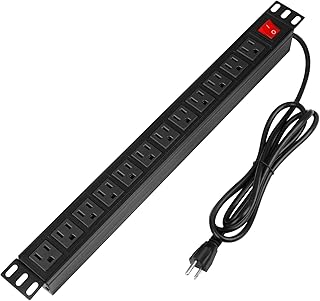
This is the unit I reach for when a small office or homelab needs ten outlets and nothing more complicated. At 15A on a 100-125V circuit it comfortably handles a modest rack of switches, a NAS, and a router without tripping the breaker.
- Pro: Ten outlets in a single 1U footprint is among the best density available without sacrificing spacing.
- Pro: The 15-foot cord solves the common problem of a rack sitting far from the wall outlet.
- Con: No surge protection or independent switches, so a single fault on the circuit line kills everything downstream.
Skip this if you need per-outlet control or surge suppression for sensitive audio or storage equipment.
StarTech RKPW081915
StarTech targets the buyer who needs TAA compliance for government or defense-adjacent procurement. The rugged steel chassis and LED ground/surge indicators make it a straightforward pick for anyone whose purchase order explicitly lists compliance requirements.
- Pro: TAA compliant out of the box, which eliminates a separate sourcing headache for procurement teams.
- Pro: LED indicators give instant visual confirmation that the ground and surge circuit are healthy.
- Con: Only eight outlets and a 6-foot cord limit its usefulness in deeper or more crowded racks.
If compliance is not a factor, cheaper options with more outlets are available.
Eaton Tripp Lite RS1215-RA
Twelve right-angle outlets and a lifetime warranty make this the default for IT managers who want one unit they will never revisit. The on/off switch cover prevents accidental power cycles, which matters in shared racks where non-technical staff walk past.
- Pro: Right-angle outlets maximize usable plug count in tight cable-management scenarios.
- Pro: Lifetime manufacturer warranty is essentially unheard of at this price tier for rackmount PDUs.
- Con: At $93.92 it costs nearly triple the entry-level competitors, and the premium buys durability rather than extra features.
Not the right choice if you are outfitting a temporary setup or a low-priority storage closet.
HHSOET 8 Outlet PDU
Independent switches on each outlet are rare in this price bracket, and the HHSOET delivers them without padding the design with unnecessary extras. The 1200J surge rating is generous relative to most competitors at under $40.
- Pro: Independent switches let you power-cycle individual devices from the front without reaching behind the rack.
- Pro: 1200J surge rating provides meaningful protection for audio gear or budget NAS units.
- Con: The 6-foot cord is short for any rack not sitting directly over a floor box or wall receptacle.
Skip this if your rack is more than a few feet from the nearest outlet.
Pyle PCO865
Nineteen outlets plus four USB ports in a single 1U unit is a staggering amount of connectivity density. This suits A/V integrators or lab environments where many small-powered devices share a single rack and you want to eliminate wall-wart clutter.
- Pro: The USB ports eliminate the need for separate chargers or multi-port hubs mounted elsewhere in the rack.
- Pro: A 15A circuit breaker on the switch provides overload protection beyond what a simple reset button offers.
- Con: With so many outlets crammed into 1U, spacing between adjacent sockets is tight and bulky adapters will block neighbors.
Not ideal for server racks where each device draws significant current and you want generous plug spacing.
BTU 8-Outlet Right Angle
At $27.99, this is the cheapest way to get eight right-angle outlets with a surge rating in a rack-mountable chassis. Wide-spaced sockets handle standard IEC and NEMA plugs without conflicts, making it a sensible pick for budget homelabs.
- Pro: Right-angle, wide-spaced outlets maximize plug compatibility at a fraction of the cost of premium units.
- Pro: ETL listed, which means the safety certification is independently verified rather than self-declared.
- Con: The 300J surge rating is modest and offers limited headroom for repeated transient events.
Pass on this if your connected equipment is expensive or you work in an area with frequent power fluctuations.
BTU 12-Outlet with Switch
The same BTU chassis design stretched to twelve outlets with a master switch, this unit straddles the boundary between rack PDU and workbench strip. It suits garage shops or equipment rooms where you want to kill all power to the rack with one action.
- Pro: Master switch provides a convenient emergency cutoff without unplugging the cord or flipping the upstream breaker.
- Pro: At $28.99 it offers twelve outlets at a price lower than most eight-outlet competitors.
- Con: Metal housing feels thin compared to the Eaton or CyberPower, raising questions about long-term rack-mounted rigidity.
Not the best choice for permanently installed enterprise racks where durability over years matters more than outlet count.
8 Outlet Rear Plug PDU
Rear-facing plugs are a small design choice that makes a meaningful difference in shallow racks where cables entering from the front create a tangle behind the switch panel. The 14AWG cord and 1875W rating are straightforward and adequate for standard 15A loads.
- Pro: Rear plug orientation keeps the front face clean and simplifies cable dressing in dense racks.
- Pro: 14AWG wire is the standard for a 15A circuit, giving predictable voltage drop over the 6-foot cord.
- Con: No surge protection at all, only an overload switch, so lightning or utility transients pass straight through to connected gear.
Skip this entirely if connected equipment is sensitive to voltage spikes or if the rack is in a location without upstream surge protection.
Buying Guide
Outlet Geometry and Spacing
Straight outlets look fine on a spec sheet but become a problem the moment you plug in a wall adapter with a transformer block. Right-angle outlets direct the plug downward or sideways, freeing space for neighboring sockets. If your rack contains a mix of standard IEC power cords and small NEMA adapters, prioritize right-angle or wide-spaced designs and verify the distance between adjacent outlets by looking at actual installation photos rather than relying on outlet count alone.
Cord Gauge and Length
Most PDUs here ship with either a 6-foot or 15-foot cord. A 6-foot cord works only if the rack is within arm’s reach of the receptacle; anything deeper means extension cords, which add voltage drop and defeat the clean-installation purpose of a rackmount unit. Check that the cord is at least 14AWG for 15A loads; thinner wire will run warm under sustained draw and can be a fire risk over years. Some premium units include strain relief molded into the cord entry point, which prevents internal conductor fatigue at the terminal.
Protection Type and Rating
Surge protection and overload protection solve different problems. A joule rating (the 300J, 1200J, and similar figures you see on spec sheets) tells you how much transient energy the MOV can absorb before degrading. Overload switches or thermal breakers protect against sustained overcurrent. A unit with only an overload switch will not protect your equipment from a lightning-induced spike. If your upstream panel lacks surge protection, choose a PDU that includes it, and note that the joule rating matters most for units protecting sensitive electronics like audio interfaces or network switches with exposed management ports.
Our Verdict
The Eaton Tripp Lite RS1215-RA is the top pick for anyone installing a permanent rack because right-angle outlets, a circuit breaker switch cover, and a lifetime warranty collectively eliminate the most common failure modes in this category. For budget buyers who simply need reliable power distribution in a homelab, the BTU 8-Outlet Right Angle at $27.99 offers the best ratio of features to cost. However, if you need independent per-outlet switching and the highest surge rating relative to price, the HHSOET wins that specific comparison despite its shorter cord.
FAQ
Can I plug a rackmount PDU into another power strip?
Technically yes, but it is poor practice. The combined resistance of multiple daisy-chained connections increases voltage drop and reduces the effective current available at each outlet, and it creates a single point of failure for the entire rack. Always plug directly into a dedicated circuit or a UPS output.
Do I need surge protection in my rack PDU?
It depends on what is upstream. If your rack sits behind a UPS or a whole-home surge protector, the PDU-level surge circuit becomes redundant. In environments with no upstream protection, a joule-rated surge circuit on the PDU is the last line of defense for connected equipment.
How many devices can I connect before tripping the breaker?
On a standard 15A/120V circuit the practical continuous load limit is roughly 12A, or about 1440 watts. Add up the rated consumption of everything plugged in; most modern network switches and NAS units draw well under 200 watts each, so you can typically run five or six devices comfortably before approaching the breaker threshold.
Are rackmount PDUs compatible with all 19-inch racks?
Any PDU labeled 1U and designed for a 19-inch rack will mount using the standard hole spacing on both sides. The practical limitation is rack depth: shallow wall-mount cabinets may not leave room behind the PDU for cords to exit without bending, so verify clearance in your specific enclosure before purchasing.


