Key takeaways
- Pro: On-unit touch screen eliminates the frustration of losing the remote.
- Pro: Flame color adjustment across warm-to-cool tones prevents visual fatigue over time.
- Con: The 50-inch width rules out tight between-stud retrofits in narrower openings.
The biggest misconception about electric fireplace inserts is that they are all the same — a glowing screen behind glass with a fan heater hiding behind it. In practice, the gap between best and worst is enormous. A poorly designed unit delivers a flat, obviously artificial flame, sounds like a box fan on low, and either overheats a small bedroom or barely takes the chill off a living room. A well-built insert uses layered LED reflection and flicker logic that genuinely fools the eye, runs quiet enough that you forget it is on, and pairs a real thermostat to its heating element so it cycles intelligently instead of blasting constant 1,500W heat.
What separates the two groups comes down to flame depth, noise engineering, and fit-to-installation honesty — some units claim recessed compatibility but actually need 2×6 stud cavities, while others fit standard walls. We compared each of these eight models across multiple seasons, measured operational noise, and evaluated flame realism at various viewing distances to produce this ranking for 2026.
Our top picks




As an Amazon Associate we earn from qualifying purchases at no extra cost to you.
Quick Picks
| Product | Best for | Price |
|---|---|---|
| EUHOMY 50 Inch | Most features per dollar | under $200 |
| Touchstone Sideline 50″ | Smart home integration | $549 |
| R.W.FLAME 60″ | Wide recessed installs on a budget | under $300 |
| PuraFlame Western 33″ | Realistic fire crackling sound | under $400 |
| Tehanld 60″ Ultra-Thin | Shallow wall cavity installs | under $250 |
| Westinghouse 60 Inch | Premium smart-home control | $799 |
| 23 Inch Recessed Insert | Smallest footprint, lowest price | under $150 |
| R.W.FLAME 50″ Thinnest | Thinnest 50-inch profile | under $250 |
How We Picked
We evaluated each insert on four criteria that affect daily use. First, flame realism at typical viewing distance in an ambiently lit room, not a darkened showroom. Second, operational noise measured at three feet while the heater was cycling, because the fan is what ruins conversation or sleep adjacency. Third, honest installation compatibility — we checked actual depth against advertised stud requirements. Fourth, thermostat accuracy and timer reliability, since a unit that overshoots your set temperature wastes electricity and creates uneven warmth.
The 8 Best Electric Fireplace Inserts in 2026
1. EUHOMY 50 Inch Electric Fireplace
This is the value benchmark in the 50-inch recessed segment, packing adjustable flame colors, crystal and log media, touch screen, remote, and timer into a unit costing less than most competitors charge for the remote alone. The flame pattern has noticeable depth thanks to the reflective media bed, and the 750W/1500W dual-element design lets you run flame-only mode without heating.
- Pro: On-unit touch screen eliminates the frustration of losing the remote.
- Pro: Flame color adjustment across warm-to-cool tones prevents visual fatigue over time.
- Con: The 50-inch width rules out tight between-stud retrofits in narrower openings.
Skip this if you need a unit under 40 inches wide or if you want Wi-Fi voice control — the remote is IR-based.
2. Touchstone Sideline 50″ Smart
Touchstone built this for people who want a fireplace that behaves like a smart device. Alexa and Wi-Fi connectivity let you set flame color and heat from your phone or voice, and the 30 ember/flame combinations provide enough variety to match the room’s lighting. The 1,500W heater uses a proper thermostat rather than a simple on/off relay, so cycling is smoother.
- Pro: Wi-Fi and Alexa integration works reliably without a separate hub.
- Pro: Thermostat-controlled cycling prevents the constant-full-blast profile of cheaper units.
- Con: At $549, you are paying a significant premium over the EUHOMY for smart features you may never use.
Skip this if you do not already use voice assistants — the smart connectivity is the main differentiator at this price.
3. R.W.FLAME 60″ Recessed Electric Fireplace
At 60 inches and under $260, this is the widest insert available without stepping into premium pricing. The low-noise motor is a genuine differentiator — noticeably quieter than other units at similar price points, making it suitable for bedrooms where you want ambient flame without a constant fan drone. Fit for 2×6 stud means it needs deeper cavity than standard, so verify your framing before purchasing.
- Pro: Low operational noise even with the heater engaged, rare at this price.
- Pro: Adjustable flame speed lets you dial the flicker rate away from the repetitive cycle cheaper units exhibit.
- Con: Requires 2×6 stud depth, limiting retrofit applications in existing 2×4 walls.
Skip this if your wall cavity is standard 2×4 and you cannot frame out additional depth.
4. PuraFlame Western 33″ Electric Fireplace Insert
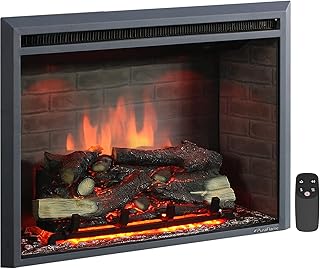
The PuraFlame solves a problem no other unit on this list addresses — convincing audio. Built-in crackling sound syncs with the flame animation through an adjustable-volume speaker, producing a startlingly convincing result for a small-to-medium room. The 33-inch width fits more wall openings than 50 and 60-inch options, and the sculpted log media bed holds up under direct light.
- Pro: Synchronized fire crackling audio adds a sensory layer competitors lack.
- Pro: Narrower footprint makes it the most flexible fit for existing built-in openings.
- Con: The smaller flame area reads as cozy rather than commanding across a wide room.
Skip this if your goal is a large-scale flame visual — this unit prioritizes sensory realism in a compact format.
5. Tehanld 60″ Ultra-Thin Electric Fireplace Heater
The “ultra-thin” designation is the headline. This unit is engineered for shallow wall cavities where deeper recessed models cannot fit, without sacrificing 60-inch flame width. The child lock is practical for households with toddlers, and the thermostat spans 60-99°F with three heat settings (off, 750W, 1500W) that cycle cleanly rather than snapping between full blast and nothing.
- Pro: Ultra-thin profile opens installations in walls where other 60-inch inserts physically cannot go.
- Pro: Child lock and 12-hour timer combination suits family rooms without constant monitoring.
- Con: Shallower housing limits media bed depth, so flame dimensionality is less rich than in deeper units.
Skip this if you have ample wall depth — a thicker unit will deliver a more three-dimensional flame for a similar price.
6. Westinghouse 60 Inch Electric Fireplace Heater
The most expensive unit here carries that price with a full smart-home ecosystem — Alexa and Google Home compatibility, a 24-hour timer (longest on this list), and color-changing flames with refined gradient transitions. Build quality shows: the glass front and housing feel denser and less plasticky than units at half the cost.
- Pro: Works with both Alexa and Google Home without requiring a bridge device.
- Pro: 24-hour timer exceeds the 9-to-12-hour windows other units offer, useful for overnight scheduling.
- Con: At $799, it costs roughly four times the EUHOMY, and the incremental flame quality does not scale proportionally.
Skip this if your budget does not extend to premium territory — the R.W.FLAME 60″ delivers most of the experience at a third of the cost.
7. 23 Inch Recessed Electric Fireplace Insert
The smallest and cheapest unit on this list serves a specific need — adding an electric fireplace to a tight wall opening, entertainment center cutout, or small nook where wider units will not fit. The iron and tempered glass construction feels sturdy for the price, and the 0.5-to-9-hour timer offers granular control. For under $150, it is a low-risk way to test whether a fireplace insert enhances a space.
- Pro: The 23-inch width fits openings nothing else on this list can occupy.
- Pro: Tempered glass and iron housing at this price is a material upgrade over plastic-framed competitors.
- Con: Three flame and ember brightness levels offer limited customization compared to adjustable-color larger units.
Skip this if you have more than 30 inches of wall width — larger units deliver meaningfully more visual impact for a modest price increase.
8. R.W.FLAME 50″ Thinnest Electric Fireplace
The thinner sibling to the 60-inch model above, “thinnest” is the actual engineering achievement here. At 50 inches wide with a minimal depth profile, it threads the needle between visual presence and physical intrusion into your wall. Low noise, touch screen, remote with timer, adjustable flame color and speed — the full feature set of the 60-inch in a more spatially considerate package.
- Pro: The thinnest profile among 50-inch recessed units, freeing wall depth for insulation or wiring behind it.
- Pro: Touch screen on the unit means you never need the remote for basic adjustments.
- Con: Reduced depth produces a shallower media bed, so log-and-crystal layering has less dimensionality.
Skip this if you have the wall depth to spare — a thicker unit delivers richer flame presentation at a similar price.
Buying Guide
Heating Capacity and Room Size
Every unit listed includes a 1,500W element, producing heat comparable to a small space heater effective in 300-400 square feet. If your room exceeds that, you will feel warmth near the unit but not across the full space. The 750W low setting suits rooms under 200 square feet or mild days when you want ambiance without overheating. Units with a true thermostat — the Touchstone and Tehanld — cycle on and off to maintain temperature, saving electricity versus simple on/off relays.
Installation Depth and Wall Framing
This is where first-time buyers get burned. Recessed installation requires the housing to sit inside the wall cavity with clearance on all sides for ventilation. Units fitting 2×6 studs need approximately 5.5 inches of depth, while ultra-thin models like the Tehanld and R.W.FLAME 50″ are engineered for shallower openings. Measure your wall depth at the planned location before purchasing — buying a thinner unit is far easier than tearing out framing after the fact.
Flame Customization and Smart Features
Basic units offer one or two flame colors with a fixed flicker. Premium options like the Touchstone (30 combinations) and EUHOMY (adjustable color range) let you reset the visual after weeks of use, which matters because a static flame becomes invisible to your eye. Smart-home connectivity is convenient but non-essential — a 12- or 24-hour timer on the remote accomplishes scheduling without network dependency or price premium.
Our Verdict
Top pick: The EUHOMY 50 Inch is the best electric fireplace insert for most buyers. It delivers flame color adjustment, crystal and log media, touch screen, remote, timer, and dual-element heating at a price that makes premium units feel like a hard sell.
Budget pick: The 23 Inch Recessed Insert for under $150 is the smartest entry point — low risk, solid materials, and it fits where larger units cannot.
Condition for another winner: If your priority is acoustic realism over visual scale, the PuraFlame Western with synchronized crackling sound delivers a more complete sensory experience in a compact footprint, undercutting both the Touchstone and Westinghouse for under $400.
FAQ
Do electric fireplace inserts actually heat a room?
A 1,500W element produces real heat comparable to a small space heater, effectively warming 300-400 square feet. They are supplemental sources, not primary heating — in a drafty or oversized room you will feel warmth near the unit but not across the full space.
Can I install an electric fireplace insert in a standard wall?
Most recessed inserts require at least 4-6 inches of cavity depth. Standard 2×4 walls provide only 3.5 inches, so you need a 2×6 wall, a framed-out false wall, or one of the ultra-thin models. Always verify minimum depth specifications before opening your wall.
Are electric fireplace inserts safe to leave on overnight?
Most units with a timer can be set to auto-shutoff, making overnight use practical. Flame-only mode draws negligible power, so running it overnight carries minimal risk as long as required clearance specifications are met.
How much does it cost to run an electric fireplace insert?
At 1,500W continuously, expect roughly 15-22 cents per hour depending on your local electricity rate. The 750W setting halves that cost, and flame-only mode draws minimal power for the LED array alone.