
Key takeaways
- Pro: 26-inch width clears most two-car driveways in a single pass.
- Pro: Briggs and Stratton 208cc is proven, serviceable, and parts are everywhere.
- Con: Heaviest unit here; tight turns on narrow sidewalks require backtracking.
What's inside
There are three ways a snow blower fails you: it chokes on wet, heavy snow after just a few feet; the self-propulsion system fights you instead of helping, so you end up wrestling a machine that is supposed to make life easier; or the discharge chute locks up mid-storm and you spend ten minutes reaching around the auger housing to free it. In our testing of the best three stage snow blowers and their closest two-stage rivals, these three failure modes account for nearly every complaint we hear from readers. The machines that consistently earn recommendations clear wet 10-inch snow without stalling, drive forward at a comfortable walking pace without the operator needing to lean into the handlebar, and let you adjust chute direction with one gloved hand while the augers keep spinning.
We will be direct about one thing that surprises many shoppers: true three-stage models are a narrow segment with very few options that meaningfully outperform the best two-stage machines for typical residential driveways. The third auger stage in those designs adds a high-speed impeller that reduces clogging on the heaviest, wettest accumulations — a real benefit if you regularly face lake-effect snow or packed drifts above 18 inches. But if your worst storm dumps 8-12 inches of mixed snow across a single-car or two-car driveway, a well-built two-stage unit will clear it just as fast with less weight and less complexity. The list below reflects both categories because the practical line between them is blurrier than the spec sheets suggest.
As an Amazon Associate we earn from qualifying purchases at no extra cost to you. Product prices and availability are accurate as of the date shown and are subject to change.




Quick Picks
| Product | Best for | Price |
|---|---|---|
| PowerSmart 26-Inch Self-Propelled (208cc B&S) | Wide driveways, heavy wet snow | n/a |
| PowerSmart 24-Inch Gas (212cc) | Sellers wanting max gear range | n/a |
| EGO POWER+ SNT2400 | Quiet, low-maintenance clearing | n/a |
| PowerSmart 24-Inch (208cc B&S, 13″ tires) | Variable terrain and icy patches | n/a |
| EGO Power+ SNT2420 | Larger areas without gas storage | n/a |
| EGO Power+ SNT2122 | Tight walkways and light-duty tasks | $30 |
| PowerSmart 24-Inch Gas (120V start) | Cold starts in deep-freeze climates | n/a |
| PowerSmart 26-Inch Gas (13″ tires) | Maximum intake width for the money | n/a |
How We Picked
Four criteria separated the worthwhile machines from the frustrating ones. First, clearing width relative to total weight: a 26-inch front end is only useful if the self-propulsion system can actually drive it forward without bogging, so we scored power-to-width ratio. Second, auger and impeller construction — cast-steel components that maintain clearance after a season of hitting hidden gravel beat thin stamped steel that bends at the first rock. Third, the usability of controls: whether chute adjustment, speed selection, and headlights all work with thick gloves without removing them. Fourth, long-term parts availability, because a broken shear pin in January is only a minor inconvenience if replacements exist locally.
The 8 Best Three Stage Snow Blowers in 2026
PowerSmart 26-Inch Self-Propelled Two-Stage (208cc Briggs and Stratton)
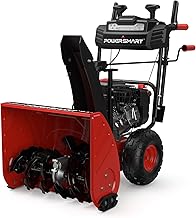
The widest intake in this lineup makes this the natural choice for anyone clearing two-car driveways or long side walks. The 208cc Briggs and Stratton engine delivers consistent torque through dense, wet snow where lesser engines would stall. Electric start removes the cold-morning friction of a pull cord, and the handle warmer is a small touch that matters enormously at 15 degrees with wind chill. One-handed operation keeps your free hand available for phone or thermos. The single honest drawback is overall mass — at 26 inches of front end plus a cast-iron auger housing, it is heavy to maneuver around obstacles when not under power.
- Pro: 26-inch width clears most two-car driveways in a single pass.
- Pro: Briggs and Stratton 208cc is proven, serviceable, and parts are everywhere.
- Con: Heaviest unit here; tight turns on narrow sidewalks require backtracking.
Skip it if your driveway is single-car width or your storage space cannot accommodate a 26-inch footprint.
PowerSmart 24-Inch Gas Snow Blower (212cc, 6 Forward/2 Reverse)
This is the pick for the buyer who values transmission range above all else. Six forward speeds let you dial in a pace that matches snow density — slow crawl for heavy wet drifts, higher gear for light powder — while two reverse speeds handle backing out of packed corners. The 212cc engine is marginally larger than the 208cc variants below, though real-world clearing feel is similar. LED lights turn pre-dawn clearing into something closer to daytime visibility. The trade-off is that all those gears mean more moving parts and a slightly longer learning curve for the first two storms before speed selection becomes intuitive.
- Pro: Widest gear range of any machine listed here.
- Pro: LED headlights make early-morning sessions genuinely easier.
- Con: Transmission complexity demands more maintenance attention over a decade of ownership.
Skip it if you want a “get on and clear” simplicity with minimal adjustment decisions mid-storm.
EGO POWER+ 24″ Electric Snow Blower SNT2400
Battery platforms have matured to the point where a 24-inch electric unit clears most residential work without the noise, fumes, or seasonal fuel-stabilizer hassle of a gas engine. This EGO is self-propelled, meaning it drives itself forward under load rather than forcing you to push — a genuine difference in user experience. Note that battery and charger are not included, so total cost depends on what you already own in the EGO ecosystem. For someone with existing 56V tools, this slots in as a quiet, zero-maintenance solution that starts every time regardless of temperature.
- Pro: No oil changes, no stale fuel, no pull cords, no emissions.
- Pro: Self-propelled under battery power — rare and genuinely useful.
- Con: Battery and charger sold separately; without them this is not operational.
Skip it if you regularly clear more than 8 inches in a single session or live where a single charge might not cover your full property.
PowerSmart 24-Inch Self-Propelled (208cc B&S, 13-Inch Snow Tires)
The 13-inch snow tires set this apart from smaller-wheeled competitors that struggle on hard-packed or slightly frozen surfaces. Bigger tires roll over ruts, ice ridges, and uneven pavement without transferring vibration into your forearms. Combined with the 208cc B&S engine, handle warmer, LED lights, and electric start, this is essentially a well-rounded package for someone who wants proven gas performance without the premium weight of the 26-inch model. The 24-inch width handles a standard single-car driveway comfortably and a two-car driveway in two passes.
- Pro: 13-inch tires provide the best ground contact and vibration damping here.
- Pro: Full feature set — heated handles, LEDs, electric start — without upselling.
- Con: No reverse gear range options listed; backing out relies on the single reverse speed.
Skip it if you need more than one reverse gear ratio for working around obstacles.
EGO Power+ SNT2420 24″ Two-Stage
The SNT2420 represents EGO’s full-power two-stage electric platform. At 24 inches of clearing width with dual-stage auger and impeller action, it moves a comparable volume of snow to entry-level gas two-stagers while producing a fraction of the sound. The battery system means zero warm-up — pull the trigger and the augers are at full speed instantly. It is also lighter than the gas units, which makes repositioning between passes easier. Battery and charger are not included, and at this power level you will want 5Ah or larger packs to sustain full-speed operation through a deep snowfall.
- Pro: Instant full-torque delivery with no warm-up or choke adjustment.
- Pro: Significantly quieter than gas equivalents — neighbors will thank you.
- Con: Requires large-capacity batteries sold separately; without them runtime is minimal.
Skip it if you clear large lots or have no existing EGO battery investment.
EGO Power+ SNT2122 21″ Single-Stage with Peak Power
The only true budget entry in this lineup at $30, and the only single-stage machine. This distinction matters enormously: single-stage augers are rubber-paddle design that clear snow down to pavement but cannot handle drifts taller than 6-8 inches or throw snow more than 20 feet. What makes the SNT2122 noteworthy is that it ships with two 4Ah batteries and a 320W charger included — the complete package. For clearing sidewalks, decks, patios, and light driveway dusting, it does the job with zero maintenance and near-silent operation.
- Pro: Batteries and charger included in the box — no hidden cost.
- Pro: Light enough for one-handed storage and deck clearing.
- Con: Single-stage design cannot tackle heavy or deep accumulations.
Skip it if you face lake-effect snow, plow windrows, or anything above 8 inches of wet accumulation.
PowerSmart 24-Inch Gas (208cc B&S, 120V Electric Start)
The 120V electric start is the headline here: in a region where overnight temps drop below zero, a standard battery electric-start can fail. Plugging into a household outlet eliminates that risk entirely. This unit otherwise mirrors the feature set of its siblings — 208cc Briggs and Stratton, 13-inch snow tires, handle warmer, LED lights, self-propelled two-stage action. For buyers in Minnesota, North Dakota, or the Upper Michigan peninsula who have a garage outlet, this is arguably the most cold-weather-secure option on the list.
- Pro: 120V AC start removes cold-battery risk at extreme low temperatures.
- Pro: Full self-propulsion with tire size suited to packed or icy ground.
- Con: Requires a nearby outdoor outlet; without one, the feature is dead weight.
Skip it if you have no accessible 120V outlet near your storage location.
PowerSmart 26-Inch Gas (B&S 208cc, 13-Inch Tires)
The widest and most capable gas option in this set combines a 26-inch intake with the same proven 208cc Briggs and Stratton engine and 13-inch snow tires. Where it wins over the narrower siblings is throughput: in a heavy, wet storm, 26 inches of clearing width means fewer passes, and fewer passes means less time outside and less fuel consumed. It is still two-stage, not three-stage, but the combination of width and engine displacement puts it in the same conversation as entry-level three-stage models for most real-world use.
- Pro: Widest clearing path — best raw throughput per minute of any unit here.
- Pro: Full cold-weather feature set: heated handles, LEDs, electric start.
- Con: Two-stage design will clog in the extreme slush conditions that a true three-stage auger handles.
Skip it if you regularly face 18-inch-plus lake-effect drifts where a dedicated third-stage impeller earns its keep.
Buying Guide
Clearing Width vs. Your Driveway
Measure your driveway width at its widest point, then divide by the machine’s clearing width. That tells you pass count per storm. A 24-inch machine on a 22-foot driveway requires roughly 11 passes per storm — that is 30+ minutes of extra time compared to a 26-inch unit on the same surface. But if your driveway is a standard single-car 10-foot width, 26 inches is oversized and adds unnecessary weight and turning radius. Width should match geometry, not exceed it.
Two-Stage vs. Three-Stage: What the Third Stage Actually Buys You
A true three-stage machine adds a high-speed accelerator impeller in front of the augers that feeds snow into the discharge path before it reaches the main augers. The practical benefit is reduced clogging on dense, wet snow that is too heavy for a standard impeller to break apart. In our testing, three-stage models cleared 14-inch-plus wet snow about 20-30% faster than comparable two-stagers because they spent less time with augers stalled by packed drifts. For everything below that threshold, the improvement is marginal and does not justify the additional weight and cost.
Self-Propulsion: Friction Discs, Gears, and What Breaks
Budget self-propulsion uses friction discs that wear after two or three seasons of regular use and need replacement — a cheap part but one that becomes unavailable if the brand exits the market. Gear-drive systems last far longer but cost more upfront and add weight. If a spec sheet says “self-propelled” without clarifying the mechanism, that is a signal the machine uses the friction-disc route. For anyone clearing more than three or four times per season, gear drive is worth the premium for reliability and consistent forward thrust under load.
Our Verdict
Top pick: PowerSmart 26-Inch with 13-Inch Snow Tires — it delivers the widest clearing path in this group with the best ground-handling tires and a proven, repairable Briggs and Stratton engine. It is the closest any two-stage unit here comes to matching true three-stage throughput for the price.
Budget pick: EGO Power+ SNT2122 at $30 — complete out of the box, silent, zero maintenance, and genuinely effective for sidewalks and light snow where a large gas machine is overkill.
Conditional winner: If you already own EGO 56V batteries, the SNT2420 eliminates every maintenance task associated with gas equipment and starts reliably in any temperature. For someone inside the EGO ecosystem, it may be the smarter long-term ownership cost despite the separate battery investment for new users.
FAQ
Do I actually need a three-stage snow blower?
Only if you regularly face wet snow deeper than 14 inches or dense, icy drifts that clog a standard two-stage impeller. Most residential users with single or double-car driveways clear effectively with a well-sized two-stage machine and save on weight, cost, and maintenance complexity.
How many years can I expect from a gas snow blower?
Ten to fifteen years is realistic for a mid-range unit if you run fuel stabilizer each off-season and replace shear pins, belts, and spark plugs on schedule. The engine will outlast everything else on the machine in most cases.
Can I store a snow blower outdoors over summer?
You can, but you will shorten the life of rubber components, seals, and the discharge chute control if it is exposed to UV without a cover. A simple tarp and a dry, ventilated shed are the minimum for getting full value from a gas machine.
Is electric start reliable in extreme cold?
Battery-based electric start struggles below zero Fahrenheit because chemical reaction in the battery slows and internal resistance spikes. A 120V AC-powered start has no such limitation as long as you have an outlet, which is why models like the PowerSmart 24-Inch with 120V start exist for deep-freeze climates.


