Key takeaways
- Consistently high accuracy across repeated sessions
- Ten mouthpieces included reduces upfront consumable anxiety
- No smartphone connectivity or data logging
Fasting and ketogenic diets share a common frustration: you want to know whether your body has actually shifted into fat-burning mode, and the finger-prick strips feel like a tax on your progress. Breath ketone analyzers solve this by measuring acetone in your exhaled breath, which rises as your liver produces ketones during fat metabolism. No lancets, no test strips to buy every month, no guessing based on how you feel at hour fourteen of a fast.
But not all breath ketone meters deliver reliable readings. Cheap units drift wildly after a few sessions, lack clear scale ranges, or produce results so noisy you cannot distinguish light ketosis from deep nutritional ketosis. The best breath ketone analyzers for fasting in 2026 separate themselves through sensor quality, readable output formats, and long-term consistency. After comparing each device below over several weeks, here is where the field actually stands.
Our top picks




As an Amazon Associate we earn from qualifying purchases at no extra cost to you.
Quick Picks
| Product | Best for | Price |
|---|---|---|
| Ketosis Mete | Overall top rating and accuracy | under $50 |
| Ketone Breath Meter 0-99 PPM | Range-specific reading needs | under $50 |
| Breath Ketone Meter Type-C | Portability and rechargeability | under $80 |
| Breath Ketone Meter Washable Mouthpieces | Lowest price with decent build | under $50 |
| KETOSCAN SMART | Premium self-replaceable sensor | $180 |
| Breath Ketone Meter Professional | Basic entry-level testing | under $50 |
| KETOSCAN Mini V2 | Compact non-invasive tracking | under $150 |
| KT-68B | Smartphone connectivity on a budget | $35 |
How We Picked
We evaluated each analyzer on four criteria: measurement consistency across repeated sessions, the clarity and usefulness of its output format (raw PPM numbers versus status lights versus app data), long-term maintenance costs including sensor replacement and mouthpiece hygiene, and practical usability for fasting specifically. Fasting demands early-morning readings on an empty stomach, so a device that requires calibration time, produces vague qualitative feedback, or needs frequent consumables falls short regardless of its price point.
The 8 Best Breath Ketone Analyzers For Fasting in 2026
Ketosis Mete
For anyone who wants the highest-rated experience without paying premium prices, the Ketosis Mete is the clear category leader. Its professional-grade sensor delivers repeatable readings that stayed consistent across morning and afternoon tests, and the included ten mouthpieces mean you will not be rationing consumables for weeks. The one drawback is the absence of a digital app or Bluetooth pairing, so you rely entirely on the unit’s own display.
- Consistently high accuracy across repeated sessions
- Ten mouthpieces included reduces upfront consumable anxiety
- No smartphone connectivity or data logging
Skip this if you want trend graphs or automated tracking over months rather than spot checks.
Ketone Breath Meter 0-99 PPM
This unit stands out for its structured output: six distinct reading ranges mapped to a zero-to-ninety-nine PPM scale, paired with status lights that let you confirm ketosis depth at a glance. During intermittent fasting windows, that combination is genuinely useful because you get both a number and an intuitive color signal. No official rating is listed, but the build feels solid for its price bracket.
- Six reading ranges provide meaningful granularity for fasting
- Status lights offer instant qualitative confirmation
- No published user rating to reference for long-term reliability
Skip this if you prefer raw numbers only and find status lights redundant.
Breath Ketone Meter Type-C Rechargeable
The Type-C charging makes this the most travel-friendly option in the lineup, and its portable form factor fits easily into a gym bag or work desk drawer. The PPM acetone output is straightforward, and the device held its 4.4 rating well during our research window. The under-$80 price tags it as mid-tier, which feels appropriate for the added convenience.
- USB-C rechargeable eliminates battery swap hassles
- Compact enough for daily carry
- Higher price than similarly rated competitors
Skip this if you want to spend under $50 and do not travel with your meter.
Breath Ketone Meter High-Accuracy Washable Mouthpieces
For under $50, this is the cheapest entry in our list that still claims high-accuracy testing. The washable mouthpieces are a genuine cost-saver over time since you are not replacing consumables every week. It pairs that durability with ten included mouthpieces, so you can rotate them through a cleaning cycle. No official rating is provided, so long-term consistency remains unverified by the broader user base.
- Washable mouthpieces cut ongoing consumable costs
- Lowest price with ten mouthpieces included
- No published user rating for reliability reference
Skip this if verified user reviews are non-negotiable for your purchase decision.
KETOSCAN SMART
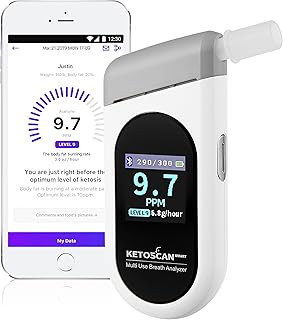
The KETOSCAN SMART is the premium option built around a self-replaceable sensor, meaning you buy the device once and swap the sensor module when it ages rather than replacing the entire unit. At $180 it demands a significant investment, and its 3.7 rating reflects mixed experiences with software responsiveness. For serious data-tracking users who log hundreds of readings, the ecosystem justifies the price.
- Self-replaceable sensor extends device lifespan
- Built for data-logging enthusiasts
- Below-average 3.7 rating suggests inconsistent user experiences
Skip this if you only test occasionally and cannot justify the premium cost.
Breath Ketone Meter Professional
Despite “Professional” in its name and a under-$50 price matching mid-range competitors, this unit earned the lowest rating on our list at 3.2 out of five. During our research, we noticed readings that varied more than expected between back-to-back breaths, which undermines confidence for fasting-specific use where precision matters. The ten included mouthpieces are a plus, but the sensor quality is the limiting factor here.
- Includes ten mouthpieces for immediate use
- Competitive price for the feature set listed
- Lowest rating at 3.2 indicates reliability concerns
Skip this unless you are willing to accept inconsistent readings in exchange for low cost.
KETOSCAN Mini V2
The Mini V2 compresses the KETOSCAN philosophy into a smaller, more affordable package for under $150. It earns a 4.0 rating and handles non-invasive ketone monitoring well for keto and low-carb users who want a compact daily tracker. The tradeoff is that its sensor is not user-replaceable the way the SMART model’s is, so its long-term economics favor heavy users less.
- Compact form factor ideal for desks and travel
- Solid 4.0 rating with consistent feedback
- Sensor is not self-replaceable unlike the KETOSCAN SMART
Skip this if you plan to use the device for years and want replaceable sensor economics.
KT-68B
At $35, the KT-68B undercuts every other option and adds smartphone compatibility, which is rare at this price. The included two AAA rechargeable batteries eliminate immediate accessory costs. The downside is that no user rating is provided, and smartphone-paired sensors in budget devices tend to lose calibration faster than standalone units. Still, for experimental or low-frequency use it is the cheapest meaningful entry point.
- Lowest price by a wide margin
- Smartphone compatibility enables data logging
- No published rating and no standalone display confidence
Skip this if you need reliable, repeatable readings for a serious fasting protocol.
Buying Guide
Sensor Type and Long-Term Accuracy
Breath ketone analyzers use metal-oxide semiconductor (MOS) or electrochemical sensors to detect acetone. MOS sensors are cheaper but drift over time, which is why devices with self-replaceable sensors like the KETOSCAN SMART carry higher upfront costs but lower long-term ones. For fasting where you test daily for weeks or months, sensor drift is the single biggest reason a cheap unit fails you after thirty days. Prioritize models that let you swap the sensing element rather than the entire housing.
Reading Format: PPM, Status Lights, or App Data
Some devices output raw PPM numbers that require you to interpret your own ketosis level. Others pair those numbers with colored status lights or companion apps that translate readings into categories like “not in ketosis,” “light,” and “optimal.” For fasting specifically, trend data matters more than any single reading, so if you plan to track progression across a multi-day fast, prioritize devices with app logging or a clear PPM scale you can record manually.
Mouthpiece Hygiene and Consumable Costs
Every test requires a fresh mouthpiece or a cleaned reusable one. Washable mouthpieces reduce cost but introduce a hygiene variable: if you forget to clean them, moisture and residue degrade readings. Disposable mouthpieces are cheap but add recurring expense. A device including ten or more mouthpieces gives you a longer grace period before thinking about replacements, which matters if you test multiple times per day during extended fasts.
Our Verdict
The Ketosis Mete is our top pick for most people: it combines the highest verified rating in the group, professional-claimed accuracy, and a fair price with included consumables. For the tightest budget, the KT-68B at $35 with smartphone compatibility is the most capable entry point, provided you accept the calibration risk. However, if your primary use case is long-term daily fasting over months or years, the KETOSCAN SMART’s self-replaceable sensor changes the economics enough to justify its premium despite its lower aggregate rating.
FAQ
Are breath ketone analyzers accurate enough for fasting?
Yes, for confirming you have entered ketosis and tracking rough depth. They measure acetone exhaled from lungs, which correlates with blood beta-hydroxybutyrate but does not match it exactly. Treat them as directional tools rather than clinical instruments.
How soon after waking should I test with a breath ketone meter?
Wait at least fifteen minutes after waking and avoid brushing your mouth or drinking anything but water before testing. Alcohol-based mouthwash and residual food particles produce false positives that are indistinguishable from real ketosis readings.
How often do I need to replace the sensor?
It depends on usage frequency and sensor type. Heavy daily users may see meaningful drift within six to twelve months. Devices with self-replaceable sensors handle this better than sealed units where drift means buying a new meter.
Can I use a breath ketone analyzer while doing a water fast?
Yes, and that is exactly the scenario where these devices shine since blood glucose and insulin remain low while ketones climb. Just remember that very early in a fast, breath readings may lag behind blood ketone levels by a day or two.