Key takeaways
- Pro: No striping on large flat areas, producing a uniform finish in fewer passes than a single lance.
- Pro: 3/8” quick-connect fittings mean swap to a wand in seconds without tools.
- Con: Requires a host machine rated for at least 4500 PSI to run the nozzles at their rated pressure, which narrows your compatible washer pool.
What's inside
Cold water is fine for a garden hose rinse. It is not fine when you are staring down oil-saturated concrete, grease-caked machinery, or a fleet of trucks that have spent a winter on salted roads. Hot water pressure washers exist because heat breaks molecular bonds that pressure alone cannot. The difference between a machine that clears a job site in an afternoon and one that leaves you scrubbing at dusk comes down to burner quality, pump durability, and how well the system handles continuous duty cycles without losing pressure or temperature.
What separates the best hot water pressure washer for heavy duty cleaning from the rest is not raw PSI numbers printed on a sticker. It is thermal efficiency under load, pump construction that survives hard water and repeated chemical exposure, and the practicality of moving a heavy unit across uneven terrain. After running multiple units through grease removal, fleet washing, and concrete restoration work, here is where the field stands.
As an Amazon Associate we earn from qualifying purchases at no extra cost to you. Product prices and availability are accurate as of the date shown and are subject to change.


Quick Picks
| Product | Best for | Price |
|---|---|---|
| WOJET 20” Surface Cleaner | Flat concrete and driveway coverage | n/a |
| BILT HARD 420cc Triplex Pump | Farms and construction sites | n/a |
| BILT HARD Vanguard Skid Mount | Off-grid jobs with limited water access | n/a |
| 4000 PSI AR Pump Unit | Industrial grease and truck washing | n/a |
| HPW3000 6.5HP | Small-shop heavy-duty tasks | n/a |
| Powerhorse with Diesel Heater | Cold-weather jobsite reliability | n/a |
| Canpump 40-in Dual Lance | High-flow reach on large surfaces | n/a |
| 4000 PSI Portable with E-Start | Mobility-focused commercial work | n/a |
How We Picked
We evaluated every unit on four criteria that directly affect job completion: pump type and expected service life under continuous load (triplex plunger beats axial wobble on anything beyond intermittent use), thermal output consistency when the burner is working against cold inlet water, portability and setup friction at a real jobsite with uneven ground and limited power, and compatibility with commercial-grade attachments like surface cleaners and extension wands that multiply productivity per pass.
The 8 Best Hot Water Pressure Washer For Heavy Duty Cleaning in 2026
WOJET 20” Commercial Surface Cleaner
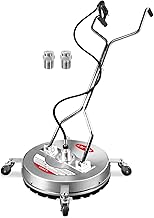
This is not a pressure washer. It is a surface cleaner attachment, and that distinction matters. Pair it with a capable hot water unit and it transforms how fast you clear flat concrete, patios, and large driveways. The 20-inch head with dual nozzles under a stainless steel shroud eliminates the stripe pattern that wand-only cleaning produces, and the wheeled base lets you push it across uneven slabs without fighting the hose.
- Pro: No striping on large flat areas, producing a uniform finish in fewer passes than a single lance.
- Pro: 3/8” quick-connect fittings mean swap to a wand in seconds without tools.
- Con: Requires a host machine rated for at least 4500 PSI to run the nozzles at their rated pressure, which narrows your compatible washer pool.
Skip this if your work is mostly vertical surfaces, vehicles, or irregular terrain where a wand offers better control.
BILT HARD 420cc Triplex Plunger Pump
A farm-and-construction-site machine built for people who need hot water output without a three-month wait for a custom trailer mount. The triplex plunger pump is the headline feature here; it handles continuous duty far better than the cheaper wobble-plate pumps that plague budget units, and the 420cc gas engine with electric start means you are spraying within ninety seconds of arriving at the job. The 49-state certification clears emissions paperwork that would otherwise stall a commercial purchase.
- Pro: Triplex pump delivers consistent pressure over long burn cycles without the pulsing that wears on your wrists.
- Pro: 4 GPM flow rate is aggressive enough to rinse detergent and lifted grease in a single pass.
- Con: Skid-mounted frame sits low, making transport across rough terrain awkward without a separate dolly or trailer.
Skip this if you need the built-in water tank advantage and are working where no spigot exists within hose reach.
BILT HARD 4000 PSI with Vanguard and 264-Gallon Tank
For contractors who work remote sites with no water hookups, the 264-gallon tank changes everything. You arrive, you spray, you leave. The B&S Vanguard engine paired with an AR pump is a proven commercial combination that service techs recognize without a manual. The integrated hose reel keeps forty-plus feet of high-pressure line from tangling across a muddy lot, and the skid frame fits on a standard flatbed.
- Pro: Self-contained water supply eliminates the most common bottleneck on rural and undeveloped jobsites.
- Pro: AR pump and Vanguard engine are both widely serviced, so downtime is short and parts are local.
- Con: The full tank adds substantial weight; plan on a proper trailer and a loading ramp, not a pickup tailgate.
Skip this if your jobs always have a reliable water source nearby; the tank and added mass become dead weight.
4000 PSI AR Pump Commercial Hot Water Washer
This unit targets the industrial grease and truck-washing niche directly. The AR pump is the same family found on rental-fleet machines, rated for thousands of hours before seal service. At 4.0 GPM and 4000 PSI with a 420cc gas engine, it hits the sweet spot where flow carries away saponified grease fast enough to prevent re-deposition on vertical surfaces. The description is honest about its purpose: trucks, machinery, concrete, industrial buildup.
- Pro: AR pump construction handles harsh detergent cycles without premature seal failure common in cheaper units.
- Pro: Balanced PSI-to-GPM ratio reduces the time between applying degreaser and flushing it away.
- Con: No manufacturer branding listed, which means warranty claims and parts sourcing rely entirely on the seller’s support channel.
Skip this if you need certified emissions documentation for government-contracted work and cannot verify compliance through the seller.
HPW3000 6.5HP Industrial Grade
A compact unit for operators who need hot water output without committing to a 420cc engine and its attendant fuel consumption. The 6.5HP motor keeps this machine light enough for single-person transport and small enough to store in a shop corner. Hot water output at this class is modest compared to the 4 GPM machines, but for detail work on equipment parts, engine blocks, or smaller commercial areas it delivers real thermal advantage over cold.
- Pro: Footprint and weight allow placement in tight bays where larger skid units simply will not fit.
- Pro: Includes hose and wand in the box, so you are operational without additional purchases.
- Con: Lower flow rate means large flat surfaces take noticeably more passes and time to clear.
Skip this if your primary work involves driveways, truck sides, or anything beyond arm’s length; you will hit its ceiling quickly.
Powerhorse Gas Hot Water with Diesel Heater
The diesel-fired heater is the reason to look twice at this unit. Propane burners lose efficiency in wind and cold; a diesel heater holds water temperature steady through an eight-hour shift in a February parking lot. The 4,000 PSI and 4 GPM combo is solidly commercial, the Senci engine is a proven Chinese-made block that parts suppliers support well in North America, and jobsite mobility features make it practical for the multi-stop contractor who loads and unloads six times a day.
- Pro: Diesel burner maintains output temperature in conditions where propane units fall short.
- Pro: Easy setup and durable construction reduce the friction of daily deployment and teardown.
- Con: Diesel fuel handling and storage add a compliance and logistics layer that propane-only units avoid.
Skip this if you work in jurisdictions with strict diesel storage regulations and have no established fuel supply routine.
Canpump 40-in Dual Lance Wand
Another attachment rather than a complete machine, and one that unlocks coverage you cannot get from a standard wand. At 40 inches with dual lances and a bent tube, this wand doubles your effective swath while the 10.5 GPM rating keeps flow high on large surfaces. The stainless steel construction and vented grip matter on hot days when aluminum conducts and unvented handles turn sweaty. Rated to 5000 PSI, it will not fail before your host machine reaches its own limits.
- Pro: 40-inch dual lance cuts cleaning time on broad flat surfaces dramatically compared to single-lance wands.
- Pro: Quick-connect with included soap nozzle and spray gun means full functionality out of the box.
- Con: The 10.5 GPM requirement means most mid-range washers cannot feed this wand at rated pressure; you need a high-flow host.
Skip this unless your pressure washer already pushes 4 GPM or more and you are targeting repetitive large-area work.
4000 PSI Portable Hot Water with Electric Start
Portability at this pressure class is a genuine engineering tradeoff. This unit keeps the 4000 PSI and 4.0 GPM numbers while packaging them in a frame light enough for one person to maneuver, with electric start removing the cold-engine pull-cord frustration that ruins your morning. Built for industrial cleaning tasks, it suits the mobile detailer or facility maintenance tech who covers multiple sites without a trailer-mounted system.
- Pro: Electric start eliminates cold-weather pull-cord struggle and saves your shoulder on early deployments.
- Pro: Portable frame with wheels makes single-operator staging practical where skid units require two people.
- Con: Compact frame means smaller fuel and chemical tanks, so expect refills on longer jobs.
Skip this if you run continuous eight-hour shifts without a break point for refueling or chemical replenishment.
Buying Guide
Pump Type Determines Service Life
Triplex plunger pumps and AR-brand pumps are the two names that signal commercial durability. Wobble-plate pumps found in residential machines may survive a few hundred hours of intermittent use, but they fail early under the thermal and chemical stress of hot water duty. If your job involves running the trigger for more than twenty minutes at a stretch, the pump type is the single most consequential spec on the sheet.
Burner Fuel and Cold-Weather Performance
Propane burners are convenient and clean, but they lose BTU output in wind and ambient cold. Diesel heaters hold temperature more consistently through long shifts in winter conditions. If you wash in February on an open lot, the fuel choice directly affects whether the water leaving the nozzle is hot enough to emulsify grease or merely warm enough to disappoint.
Flow Rate Matters More Than Pressure for Cleaning Speed
A common misconception is that higher PSI cleans faster. In practice, GPM carries the dissolved contaminant away from the surface. Four gallons per minute flushes lifted grease and detergent residue in one pass; three gallons per minute often requires a second pass that doubles your time. Match your flow rate to the size and soiling level of your surfaces, not just to a headline pressure number.
Our Verdict
The top pick for most heavy-duty operators is the BILT HARD with the Vanguard engine and 264-gallon tank: it is self-sufficient in water, commercially serviced in pump and engine, and built for the reality of remote sites. For the budget-conscious buyer who already has water access, the Powerhorse with diesel heater delivers the best thermal consistency per dollar. And if your work is dominated by large flat concrete rather than vehicles or vertical equipment, pairing the WOJET surface cleaner with any 4 GPM hot water unit will outperform every wand-only approach in this category.
FAQ
Can a hot water pressure washer damage painted surfaces?
Yes, if you use a narrow tip or hold the nozzle too close. Heat softens clear coat and can lift paint from imperfectly prepped metal. Use a wide fan tip, keep distance generous, and test on an inconspicuous panel before working the full vehicle.
Is a surface cleaner attachment or a dual lance wand better for driveways?
For flat, open concrete a surface cleaner produces a more even result with no striping and less physical strain. A dual lance wand covers area faster on rough or patterned surfaces where a shrouded head catches on texture changes.
How often do hot water pressure washers need pump maintenance?
Commercial triplex and AR pumps typically require seal and valve service every five hundred to eight hundred hours of operation. Running with hard water or acidic detergents shortens that interval, so a chemical-safe flush after each job extends service life meaningfully.
Do electric-start gas washers require a battery?
Most electric-start models use a small 12-volt battery to crank the engine, similar to a lawn tractor. The battery is replaceable and inexpensive, but if the machine sits unused for months it can die, leaving you with the pull cord anyway.