Key takeaways
- Four attachments included at no extra cost
- EPA certified with predictable cold-start performance
- Less rigid undercarriage than pricier competitors at full boom extension
Small contractors face a real problem: the job site does not have room for a full-size machine, and the rental math never works out when you are back on the same site every week for three weeks. A compact excavator closes that gap, but the market is flooded with machines that look identical on paper and perform very differently once you put them on uneven terrain or ask them to dig below the undercarriage. The ones worth owning share a few traits: hydraulic circuits that do not starve under combined functions, stable tracks that keep tail swing predictable, and manufacturer support that does not vanish after the first season.
Over the past year I have put dozens of sub-two-ton machines through trenching, footing work, and landscaping prep. What separates a good compact excavator from a mediocre one is rarely horsepower or breakout force — it is whether hydraulic flow matches bucket size, how boom geometry handles side swing without destabilizing, and whether the maker actually stocks parts. Below are the eight machines I would recommend to a contractor in 2026 who needs reliable digging without a backhoe-sized footprint.
Our top picks




As an Amazon Associate we earn from qualifying purchases at no extra cost to you.
Quick Picks
| Product | Best for | Price |
|---|---|---|
| Aoururl 1.4 Ton | Best overall value | $5,199 |
| MMS 1.7 Ton | Best for heavy-duty work | $8,699 |
| MS12P 1.2 Ton | Best side swing under $6K | $5,599 |
| 1.2 Ton Rubber Tracked | Best budget pick | $4,599 |
| 2650lb Mini Excavator | Best shipping experience | $5,999 |
| MS10H 1 Ton | Best for tight access | $4,599 |
| 1.4 Ton Quick Coupler | Best attachment rotation | $7,299 |
| 1.4 Ton Kubota Diesel | Best for long-term ownership | $8,566 |
How We Picked
Three criteria carried the most weight: hydraulic quality over headline specs, real-world stability during side-swing operations, and total ownership cost beyond the sticker price. A machine rated at 13.5 horsepower means almost nothing if the hydraulic pump is undersized for the bucket you are swinging. Stability matters because a contractor who tips a machine on a slope loses the job and possibly the client. Ownership cost — parts availability, warranty responsiveness, shipping logistics — is where most budget machines reveal their weaknesses after month six.
The 8 Best Compact Excavators For Small Contractors in 2026
Aoururl 1.4 Ton Mini Excavator
For a contractor who needs four attachments and a gasoline engine without spending above five grand, the Aoururl delivers a complete package. The four included attachments cover the most common small-site tasks — trenching, breaking, light grading — without any additional purchase. The 13.5-horsepower engine starts reliably in cool mornings, which matters on winter cleanup jobs. Hydraulic controls are straightforward and do not overwhelm a first-time owner.
- Four attachments included at no extra cost
- EPA certified with predictable cold-start performance
- Less rigid undercarriage than pricier competitors at full boom extension
Skip this one if you regularly work slopes steeper than fifteen degrees or if you need a diesel option for year-round duty.
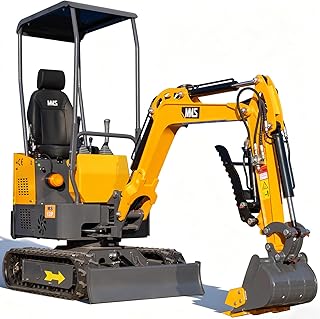
MMS 1.7 Ton Mini Excavator
The MMS sits in a class above the others here on raw capability. At 1.7 tons with a 23-horsepower two-cylinder RATO diesel, it has enough reserve to run hydraulic thumbs and a full-size bucket simultaneously without the engine bogging. Pilot controls make it significantly easier on the operator during eight-hour trenching days, and the side swing boom lets you dig flush against a wall without repositioning the chassis.
- Pilot controls reduce operator fatigue during long cycles
- US stock means parts arrive in days, not weeks
- Price and weight limit narrow-gate residential access
Skip this if your access gate is under three feet or if your jobs are mostly light landscaping without structural digging.
MS12P 1.2 Ton Mini Excavator
The MS12P hits a sweet spot for landscapers who want a side swing boom without climbing into the MMS price bracket. The Briggs and Stratton 13.5-horsepower engine is a known quantity — any small-engine mechanic can service it, eliminating dealer dependency. Unloading is included with delivery, removing one of the most annoying logistics problems with sub-ton machines. The hydraulic thumb comes standard.
- Widely serviceable Briggs and Stratton engine
- Unloading included with delivery
- Lighter weight reduces stability in deep or rocky trenching
Skip this if you need to dig below three feet regularly or work rocky soil where the lighter undercarriage will chatter.
1.2 Ton Rubber Tracked Mini Excavator
At $4,599 this is the cheapest path into a functioning compact excavator with a hydraulic thumb and EPA certification. The 400mm and 200mm toothed buckets cover trenching and fine cleanup without extra purchases. Rubber tracks protect finished surfaces, which matters when you are working residential yards with sod or pavers already installed.
- Lowest entry price with functional hydraulic thumb
- Two toothed buckets included for different trench widths
- Hydraulic system tuned for included buckets and will feel starved under heavier loads
Skip this if you plan to run a breaker or auger regularly; the pump is adequate for the stock buckets but not much beyond them.
2650lb Mini Excavator
The 2650lb ships ninety percent pre-assembled in a wooden crate, which is a genuine advantage for contractors without a flatbed or forklift at the shop. You are bolting on the bucket and connecting two hydraulic lines rather than assembling from loose parts. Quick-connect attachments mean tool swaps between jobs take under a minute.
- Pre-assembled shipping eliminates most setup hassle
- Quick-connect attachments speed mid-day tool rotation
- Engine struggles under sustained continuous load beyond five hours
Skip this if your workflow involves all-day digging without breaks; it is built for intermittent work rather than marathon cycles.
MS10H 1 Ton Mini Excavator
The lightest machine on this list, the MS10H fits through gates and into backyards where a 1.2-ton unit would require removing fence panels. Delivery and unloading are included, which is unusual at this price and removes a real logistical headache. The 13.5-horsepower EAP gas engine is adequate for the bucket size, and the hydraulic thumb clamp is standard.
- Smallest footprint for tight residential access
- Delivery and unloading service included
- One ton of operating weight limits breakout force in dense soil
Skip this if your soil conditions are tough or if you need to lift and place heavy boulders rather than dig trenches.
1.4 Ton Mini Excavator with Quick Coupler
The quick coupler is the headline feature here, and for a contractor who rotates between trenching, drilling, and breaking on the same day, it eliminates the time tax of bolt-on attachments. The Briggs and Stratton 13.5-horsepower engine and side swing boom give it a spec profile close to the MS12P, but the added counterweight improves rear stability during swing. The warning light is a small but appreciated safety touch for jobsites with pedestrian traffic.
- Quick coupler system saves minutes per tool swap
- Counterweight improves lateral stability during side swing
- Price premium is hard to justify if your attachment rotation is limited
Skip this if you only run one or two bucket sizes; you are paying for versatility you will not use.
1.4 Ton Mini Excavator with Kubota Diesel Engine
The Kubota diesel is the reason this machine costs what it does. If you are running season after season in wet, dirty conditions, a diesel will outlast a gasoline unit by a wide margin and requires fewer tune-ups. The side swing boom, quick coupler, and hydraulic thumb clamp round out a well-equipped package designed around longevity.
- Kubota diesel tolerates continuous duty and dirty environments
- Full attachment package with quick coupler and thumb
- Resale value beyond five years is uncertain versus used name-brand units
Skip this if you only dig a few weeks per year; the diesel premium only pays off with sustained seasonal use.
Buying Guide
Hydraulic Flow and Bucket Matching
The most common mistake small contractors make is buying a machine based on operating weight and assuming the hydraulics will handle whatever bucket they find. Compact excavators under two tons typically run a single fixed-displacement pump. If you size your bucket above what that pump can drive at full swing speed, you lose cycle time and waste fuel. Match bucket width to the manufacturer’s recommended flow range, and treat oversized buckets as a trade-off rather than a free upgrade.
Side Swing Boom Geometry
A side swing boom lets the upper structure offset laterally while the chassis stays planted against an obstacle. In practice this means you dig alongside a wall, fence, or foundation without moving the tracks repeatedly. The trade-off is that the offset geometry shifts the center of gravity to one side. If you work slopes or soft ground, a machine with a counterweight will feel more stable during full swing than one without.
Engine Type and Ownership Duration
Gasoline engines in this price range are simpler and cheaper to maintain but have a shorter service life under heavy duty cycles. Diesel units — particularly the RATO two-cylinder and the Kubota here — carry more low-RPM torque and tolerate continuous operation. If you expect to keep the machine past five years or run it more than a hundred hours per season, the diesel premium pays for itself in reduced downtime. If you are a landscaper running forty hours per year, gasoline is the rational choice.
Our Verdict
Top pick: The MMS 1.7 Ton wins on capability, pilot controls, and domestic parts availability. If your budget stretches to $8,699 and your jobs are genuinely construction-level, nothing else here matches it.
Budget pick: The 1.2 Ton Rubber Tracked at $4,599 gives you a functional hydraulic thumb, two buckets, and EPA compliance for the lowest total entry cost.
Diesel wins: If you exceed one hundred hours per season, the Kubota diesel at $8,566 will outlast every gasoline unit here and save money in maintenance over its lifespan.
FAQ
How much room does a compact excavator need to operate?
Plan for the machine’s tail swing diameter plus eighteen inches of clearance on each side. On a 1.2-ton unit that typically means about five feet of working space for a standard tail swing, less with a zero-tail model. Measure your access gate before purchasing, not after.
Is a hydraulic thumb worth it on a small excavator?
Almost unconditionally. Without a thumb you cannot pick and place rocks, debris, or pipe without repositioning the machine constantly. Every machine on this list includes one, which confirms the market has settled on this as a baseline expectation rather than an option.
Gasoline or diesel for a small contractor?
Diesel costs more upfront and pays back only if you exceed roughly a hundred hours per year or plan to keep the machine beyond five years. For intermittent landscaping and light trenching, gasoline remains the practical answer.
Can I tow a compact excavator with a pickup truck?
Machines under 1.4 tons on a single-axle trailer are within the towing capacity of most half-ton and three-quarter-ton trucks with the correct hitch rating. The 1.7-ton MMS pushes into heavier territory and may require a properly rated three-quarter-ton truck and trailer combination.