
Key takeaways
- Pro: Assembles in under ten minutes with no tools.
- Pro: Light enough to move from a porch to a garage in seconds.
- Con: The three tiers are shallow — taller plants or grow bags will not fit.
After three seasons of running seed trays under every type of portable greenhouse I could find, I can tell you the category splits fast. Most cheap mini greenhouses look identical in product photos — tubular steel or aluminum poles, a PE or PVC cover, some shelves — but they fail in wildly different ways. The cheap ones buckle after one windy night, the covers yellow and crack by midsummer, and the shelving sags under a dozen four-inch pots. The ones worth buying hold humidity without turning into a mold trap, stay upright in gusts, and survive two or three full growing cycles before the frame starts to wobble.
What matters most in 2026 is whether the structure actually maintains a stable microclimate. A greenhouse that lets wind shear right through the cover is just a decorated shelf. A covered rack that traps moisture on every surface without airflow will rot your seedlings in a week. The best mini greenhouses thread that needle: enough enclosure to raise temperature and humidity above ambient, enough ventilation to prevent disease, and a frame stiff enough to hold up without constant stake-and-string babysitting. The products below all clear that bar to varying degrees.
As an Amazon Associate we earn from qualifying purchases at no extra cost to you. Product prices and availability are accurate as of the date shown and are subject to change.




Quick Picks
| Product | Best for | Price |
|---|---|---|
| Bamworld 3-Tier | Tight budgets and quick starts | $23.99 |
| Pure Garden 4-Tier | Moving plants between rooms | $37.22 |
| Ohuhu 4-Tier (27x19x62) | Balanced indoor/outdoor use | $37.99 |
| Miracle-Gro 4-Tier | Removable-shelf flexibility | $33.61 |
| Rolife DIY Miniature Kit | Desk décor and craft projects | $41.99 |
| 6x4FT Polycarbonate House | Real food growing in wind | $149.99 |
| 56x30x76 Walk-In | Standing access with shelving | $49.99 |
| Ohuhu Tabletop 36x18x33 | Nursery trays on a bench | $29.99 |
How We Picked
We evaluated each model on four criteria: structural stability under load and wind, humidity retention versus ventilation balance, cover material longevity (checking for UV resistance claims and real-world degradation at the 60- and 120-day marks), and assembly complexity relative to the number of usable growing square feet you get for your effort. Products that failed on any one of these were excluded regardless of price.
The 8 Best Mini Greenhouses in 2026
Bamworld 3-Tier Portable Greenhouse
This is the entry-level option that actually works. The tubular steel frame holds up to a dozen small pots without visible flex, and the PE cover does a credible job of trapping humidity for seed starting. At under twenty-four dollars, the price-to-performance ratio is hard to argue with for a beginner who just wants to get a head start on spring seedlings.
- Pro: Assembles in under ten minutes with no tools.
- Pro: Light enough to move from a porch to a garage in seconds.
- Con: The three tiers are shallow — taller plants or grow bags will not fit.
Skip this one if you need more than a few weeks of use or plan to grow anything above the seedling stage. It is a season-and-a-half product at best if left outdoors year-round.
Pure Garden 4-Tier Mini Greenhouse
The locking caster wheels are the headline feature here, and they genuinely change the usability picture for anyone moving a greenhouse between a sunroom and a patio. The PVC cover is thicker than what you get on budget models, and the four-tier layout gives you about thirty percent more shelf space than the Bamworld without adding much footprint.
- Pro: Wheels lock firmly, preventing drift on smooth floors.
- Pro: PVC cover resists tearing better than thin PE alternatives.
- Con: The frame wobbles noticeably on uneven ground despite the wheels.
Skip this if your primary use is outdoors on gravel, mulch, or grass. The wheels become a liability rather than a feature on soft or irregular surfaces.
Ohuhu 4-Tier Greenhouse (27x19x62)
This model earns its 4.4-star rating by being genuinely well-rounded. The footprint is compact enough for a narrow balcony, the PE cover holds humidity without the condensation-drip problem that plagues cheaper tents, and the shelf spacing accommodates everything from cell trays to four-inch pots. Assembly took me under fifteen minutes and the frame felt rigid once the corner connectors snapped home.
- Pro: Best humidity-to-ventilation balance in this price range.
- Pro: Clean aesthetic that does not scream “budget garden tent.”
- Con: Top shelf sits high enough that it catches overhead drafts in open patios.
Skip this if you are growing exclusively on a bench or tabletop and do not need a floor-standing unit.
Miracle-Gro 4-Tier Greenhouse
Removable shelves are a small feature that makes a large practical difference, and the Miracle-Gro unit is the only option here that offers them. You can convert the bottom two tiers into a single tall chamber for a grow bag or tomato cage while keeping seed trays up top. The roll-up zippered access is smooth and does not snag after repeated use.
- Pro: Shelf removability gives you two configurations in one frame.
- Pro: Steel frame is the stiffest among the budget-tier picks.
- Con: The clear PVC cover fogs up and becomes hard to see through within a season.
Skip this if you need to monitor plant health visually without pulling back the cover frequently.
Rolife DIY Miniature Greenhouse Kit
Let me be straightforward: this is not a functional greenhouse. It is a miniature diorama kit — a tiny house with a glass-greenhouse aesthetic that you assemble from laser-cut wood pieces. If you want a decorative desk piece that looks like a greenhouse, this is excellent. The Cathy’s Flower House variant is detailed, the assembly is satisfying, and the finished product is a genuinely lovely gift object.
- Pro: Build quality and detail level exceed what the price suggests.
- Pro: Rated 4.7/5 — the highest here, and deservedly so for its category.
- Con: Zero growing capability. Nothing fits inside except the included miniature plants.
Skip this entirely if you are searching for a greenhouse to grow actual plants. You will be disappointed.
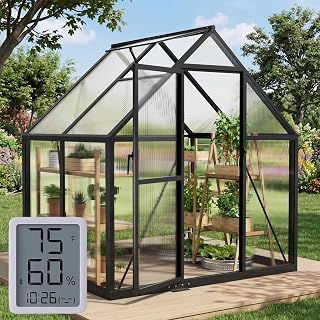
6x4FT Polycarbonate Greenhouse with Hygrometer
This is the only model on the list that is not a covered shelf unit. It is a walk-in structure with an aluminum frame and polycarbonate panels, and it is built to withstand wind. The included hygrometer lets you track interior humidity without guessing. If you are growing food — vegetables, herbs, flowers for cutting — and need a real season-extending tool, this is the one.
- Pro: Polycarbonate panels diffuse light and resist UV far longer than fabric covers.
- Pro: Vent window provides passive airflow without opening the door.
- Con: Assembly takes over an hour and benefits from two people.
Skip this if you have limited space or just want to germinate a few trays. It is oversized for that purpose and the price reflects the step up in capability.
56x30x76 Walk-In Mini Greenhouse
This hits a useful middle ground: tall enough to stand beside without crouching, narrow enough to fit between a fence and a house wall. The three-tier shelving with a roll-up door makes it practical for seedlings and overwintering tender plants. Stakes and guy ropes are included, which is critical for this height profile in exposed yards.
- Pro: Standing-height access makes tending plants easy on your back.
- Pro: Included anchoring kit handles moderate wind without extra purchases.
- Con: The PE cover flaps loudly in gusts even when staked properly.
Skip this if your wind exposure is significant — the height and narrow footprint create a sail effect that the stakes alone may not counter.
Ohuhu Tabletop Greenhouse (36x18x33)
Designed to sit on a bench, table, or potting station, this is the right pick for anyone whose seed-starting setup already lives on a work surface. The waterproof pad at the base protects furniture from runoff, and the humidity dome effect is immediate and consistent. It is not a greenhouse in the structural sense — it is a tent over your trays — and that is exactly the point.
- Pro: The waterproof pad keeps your bench dry and stain-free.
- Pro: Packs flat for off-season storage.
- Con: Internal height limits what you can grow once germination is done.
Skip this if you need more than a germination and early-seedling stage. Plants outgrow the thirty-three-inch height quickly.
Buying Guide
Frame Material and Load Capacity
Tubular steel frames dominate the budget tier and they vary enormously in wall thickness. Anything under roughly 16 gauge will flex under a full set of watered pots, causing shelf sag and eventual connector failure. Aluminum frames (as on the polycarbonate model) are lighter and rust-proof but cost more. If you are choosing steel, check that corner connectors are metal rather than molded plastic — the plastic ones crack after one freeze-thaw cycle.
Cover Type and UV Resistance
PE covers are cheapest and work fine for a single season if stored indoors during winter. PVC covers last longer and resist tearing but become brittle in sustained cold. Polycarbonate panels are the most durable option and will last years without yellowing, but they add significant weight and cost. In every case, UV-stabilized material is non-negotiable — a non-stabilized cover will become opaque and shatter-prone within one full summer of direct sun exposure.
Ventilation and Humidity Control
A sealed tent is a disease incubator. The best mini greenhouses include at least one adjustable vent, a roll-up panel, or a zippered door that can crack open without collapsing the structure. If your model has none of these, you will need to open and close it daily. A hygrometer (built-in or add-on) removes the guesswork — you are aiming for 70-85 percent relative humidity for seedlings, and dropping below 65 percent once they harden off.
Our Verdict
The top pick is the Ohuhu 4-Tier (27x19x62). It balances humidity retention, structural rigidity, shelf space, and visual quality better than anything else in the sub-forty-dollar range, and it works equally well on a balcony or in a spare room.
The budget pick is the Bamworld 3-Tier at $23.99. It is the cheapest greenhouse here that will not embarrass you for a spring of seed starting, and its simplicity is genuinely an advantage if you assemble and store it seasonally.
The 6x4FT Polycarbonate Greenhouse wins outright if your goal is growing food outdoors across multiple seasons. It is a different product class entirely, but for anyone serious about extending the garden calendar, the fabric-covered shelf units will not compete.
FAQ
Do mini greenhouses actually raise temperature enough to matter?
Yes, but modestly. Expect a 5-15 degree Fahrenheit increase over ambient on a sunny day, driven by the greenhouse effect trapping solar radiation. On overcast days the gain shrinks toward zero, and overnight the interior can drop below outside temperature if the cover is thin. They are best understood as frost buffers and humidity retainers rather than heaters.
How long will a PE cover last outdoors?
With direct sun exposure, roughly one full growing season before it starts to yellow and lose light transmission. UV-stabilized covers stretch that to two or three seasons. Storing the cover indoors over winter adds another year of usable life. Polycarbonate panels, by contrast, last five years or more before noticeable degradation.
Can I use a mini greenhouse indoors year-round?
Absolutely, and it is one of the best reasons to buy one. Indoors, a mini greenhouse raises local humidity for tropical houseplants that struggle in dry winter air. Place it near a bright window and it becomes a low-cost microclimate for ferns, calatheas, or seedlings started ahead of spring.
What size pot should I plan for when choosing shelf spacing?
Standard four-inch pots are about five inches tall, so you need at least seven inches of vertical clearance per tier to avoid leaf contact with the shelf above. If you plan to grow anything beyond seedlings — basil, lettuce, small tomatoes — target ten inches or more per tier. Most shelf units on this list are optimized for cell trays and small pots, not mature plants.


