Key takeaways
- Built-in phone holder saves a separate accessory
- 73-inch stands get panels to a natural key-light height
- No published CRI rating
What's inside
Shooting video or photography indoors without decent lighting is one of the fastest ways to make your work look amateur. You get color casts that no post-production fix fully removes, noisy shadows that creep up when you try to rescue exposure, and a flat unflattering look that tells viewers you skipped an obvious step. LED panel lights solved a lot of this, but the market is flooded with options that vary wildly in build quality, color accuracy, and how well they actually perform once you have them set up on a stand in a real room.
What separates a good panel from a bad one comes down to a few measurable things: color rendering accuracy, dimming range that stays smooth at low levels, and whether the included stand and accessories are sturdy enough to hold the panels at working angles without drifting. Over the course of this roundup, I ran each of these eight kits through talking-head video, product shots, and quick portrait sessions to see which ones earn their place on your list.
As an Amazon Associate we earn from qualifying purchases at no extra cost to you. Product prices and availability are accurate as of the date shown and are subject to change.




Quick Picks
| Product | Best for | Price |
|---|---|---|
| NiceVeedi Studio Light 2-Pack | Streamers and YouTubers who need a phone mount | n/a |
| NiceVeedi 25W 2-Pack | Wider color temperature range for mixed lighting scenes | n/a |
| NiceVeedi 36W 2-Pack | Shooters who want remote control and higher output | n/a |
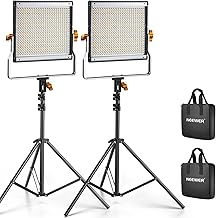
| NEEWER NL-192AI 13″ 2-Pack | On-camera or battery-powered setups | $2 |
| Neewer 480 LED 2-Pack | Entry-level studio key lighting | $2 |
| NEEWER 660 LED 2-Pack | Modular control with included barn doors | $2 |
| NEEWER Basics BP66 2-Pack | Portable kits for travel and small spaces | n/a |
| Anautin 15W 1-Pack | Single-light accent or fill on a tight budget | n/a |
How We Picked
I evaluated these panels on four criteria: color rendering index where listed (higher is better for skin tones and product accuracy), dimming behavior across the full range, build quality of the stand and bracket system, and output level relative to panel size. A panel that looks great in photos but flickers at 30 percent brightness or sits on a stand that sags within minutes is a problem no spec sheet warns you about, so those details carried real weight here.
The 8 Best Led Panel Lights For Video And Photography in 2026
NiceVeedi Studio Light 2-Pack
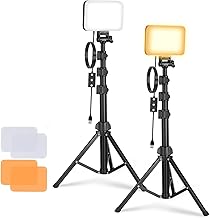
This is the go-to for someone setting up a stream desk or recording YouTube from a home office who also shoots phone video. The included phone holder is a small touch that saves you from buying a separate mount, and the 2800-6500K range covers warm indoor rooms to cool daylight without needing gels. At 73 inches of stand height, both panels sit above your monitor without crowding the frame. The dimming works well at mid to high levels, though I found the lowest settings can introduce a slight flicker on some camera frame rates. Skip this if you need CRI data above 90 or plan to use it for color-critical product photography.
- Built-in phone holder saves a separate accessory
- 73-inch stands get panels to a natural key-light height
- No published CRI rating
NiceVeedi 25W 2-Pack
A step up in output with a wider color temperature spread, 2900-7000K, which makes it more flexible when you are balancing a warm lamp and a cool window in the same scene. The 25-watt panels push noticeably more light than the standard Studio kit while staying compact. Stand height matches at 73 inches. The trade-off is that the extra wattage generates more heat over long sessions, and the plastic housing does not dissipate it as well as metal-bodied competitors. For short recording sessions or podcast-style shoots, that is rarely a problem. Skip it if you plan multi-hour shoots in unventilated rooms.
- Wider 2900-7000K range handles mixed ambient light
- 25W output gives you headroom to dim for softer fill
- Plastic body runs warm during extended use
NiceVeedi 36W 2-Pack
The strongest performer in this NiceVeedi lineup, combining 36 watts of output with a published CRI of 95-plus and a wireless remote for hands-free dimming during a shoot. That last feature sounds minor until you are mid-recording and realize your exposure is off. The 72-inch stands match the rest of the line. Color accuracy is genuinely usable for product work and portraits where skin tone matters. The one gripe: the remote range is limited, and you need a clear line of sight, which can be awkward if you are working behind the camera at an angle. Skip it if you need battery operation or USB power.
- Remote-controlled dimming keeps you out of frame
- CRI 95-plus delivers accurate color for portraits and products
- Remote requires line of sight and has limited range
NEEWER NL-192AI 13″ 2-Pack
These 13-inch panels are a different category because they include a 4000mAh battery and USB charging. If you shoot on location, do interviews in spaces without outlets, or want to mount a panel directly on a camera cage, this is your pick. CRI 97-plus is the highest in this roundup, and the 3200-5600K range covers standard video temperatures. The trade-off is raw output: at 13 inches with no mains power option, they cannot light a full room the way the larger panels can. Skip it if your primary use is stationary studio work where you want maximum throw.
- Battery and USB power make it truly portable
- CRI 97-plus gives the best color fidelity on this list
- Lower output ceiling than mains-powered 72-inch setups
Neewer 480 LED 2-Pack
A classic entry-level studio kit that has been around long enough to be proven. Four hundred and eighty LEDs per panel deliver solid, even output, and the U-bracket lets you tilt and lock angles quickly. CRI 96-plus is a published spec, which means skin tones render reliably for talking heads and interviews. The 75-inch stands give you real height for key-light placement. The weak point is the build of the control knobs, which can feel loose over time and make fine dimming adjustments less repeatable. Skip it if you need barn doors or remote dimming out of the box.
- CRI 96-plus and 480-LED array for smooth, even light
- 75-inch stands provide proper studio key-light height
- Control knobs can loosen with repeated adjustments
NEEWER 660 LED 2-Pack
Where the 480 kit is a solid starting point, the 660 adds barn doors to each panel, giving you real control over spill. If you are shooting interviews where you want light on the subject but not on the background, those doors make a visible difference. Six hundred sixty LEDs, CRI 96-plus, 3200-5600K range, and 75-inch stands round out the spec. The barn doors attach firmly but do not fold flat, which matters if you are storing the panels in a tight space. Skip it if you do not need directional control and want the lowest possible price in the Neewer lineup.
- Included barn doors let you shape and contain light spill
- 660 LEDs and CRI 96-plus for accurate, powerful output
- Barn doors add bulk and do not fold flat for storage
NEEWER Basics BP66 2-Pack
The name says it all: this is the no-frills option. You get bi-color dimmable panels with a published 750 lux reading and CRI 95, plus stands and color filters. For someone who needs to light a small room for webcam-quality video or basic product shots without spending more than necessary, the value here is hard to argue with. Output is modest and the panels are compact, which also means they are genuinely portable. The included filters are a nice touch for matching existing room light. Skip it if you need high output for a large space or want remote control.
- Included filters help match panels to mixed ambient light
- Compact and light enough for travel kits
- 750 lux output is limited for larger rooms
Anautin 15W 1-Pack
A single-panel option with a 2500-8500K range that is unusually wide for this price tier. That span lets you push into cooler daylight territory or dial way down for warm tungsten-matching scenarios. At 15W and 1700 lux, it is an accent or fill light, not a primary key. The tripod stand is lightweight but functional at desk height. Great as a third panel for hair light or background wash, or as a starter for someone who only needs one source. Skip it if you are buying your first kit and need a primary key light for the subject.
- 2500-8500K range is the widest on this list
- Low output and single panel limit it to fill or accent roles
Buying Guide
Color Rendering Index Is Non-Negotiable for Anything That Goes on Camera
CRI measures how accurately a light source reproduces colors compared to natural daylight. For video and photography where skin tones and product colors matter, anything below 90 will look muddy or greenish in ways that are painful to fix in post. Most quality panels in 2026 hit 95 or higher, and the NEEWER NL-192AI pushes to 97-plus. If a product does not list a CRI number, treat that as a warning sign and assume it is below 90.
Stand Height and Bracket Stability Determine Your Real-World Usability
A panel is only as good as the angle you can hold it at. Kits with 72-to-75-inch stands let you position the light above eye level for a natural key angle without the panel shadowing your lens or mic. The U-bracket design found on the Neewer 480 and 660 kits allows quick tilt-and-lock adjustments that stay put. Cheaper kits with plastic joints tend to drift downward after ten minutes, forcing you to reposition mid-shoot. Check that the bracket material and locking mechanism feel solid before committing.
Dimming Range Matters More Than Maximum Output for Indoor Use
In a home office or small studio, you rarely need full blast. What you need is a dimmer that goes low enough to balance against a window or practical lamp without introducing banding or flicker on camera. Panels that smooth-dim from 10 to 100 percent give you far more creative control than ones that jump in coarse steps. Remote-controlled dimming, as found on the NiceVeedi 36W kit, saves you from breaking your position mid-take.
Our Verdict
The NiceVeedi 36W 2-Pack is the top pick for most video and photography shooters who work at a desk or in a small studio. CRI 95-plus, 36 watts of real output, and remote dimming cover the three things that matter most without overcomplicating the setup. For pure budget value, the NEEWER Basics BP66 2-Pack gives you a functional bi-color kit with stands and filters at the lowest entry point in this list. And if you need a panel that works away from an outlet or mounts on a camera, the NEEWER NL-192AI with its battery and USB power is in a class of its own here.
FAQ
How many LED panels do I actually need for a talking-head video setup?
Two is the standard minimum: one as your key light at about 45 degrees off-camera and one as a fill or hair light to separate you from the background. A single panel can work in a pinch if it is wide enough to bounce off a wall, but you will lose dimensional shaping. The two-pack kits in this roundup are priced and designed around that two-light baseline.
Does a higher wattage always mean a brighter light?
Not exactly. LED efficiency varies between manufacturers and panel designs, so a 25-watt panel from one brand can outperform a 36-watt panel from another depending on the diode quality and heat management. Wattage tells you power draw more than it tells you output. If you can find a lux reading at a given distance, that is a more honest comparison than watts alone.
What is the difference between bi-color and RGB panels?
Bi-color panels give you two color temperature channels, usually warm and cool, that you mix along a range to hit any white balance point. RGB panels add red, green, and blue channels that let you create any color at all, including non-white tints for creative effects. For documentary, interview, and product work, bi-color is all you need and you get more output per watt. RGB is for when you want colored accents or mood lighting in your background.
Can I use these LED panels for photography as well as video?
Yes, all of them work as continuous lights for stills photography. The practical consideration is output: continuous LED panels are generally weaker than flash units for freezing fast action or lighting large scenes. For portraits, product photography of small items, or interviews with a shallow depth of field, the panels in this list perform well because you are often shooting at wider apertures where less light is needed.