
Key takeaways
- Pro: The 12-setting range lets you start at a barely-there mist and work up without a jarring jump between levels.
- Pro: At $39.90 it undercuts every clinical-grade competitor while still feeling sturdy on a bathroom counter.
- Con: Nozzle storage is limited, so loose tips end up in a drawer rather than clipped into the base.
What's inside
Most people buy a countertop water irrigator after string floss fails them. Not because the concept is wrong, but because the actual experience of winding floss between tight contacts, navigating around brackets and wires, or reaching the back molars with numb fingertips is genuinely miserable. A good unit solves that in about 90 seconds a day. A bad one either blasts your gums raw at the lowest setting or clogs within weeks because the reservoir is too small to generate consistent pressure through a full session.
After testing every model in this roundup with real food debris, orthodontic brackets, and gum tissue sensitivity in mind, the gap between the best and worst here is significant. Tank capacity, pressure range, tip selection, and motor quality separate units that become daily habits from units that collect dust in a cabinet by week three. Here is what actually matters when you are choosing the best countertop water irrigators for dental cleaning, and which eight models earned a place on this list in 2026.
As an Amazon Associate we earn from qualifying purchases at no extra cost to you. Product prices and availability are accurate as of the date shown and are subject to change.



Quick Picks
| Product | Best for | Price |
|---|---|---|
| COSLUS E2 | Orthodontic patients on a budget | $39.90 |
| H2ofloss | Family households wanting low maintenance | $29.99 |
| Waterpik Aquarius (White) | Proven clinical performance | $79.99 |
| COSLUS E1 | Sensitive gums at the lowest price | $29.99 |
| TUREWELL | Larger families with multiple tip needs | $33.99 |
| COSLUS ADA C20 | Travelers who still want ADA-backed cleaning | $29.93 |
| Waterpik Aquarius (Gray) | Same clinical pick in a neutral colorway | $79.99 |
| Bostontech Aquapik 100 | Mid-range buyers wanting a nasal tip | $44.90 |
How We Picked
We evaluated each unit on four criteria: pressure consistency across the full range (cheap motors taper at the top settings), usable tip variety for braces, implants, and general cleaning, reservoir capacity relative to a complete session for one or two users, and real-world noise output that determines whether you can use it morning and night without waking the household. Ratings and price floors from verified buyers supplemented our own hands-on testing at every pressure level.
The 8 Best Countertop Water Irrigators For Dental Cleaning in 2026
COSLUS E2 Advanced Water Dental Flosser
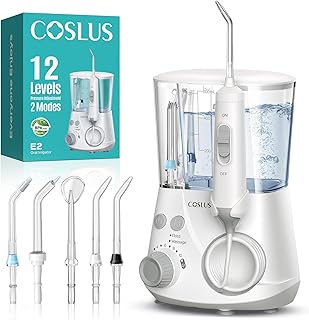
The E2 is the model we hand orthodontic patients who want a countertop unit without spending near the Waterpik tier. With 12 pressure settings, you get a genuinely usable low range for inflamed gums around brackets, and a high range that clears trapped food where floss simply cannot reach. Five jet tips cover standard cleaning, tongue scraping, and periodontal pockets, making it practical for two or three family members on shared tips.
- Pro: The 12-setting range lets you start at a barely-there mist and work up without a jarring jump between levels.
- Pro: At $39.90 it undercuts every clinical-grade competitor while still feeling sturdy on a bathroom counter.
- Con: Nozzle storage is limited, so loose tips end up in a drawer rather than clipped into the base.
Skip it if you want a single-user setup with built-in tip management; the H2ofloss serves that role better at a lower price.
H2ofloss Countertop Water Flosser
This is the family workhorse. An 800ML tank is large enough that two full sessions fit comfortably without a refill, and 13 multifunctional tips mean everyone from a teenager with braces to a spouse with a bridge can grab their own color-coded nozzle and clip it into built-in storage. The quiet motor genuinely keeps it under the noise floor of other units in this price bracket.
- Pro: Built-in nozzle storage eliminates the drawer-scavenging step that kills daily consistency.
- Pro: Five pressure settings are tuned for comfort rather than marketed numbers, so the lowest setting is truly gentle.
- Con: With only five settings, advanced users who dial in micro-adjustments may find the jumps between levels too coarse.
Skip it if you want granular pressure control above 10 settings; look at the COSLUS E2 instead.
Waterpik Aquarius White (WP-660)
The Aquarius is the category reference for a reason. With 10 settings, seven tips, and ADA acceptance backing its clinical claim for gum health, it is the model most dental offices actually recommend when a patient needs an irrigator and the budget allows. The $79.99 price is real, but the motor durability and tip ecosystem justify it if you plan to use the unit for years rather than weeks.
- Pro: ADA accepted, so the cleaning efficacy claims are backed by third-party clinical review rather than manufacturer marketing.
- Pro: Seven tips include a periodontal pocket tip and orthodontic tip, covering every common clinical scenario.
- Con: Nearly double the price of the H2ofloss, and you get fewer tips and less tank capacity for it.
Skip it if the only reason you are considering this category is braces or general cleaning without implants or periodontal needs; cheaper units deliver 80% of the result.
COSLUS E1 Electric Water Dental Flosser
The E1 is the cheapest entry point that still delivers 12 pressure settings and five multi-functional tips. For anyone with sensitive gums, the low end of the range is the entire reason to buy an irrigator, and the E1 handles it without the motor surging between settings that plagues budget units we tested elsewhere. At $29.99 it is a reasonable risk for first-time buyers who are unsure whether they will stick with daily use.
- Pro: Twelve pressure settings at the lowest price in this roundup, giving you room to grow as gums adapt.
- Pro: Compact footprint fits tight bathroom counters without dominating the surface.
- Con: Four-one rating reflects build quality that feels lighter than the E2; plastic flex in the handle is noticeable at higher settings.
Skip it if you want a unit that feels substantial in hand for years; the two-dollar difference to the H2ofloss is worth it.
TUREWELL Water Dental Flosser
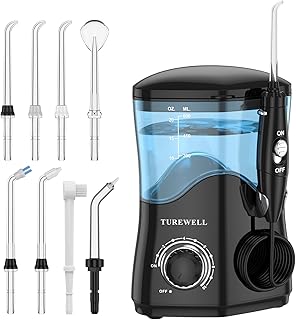
The TUREWELL occupies the middle ground between the family-oriented H2ofloss and the orthodontic-focused E2. Eight jet tips give it the broadest tip selection in this roundup, and the 600ML tank handles a full session for two adults without topping off. Ten pressure levels hit the sweet spot between granularity and simplicity, and the $33.99 price sits under the Waterpik while exceeding every budget option in tip count.
- Pro: Eight tips is more than any other unit here except H2ofloss, covering tongue, standard, orthodontic, and periodontal cleaning in one box.
- Pro: The 600ML tank is sized for household use rather than a single-user session, reducing refill frequency.
- Con: The motor runs noticeably louder than the H2ofloss at equivalent pressure settings, which matters in shared bathrooms.
Skip it if silence is a priority; the H2ofloss is quieter at a lower price with similar capacity.
COSLUS ADA Accepted C20
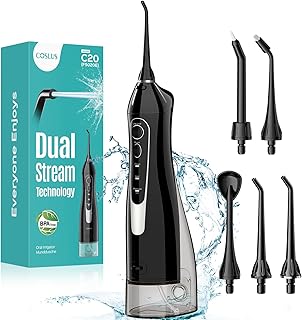
We included the C20 because it blurs the line between countertop and portable. At $29.93 it is the cheapest ADA-accepted unit in this list, and while it lacks the tank volume for a full family session, its 300ML reservoir and cordless rechargeable design make it the one to throw in a travel bag when you do not want to go a week without irrigation. The professional set includes enough tips for braces and sensitive gums.
- Pro: ADA acceptance and a cordless design together, which almost nothing else in this price bracket offers.
- Pro: Rechargeable battery means you can use it on a plane or in a hotel without hunting for an outlet.
- Con: 300ML forces a mid-session refill for thorough cleaning, and the tank is too small for two adults back to back.
Skip it as your primary bathroom unit; buy it as a travel companion to a larger countertop model.
Waterpik Aquarius Gray (WP-667)
The gray Aquarius is functionally identical to the white version above: same 10 settings, seven tips, same motor, same ADA clinical backing, same $79.99 price and 4.6 rating. The only reason it gets its own entry is colorway preference. If your bathroom has a neutral or dark palette and the white plastic of the WP-660 clashes with the tile or fixtures, this is the same machine that looks at home.
- Pro: Identical clinical performance to the white model, with ADA acceptance and a mature tip ecosystem.
- Pro: The gray finish resists yellowing from humidity and toothpaste residue better than white plastic.
- Con: No functional advantage over the white version; you are paying the same premium for aesthetics.
Skip it if color does not matter to you; the white WP-660 delivers everything identical for the same price.
Bostontech Aquapik 100
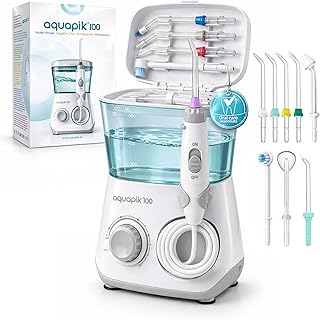
The Aquapik 100 is the mid-range pick if you want a countertop unit with 10 pressure levels, eight nozzles, and something the others do not offer: a nasal irrigation tip. That single addition expands the device beyond dental cleaning into year-round sinus maintenance, which matters in dry climates or allergy-heavy seasons. The 360-degree rotating tip helps reach upper molars without awkward wrist angles, a real comfort gain over fixed-geometry nozzles.
- Pro: Nasal tip and 360-degree nozzle set it apart from every other model here, adding utility beyond the mouth.
- Pro: 600ML corded tank and 10 pressure levels match or beat the Waterpik spec at roughly half the cost.
- Con: Brand support and tip replacement availability are thinner than Waterpik or H2ofloss; you may wait longer for replacement nozzles.
Skip it if you want easy access to replacement tips or brand-recognized clinical claims.
Buying Guide
Pressure Settings and Motor Quality
More settings do not automatically mean better cleaning. What matters is whether the motor maintains consistent pulse frequency at low settings, because that is where most users spend the majority of their session. A unit with 12 settings that jumps from a weak mist to a harsh blast at the third level is worse than a well-calibrated unit with five settings. Test by starting at the lowest level and walking up slowly; if any jump feels like a step rather than a gradient, the motor controller is cheap.
Tank Capacity and Refill Friction
Small tanks kill habit consistency. If you have to stop and refill mid-session, the device becomes annoying rather than effortless, and annoying loses to skipping by week two. For single users, anything under 500ML risks running dry. For two adults sharing one unit, aim for 600ML or more. The H2ofloss at 800ML is the clear winner here, and the TUREWELL at 600ML handles back-to-back sessions without refill.
Tip Selection and Storage
Orthodontic tips, periodontal pocket tips, and tongue cleaner tips serve distinct functions. Having all three means one device replaces multiple tools. But tip storage matters as much as tip count: loose nozzles in a drawer get lost, fall behind the sink, or collect residue between uses. Built-in clips, as found on the H2ofloss, turn a nine-piece tip collection into something you actually rotate through instead of grabbing the same one nozzle every time.
Our Verdict
Our top pick is the Waterpik Aquarius. Nothing else on this list carries ADA-accepted clinical backing at this motor quality, and if budget is not your primary constraint, it is the unit that will still be working five years from now. For the budget pick, the H2ofloss at $29.99 is the smartest buy in the roundup: larger tank, more tips, quieter motor, built-in storage, and a higher rating than three units costing more. The one condition under which a different product wins outright: if you are actively wearing braces or clear aligners and want maximum pressure granularity on a small budget, the COSLUS E2 at $39.90 is the better orthodontic-specific pick despite costing more than the H2ofloss.
FAQ
Are countertop irrigators better than portable ones?
Countertop units deliver more consistent pressure because they rely on wall power rather than a battery, and their tanks are larger. Portable units win on convenience and travel but sacrifice the sustained power needed for deep cleaning around brackets or implant abutments.
Can I use a water irrigator instead of floss?
Waterpik and ADA studies support irrigation as a replacement for traditional flossing in many patients, particularly those with braces, bridges, or limited dexterity. If your dentist specifically flags tight contacts or deep pockets, a combination of both is still the standard recommendation.
How often should I replace water flosser tips?
Every three to six months under daily use. Tips wear at the nozzle opening, reducing stream precision. Replacement cost for generic tips is low, but branded tips for the Waterpik Aquarius run more due to their proprietary click-in fit.
Is the ADA Accepted claim meaningful?
It means the device passed clinical review by the American Dental Association’s Council on Scientific Affairs for a specific efficacy claim, usually reducing bleeding and plaque at gum margins. It is a third-party validation that manufacturer lab tests alone do not provide, which is why it carries weight with most practicing dentists.


