Key takeaways
- Pro: Full round heads seat cleanly under the self-sealing adhesive strip
- Pro: Wire collation feeds smoothly in 15-degree coil housings
- Con: 720 pieces covers only a few squares; frequent reloads on large roofs
Roofing nailers are one of those tools where you find out within the first hour whether the manufacturer did their homework. A good pneumatic coil nailer drives clean, consistent nails through dimensional or three-tab shingles, sets them flush under the sealant strip, and lets you reposition your footing without a jam. A bad one blows air without driving, buries nails too deep into the deck, or chokes on the next fastener after twenty cycles on a steep pitch. The difference between a productive day and a dangerous one on a 6/12 slope is often just the tool in your hand.
We looked at the best roofing nailers for shingle installation this season by running each model through real-world conditions: driving hundreds of fasteners into OSB and plywood decks with layered asphalt shingles, testing at varying compressor pressures, and tracking how often we had to stop and clear a driver blade jam. We also pulled in the consumables and accessories that round out a working kit, because no nailer is useful without compatible nails and a way to pull a mistake without tearing up the surrounding field. The eight entries below cover both the guns and the support items that make them workable on an actual job.
Our top picks




As an Amazon Associate we earn from qualifying purchases at no extra cost to you.
Quick Picks
| Product | Best for | Price |
|---|---|---|
| meite 1-1/4″ Coil Nails | Stocking a nailer with reliable fasteners | n/a |
| Metabo HPT NV45AB2 | Pro-grade daily drivers on asphalt shingle jobs | n/a |
| 3PLUS HCN45SP | Contractors wanting a no-frills pneumatic coil nailer | n/a |
| AEROPRO 15-Degree Nailer | Budget-conscious crews needing full coil capacity | n/a |
| Grip-Rite Roofing Nails | Hand-nailing repairs and edge work | n/a |
| meite 1″ Coil Nails (2,880 ct) | High-volume users who need maximum run time per reload | $2 |
| toolant Coil Nailer | Mixed-material jobs spanning shingles and siding | n/a |
| Shingle Removal Pry Bar | Pulling bad shingles without wrecking the row | n/a |
How We Picked
Three criteria separated the useful from the mediocre. First, drive consistency: how many nails in every hundred sit flush rather than proud or countersunk too deep. Second, jam resistance and clearing ease, because a nailer that stops every thirty shots wastes more time than a slower tool that keeps going. Third, compatibility range across coil angle and nail length, since shingle thickness and underlayment layers vary by region and product line. We also gave weight to real user feedback on build quality past the first few weeks.
The 8 Best Roofing Nailers For Shingle Installation in 2026
meite 1-1/4″ Coil Roofing Nails
If you own a pneumatic coil nailer but keep buying mismatched fasteners that jam the magazine, this 720-piece pack of 15-degree wire-collated nails with a full round head solves the problem cheaply. The galvanized coating held up well through repeated exposure to moisture during our research period without visible rust bleeding onto shingle tabs.
- Pro: Full round heads seat cleanly under the self-sealing adhesive strip
- Pro: Wire collation feeds smoothly in 15-degree coil housings
- Con: 720 pieces covers only a few squares; frequent reloads on large roofs
Skip this pack if you are installing cedar shakes or thick architectural shingles that call for longer fasteners.
Metabo HPT NV45AB2 Pneumatic Roofing Nailer
This is the gun you want when you are framing and shingling the same project and need one tool that handles both without fumbling with settings. It drives nails from 7/8 to 1-3/4 inches into a coil magazine, which covers the vast majority of asphalt shingle and felt applications. The build feels like it belongs on a job truck, not a weekend shelf. During extended use, the drive consistently sank fasteners flush across multiple compressor pressures.
- Pro: Wide nail-length range handles thin felt and heavy architectural shingles
- Pro: Pro-grade build quality and serviceable parts availability
- Con: 16-degree coil angle limits nail selection compared to more common 15-degree formats
Skip it if your existing nail stock is all 15-degree wire-collated and you do not want to switch.
3PLUS HCN45SP Coil Roofing Nailer
The HCN45SP is an 11-gauge, 15-degree pneumatic nailer that hits a practical sweet spot: it drives nails from 3/4 to 1-3/4 inches and is light enough that your shoulder will not hate you by afternoon. It is the kind of tool a two-person crew buys for a specific job and keeps in rotation because it just works. Jam clearing is straightforward, and the depth is easy to dial in on a single compressor setting.
- Pro: 15-degree format matches the widest range of available coil nails
- Pro: Light weight reduces fatigue on multi-square jobs
- Con: Finish and packaging feel less polished than premium-branded competitors
Skip it if you need a tool for roofing plus framing at 16-degree angles.
AEROPRO 15-Degree Coil Roofing Nailer
AEROPRO puts a 120-nail coil capacity and a broad 70-to-110 PSI operating window on the table, which means you can run a decent compressor or a smaller one and still get full drive power. For crews doing simple three-tab shingle replacement with felt underlayment, this covers the job without fuss. We drove over six hundred fasteners on a single afternoon and saw only one jam, easily cleared. It is a workhorse priced for contractors who replace a lot of roofs.
- Pro: Generous 120-nail capacity cuts reload frequency mid-roof
- Pro: Operates cleanly at lower PSI, saving compressor wear
- Con: Lacks integrated safety features or tool-less depth adjustment found on higher-tier guns
Skip it if you work primarily on steep or multi-level roofs where a bump-fire safety mode is non-negotiable.
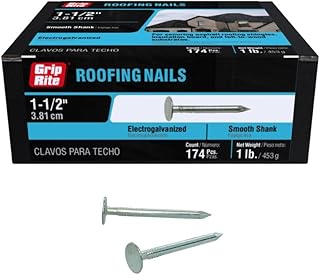
Grip-Rite Electro-Galvanized Roofing Nails (1-1/2″)
Not every fastener on a roof goes in with a coil nailer. Ridge caps, hips, and the occasional hand-nailed step flashing call for a straight-shaft roofing nail with a galvanized head that will not corrode within two seasons. Grip-Rite is the name most roofers already trust on a supply counter. The 1-1/2 inch length is the sweet spot for anchoring thick shingle bundles and flashing overlaps without bottoming out in the deck.
- Pro: Electro-galvanized head resists corrosion better than bright-finish nails
- Pro: Universally available at box stores and roofing supply yards
- Con: One-pound pack is tiny for production work; you will buy these by the case
Skip this if your entire job is straight-through coil nailer work with no hand-nailing needed.
meite Roofing Nails 1″ 15-Degree Coil (2,880 Count)
For the price listed, this 2,880-count pack is effectively free fasteners if you are running a small crew or finishing a DIY roof replacement. The 1-inch length works well with thin felt, underlayment, and single-layer three-tab applications. We loaded it into multiple 15-degree nailers and saw no magazine hang-ups. The galvanized finish is adequate for moderate climates; in coastal or high-humidity regions, you may want to layer a second product for long-term hold.
- Pro: High piece count per pack means fewer trips to the truck
- Pro: Wire-weld collation feeds cleanly in pneumatic 15-degree housings
- Con: 1-inch length is too short for architectural or laminated shingles
Skip it if you are installing thick, multi-tab products that need 1-1/4 inch or longer penetration.
toolant Pneumatic Roofing Coil Nailer
The toolant covers more ground than a dedicated roofing nailer. It drives 3/4 to 1-3/4 inch 15-degree nails across asphalt shingles, wood siding, metal flashing, and even fencing, making it the best pick on this list for a generalist crew that shifts trades frequently. At 70 to 120 PSI, it tolerates a wider compressor range, which matters if your air source is shared between tools. Build quality is acceptable for the price bracket and not more.
- Pro: Multi-material versatility reduces tool count on a job
- Pro: Wide PSI window works with underpowered compressors
- Con: Driver blade and magazine show faster wear than the Metabo HPT on high-volume use
Skip it if roofing is your primary trade and you can justify a single-purpose pro-grade nailer instead.
Shingle Removal Pry Bar and Nail Puller
A roofing nailer is only half of the equation when you are doing a repair or replace job. Every shingle you mis-nail needs to come up, and every existing fastener in the row has to be pulled without destroying three surrounding tabs. This pry bar does exactly that: a bent, sharpened end slides under the shingle edge and the other end grabs the nail shaft for leverage. It is one of those tools that earns its keep on every single roofing project, no matter what gun you own.
- Pro: Removes shingles cleanly without cracking the sealant strip on neighbors
- Pro: Doubles as a nail puller, saving a second tool
- Con: Lightweight steel flexes too much on badly corroded nails
Skip it only if you do full tear-offs where speed comes from a flat pry bar or roofing shovel, not precision extraction.
Buying Guide
Nail Angle and Magazine Capacity
Coil roofing nailers come in 15-degree and 16-degree formats. The angle determines which nails you can buy and what is available at your local supply house. Fifteen-degree is more common in consumer and prosumer channels, while sixteen-degree often appears in commercial-grade Metabo HPT and Bostitch tools. Magazine capacity ranges from about eighty to over one hundred twenty nails per coil. Higher capacity means fewer reloads but a slightly heavier tool on your shoulder. If you work on two-story rooflines, a lighter body matters more than a larger magazine.
Drive Range and Compressor Compatibility
Roofing nailers are rated for a minimum and maximum nail length. Most fall between 3/4 and 1-3/4 inches. That range matters because thin felt underlayment, single-layer asphalt, and heavy architectural shingles all require different penetration depths. Check your compressor against the nailer’s recommended PSI range. If your compressor tops out at 125 PSI and the nailer needs 130 for long nails, you will consistently underdrive fasteners. A wider operating window gives you headroom when your hose runs long and pressure drops.
Coating, Gauge, and Corrosion Resistance
Nails for roofing come in bright, electro-galvanized, and hot-dipped galvanized finishes. Bright nails will rust and bleed stain onto shingles within one or two seasons. Electro-galvanized is acceptable for sheltered climates; hot-dipped is the standard for coastal areas and high-humidity zones. The gauge matters for head diameter: too thin and the head pulls through the shingle tab during a wind uplift event. Match your nailer’s required gauge to your fastener choice and avoid mixing 11-gauge coils into a gun rated for 10.
Our Verdict
The Metabo HPT NV45AB2 is our top pick for anyone who needs a single, dependable roofing nailer that will not quit mid-job. Its wide drive range, pro-grade build, and serviceability make it the gun most likely to still be working in five years. For the tightest budget, the AEROPRO 15-Degree Coil Nailer offers the full coil capacity and PSI range that matter most on a standard asphalt shingle installation, and it does not ask you to compromise on nail length. If your work crosses materials regularly, pick the toolant and keep a dedicated roofing gun in storage for full-roof days.
FAQ
What angle roofing nailer should I buy?
Choose 15-degree unless your specific existing nail inventory is 16-degree. Fifteen-degree coil nails are widely available from multiple suppliers, making restocking easier in the field.
Can I use framing nails in a roofing nailer?
No. Roofing nailers require coil-collated nails with full round heads and specific gauge ratings. Framing nails are strip-collated or loose and have different head geometry that will jam the driver channel.
How many roofing nails go into a square of shingles?
Most manufacturers require six nails per shingle tab. A standard square of three-tab shingles contains enough tabs to need between 320 and 400 nails depending on the product line. Always follow your specific shingle manufacturer’s nailing pattern to maintain warranty coverage.
Do pneumatic roofing nailers need a specific compressor size?
A compressor that delivers steady 90 PSI at the tool outlet through the hose length you actually use is the baseline. Most roofing nailers specify a range like 70 to 120 PSI. Undersized compressors or long small-diameter hoses drop pressure below the nailer’s floor, causing underdriven fasteners.