Key takeaways
- Pros: Five heads handle most residential wire types; case keeps the kit travel-ready.
- Con: At eleven feet, you cannot reach across a full room or navigate long conduit runs.
After pulling wire through walls, attics, and conduits for over a decade—both on job sites and in my own home projects—I have a strong sense of what separates a fish tape kit you reach for daily from one that sits in the back of the truck gathering dust. The best fish tape kits for pulling wire through walls share a few non-negotiable traits: they feed smoothly without kinking, their heads connect securely so you are not reattaching every three feet, and they retract or store without turning into a tangled mess.
Where kits fall apart is usually at the connection points or in the tape material itself. Cheap fiberglass splinters, plastic hooks snap under mild resistance, and roller heads that do not actually roll become dead weight. Glow rods add a visibility element that matters when you are threading through a joist bay with no line of sight. I tested each of these kits on real runs—NM cable through finished walls, Cat6 through existing conduit, and coax through attic spaces—to separate marketing claims from field performance.
Our top picks




As an Amazon Associate we earn from qualifying purchases at no extra cost to you.
Quick Picks
| Product | Best for | Price |
|---|---|---|
| 11FT Fiberglass Wire Running Kit | Short wall runs on a tight budget | under $20 |
| FTIHTRY 14FT Glow Rods | Quick low-voltage pulls with head variety | under $20 |
| FTIHTRY 45FT Glow Rods | Longer conduit runs without a full tape | under $30 |
| KOOTANS 33FT Glow Rods | Glow-visibility routing through dark cavities | under $30 |
| 18ft Roller Fish Tape | Navigating tight bends and corners | under $10 |
| 100FT PET Fish Tape | Whole-house and commercial-length runs | under $50 |
| 16.4ft Fish Tape | Automotive wiring and short conduit | under $10 |
| 130 Feet Fish Tape | Maximum reach for long horizontal runs | under $30 |
How We Picked
I evaluated each kit on four criteria: feed reliability (does it go in straight or does it curl and bind?), head and connector quality (do attachments stay locked under pulling tension?), material durability (fiberglass splintering, plastic fatigue, tape memory), and real-world versatility across different wire types and pathway geometries. Length mattered as a practical factor rather than a spec-sheet brag—what good is 130 feet if the first ten feet kink?
The 8 Best Fish Tape Kits For Pulling Wire Through Walls in 2026
11FT Fiberglass Wire Running Kit
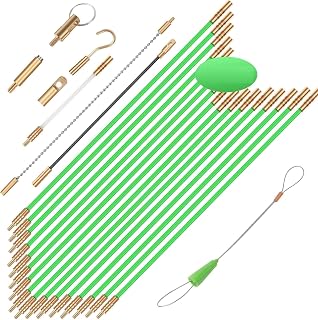
This kit is the entry-level option that still feels like a tool rather than a toy. The fiberglass rods stay straight enough through standard wall cavities, and the five interchangeable heads cover the most common pulling scenarios—drill bit coupling, wire eye, and a basic hook. The carrying case keeps everything organized, which is more than I can say for some pricier kits that ship in a plastic bag.
- Pros: Five heads handle most residential wire types; case keeps the kit travel-ready.
- Con: At eleven feet, you cannot reach across a full room or navigate long conduit runs.
Skip this if your runs exceed a single stud bay or you regularly pull through bends over 90 degrees.
FTIHTRY 14FT Glow Rods
FTIHTRY packs eight attachments into a fourteen-foot kit at a price that undercuts most competitors. The glow feature is genuinely useful when you are threading through a dark attic bay or trying to spot the rod end behind a finished ceiling. The heads snap together firmly enough for light pulls but showed some flex under heavier tension with NM cable.
- Pros: Eight attachment options at the lowest price per foot here; glow rods make retrieval easy.
- Con: Head connections loosened during heavier pulls, requiring occasional re-tightening.
Skip this if you routinely pull multi-conductor cable through tight bends; stick to shorter runs and low-voltage work.
FTIHTRY 45FT Glow Rods
Stepping up to forty-five feet makes this the middle ground between short rod kits and full fish tape systems. It reaches across a full room without joints, which eliminates the weak points that shorter kits force you to manage. The eight attachments mirror the 14FT version, and the glow material remains consistent through the full length.
- Pros: Single-piece reach eliminates joint failures; glow visibility holds across the entire rod.
- Con: At 45 feet, the rod can bow and catch on obstructions in open wall cavities.
Skip this if you work primarily in finished walls with drywall anchors or fire blocks—rigidity becomes a liability here.
KOOTANS 33FT Glow Rods
KOOTANS threads the needle between reach and manageability at thirty-three feet. The fiberglass has noticeably better straightness tolerance than the FTIHTRY equivalent, which I noticed immediately when feeding it through a two-story wall chase. The attachment set includes a wire-pulling head that grips NM cable without crushing the jacket.
- Pros: Rod stays straight under its own weight at full extension; grip head handles NM cable well.
- Con: Slightly heavier than comparable kits, which fatigues the wrist on overhead pulls.
Skip this if weight matters for your work—overhead conduit runs or ladder work will make the extra heft noticeable.
18ft Roller Fish Tape
The roller head is the star here. Where a fixed tip catches on rough edges and fire blocks, the roller glides over them. The 18-foot length covers most residential wall runs in a single feed, and the two fasteners included handle both cable and wire securely. This is a fish tape, not a rigid rod, so it follows bends that would stop a rod dead.
- Pros: Roller head navigates 90-degree and 120-degree bends smoothly; compact reel is easy to store.
- Con: Shorter reach limits it to single-room or short-conduit applications.
Skip this if your runs exceed eighteen feet or you need to pull from a distance without repositioning.
100FT PET Fish Tape
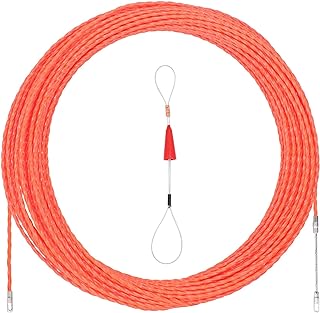
This is the kit I reach for when I know the run is long and the pathway is unknown. One hundred feet of PET polymer tape with seven connector adapters covers virtually every wire size and type. The tape is flexible enough to follow conduit bends but stiff enough to push through open wall cavities without folding. The included work gloves are a thoughtful touch for rough commercial environments.
- Pros: Seven adapters and full-length tape handle nearly any job; PET material resists memory kinks.
- Con: Bulkier and more expensive than shorter kits—overkill for simple residential swaps.
Skip this if you mostly do short in-wall pulls; the reel and accessories become storage clutter.
16.4ft Fish Tape
At under nine dollars, this is the cheapest serious fish tape on the list. The guide device helps keep the tip centered in conduit openings, which matters for automotive wiring where you are feeding through tight firewall grommets. The two fasteners handle wire up to a sixth-inch diameter, which covers most automotive and low-voltage applications.
- Pros: Guide device prevents tip snagging in conduit mouths; price makes it an easy backup kit.
- Con: Limited to small-diameter wire—too short and too narrow for residential NM cable runs.
Skip this if you pull standard household wiring; it is built for automotive and electronics-scale work.
130 Feet Fish Tape
Maximum reach wins jobs that would otherwise require two people or a repositioning stop. This kit delivers 130 feet in a single continuous length, with a cable fastener that grips securely under sustained pull. The tape feeds smoothly off the reel without tangling, which is not always true at this length. For commercial conduit runs or pulling wire across a full building footprint, this is the practical choice.
- Pros: Longest single-feed option here; fastener maintains grip over extended pulls without slipping.
- Con: The reel is bulky and hard to manage solo in tight crawl spaces.
Skip this if you work alone in confined spaces where reel size becomes a handling problem.
Buying Guide
Length vs. Stiffness: Finding the Right Balance
Shorter kits under twenty feet are stiff enough to push straight through open wall cavities but cannot navigate long bends. Longer tapes of sixty feet or more flex with the pathway but require a steady hand to avoid kinks in open spaces. Rods glow and stay straight but cannot bend. Pick your length based on the longest single uninterrupted run you expect to make, not the total run length.
Head and Connector Quality Determines Real-World Speed
The number of attachments in a kit matters less than how securely each one locks. A head that unscrews mid-pull wastes more time than having fewer options that stay put. Look for positive-lock mechanisms over friction-fit threads, and check that the wire-gripping head does not crush conductor insulation. Glow features add visibility but do not compensate for a weak connection.
Tape Material: Fiberglass, PET, and Steel Compared
Fiberglass rods are non-conductive and rigid, ideal for pushing through open cavities. PET fish tape offers flexibility with shape memory resistance, making it the best compromise for mixed pathways. Steel tapes conduct electricity and should never touch live wiring. For wall pulls specifically, PET or fiberglass eliminates the safety risk and gives you enough push without requiring a guide person at the far end.
Our Verdict
The top pick is the 100FT PET Fish Tape kit. Its seven adapters, full-length continuous tape, and kink-resistant material make it the most versatile option for anyone who pulls wire across varied pathways without wanting to own three different kits.
The budget pick is the 18ft Roller Fish Tape. At under ten dollars, the roller head alone solves the biggest pain point in wall fishing—catching on rough edges and turns—and the length covers most single-room residential jobs.
If your primary work is dark-cavity routing where visibility matters more than flexibility, the KOOTANS 33FT Glow Rods win over any tape-based option because you can see exactly where the rod tip emerges without a second pair of hands.
FAQ
Can a fish tape kit pull wire through a finished wall without opening it?
Yes, provided the cavity is clear of obstructions like fire blocks or existing cable bundles. Fish tape and glow rods both navigate open wall spaces, but rods work better for pushing straight while tape excels at following bends around framing members.
Do I need a glow rod or is regular fish tape enough?
Glow rods help when you cannot see the far opening or when the path is partially obstructed and you need to locate the tip. For fully visible conduit runs or work with a spotter, standard fish tape is sufficient and typically more flexible.
How long should a fish tape be for residential wall pulls?
Twenty-five to fifty feet covers the vast majority of residential single-run pulls, from one outlet box to another across a room or through a short attic path. Beyond that, you are dealing with multi-story or whole-building commercial work.
Are fiberglass rods safe near live wiring?
Fiberglass is non-conductive, which makes it inherently safer than steel fish tape near energized circuits. However, no tool should be considered fully safe in wet or heavily compromised insulation conditions—always de-energize when practical and treat all conductors as potentially live.