Key takeaways
- Lift-out baskets: Best for frequently used food such as vegetables, breakfast items, and ice cream. Two baskets are more useful than one in a medium or large freezer.
- Sliding baskets: These let you move the upper layer aside without removing it completely.
- Interior dividers: Useful for separating meat, prepared meals, and produce, although removable plastic or wire bins can provide similar results.
- Interior light: Particularly valuable in a dim garage and less expensive than repeatedly leaving the lid open while searching.
- External temperature display: Convenient, but not a substitute for an independent freezer thermometer.
- Power-on indicator: A small feature that can reveal an unplugged unit before food starts thawing.
- Lock: Helpful for households with children or for shared garages, but it does not replace safe food storage practices.
The best chest freezers for garages are garage-ready models with a published operating range, enough usable space for your shopping habits, and a simple storage system—rather than the largest freezer that fits through the door.
Our top picks
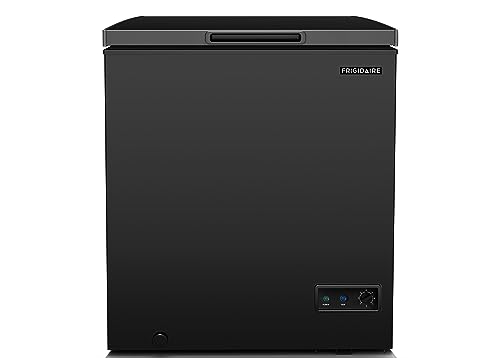 FRIGIDAIRE EFRF5003-BLACK Chest Deep Freezer-Garage-Ready
- Large Storage Capacity - Effortlessly store frozen food…
- Adjustable Thermostat - Set the temperature with ease…
- Effortless Organization - Equipped with a removable vinyl-coated…
 Igloo 3.5 Cu Ft. Upright Deep Freezer
- Spacious Capacity: Our white deep freezer offers 3.5…
- Quick Freezing System: This chest freezer uses a…
- Precise Temperature Control: This upright deep freezer has…
 7.0 Cu Ft Chest Freezer
- Energy Efficient Design - This 7.0 Cu Ft…
- Quiet Operation - Designed with quiet technology, this…
- Adjustable Temperature Control - Equipped with a 6-setting…
| Product | Key specs | |
|---|---|---|
| FRIGIDAIRE EFRF5003-BLACK Chest Deep Freezer-Garage-Ready | Large Storage Capacity - Effortlessly store frozen food… Adjustable Thermostat - Set the temperature with ease… Effortless Organization - Equipped with a removable vinyl-coated… | Check price |
| Igloo 3.5 Cu Ft. Upright Deep Freezer | Spacious Capacity: Our white deep freezer offers 3.5… Quick Freezing System: This chest freezer uses a… Precise Temperature Control: This upright deep freezer has… | Check price |
| 7.0 Cu Ft Chest Freezer | Energy Efficient Design - This 7.0 Cu Ft… Quiet Operation - Designed with quiet technology, this… Adjustable Temperature Control - Equipped with a 6-setting… | Check price |
 14 cu ft Chest Freezer 14 cu ft Chest Freezer | Large Storage Capacity - Effortlessly store frozen food… Adjustable Thermostat - Set the temperature with ease… Effortless Organization - Equipped with a removable vinyl-coated… | Check price |
As an Amazon Associate we earn from qualifying purchases at no extra cost to you.
Quick picks by household situation
| Best for | Recommended type or model family | Typical usable capacity | Why it fits | Approximate price range |
|---|---|---|---|---|
| Small household or limited garage space | 5–7 cu. ft. garage-ready chest freezer, such as the Midea MRC050S0AWW or GE FCM7 series | About 4.5–6.3 cu. ft. | Lower purchase cost, easier defrosting, and enough room for several weeks of frozen food | $200–$350 |
| Most families | 10–11 cu. ft. garage-ready model, such as the GE FCM11 series | About 9–10 cu. ft. | A practical balance of bulk storage, energy use, and manageable footprint | $350–$550 |
| Bulk shoppers or large families | 14–16 cu. ft. model, such as the GE FCM16 series or comparable Frigidaire chest freezer | About 13–15 cu. ft. | Stores large quantities, but needs more floor space and disciplined organization | $550–$800 |
| Frequent access and better organization | Chest freezer with two or more lift-out baskets, dividers, or sliding compartments | Varies by cabinet size | Less digging through frozen food and fewer forgotten packages | Usually $300–$700 |
What matters most in a garage chest freezer
Garage operating temperature
A garage can be much hotter or colder than the kitchen. In summer, an unconditioned garage may exceed 100°F; in winter, temperatures in some regions can approach or fall below freezing. A freezer designed for indoor rooms may not regulate correctly in those conditions.
Look for a manufacturer-published garage-ready operating range. Many suitable models are rated for roughly 0°F to 110°F, but the exact range differs by model. Do not assume that a product described as “garage friendly” has the same cold-weather rating as another model. Check the installation guide, not just the retailer headline.
Temperature range does not mean the freezer can be placed anywhere. Keep it away from direct sunlight, furnaces, water heaters, and large gaps beneath garage doors. Leave the manufacturer’s specified clearance around the cabinet so heat can escape from the compressor area.
Usable capacity, not just advertised capacity
Chest-freezer capacity is measured in cubic feet, but baskets and food packaging reduce the space you can use efficiently. A 7-cubic-foot freezer may hold roughly 6 cubic feet of practical storage once the basket and air space are accounted for. A 15-cubic-foot unit may provide about 13–14 cubic feet of convenient loading space.
As a rough planning guide, allow approximately 1.5 to 2.5 cubic feet per person for ordinary household use. Add more if you freeze garden produce, buy meat in bulk, or want to store prepared meals. A freezer that is too full becomes difficult to organize; one that is nearly empty for long periods can waste floor space and energy.
Energy use and operating cost
Chest freezers are generally efficient because cold air stays inside when the lid opens, but annual energy use varies with size, insulation, ambient temperature, and how often the lid is opened. Comparable models commonly fall in the broad range of about 200–450 kWh per year.
To estimate your annual electricity cost, multiply the Energy Guide annual kWh figure by your electricity rate. For example, a freezer rated at 270 kWh per year costs approximately $40.50 annually at $0.15 per kWh:
270 kWh × $0.15 = $40.50 per year
Your actual cost can be higher in a hot garage, especially if the freezer is exposed to sunlight or lacks ventilation. Compare the yellow EnergyGuide label rather than assuming that a smaller cabinet always has the lowest lifetime cost.
Head-to-head: small, medium, and large chest freezers
| Category | Typical exterior footprint | Typical weight | Storage strengths | Trade-offs |
|---|---|---|---|---|
| 5–7 cu. ft. | About 25–38 in. wide and 20–27 in. deep | About 70–110 lb | Frozen meals, ice, small meat purchases, seasonal food | Limited room for large boxes; usually one basket |
| 10–11 cu. ft. | About 40–50 in. wide and 25–30 in. deep | About 115–160 lb | Family-sized storage with room for separate food categories | Heavier to move and harder to reach the bottom |
| 14–16 cu. ft. | About 50–65 in. wide and 28–33 in. deep | About 150–220 lb | Bulk meat, garden harvests, large prepared-food inventories | Requires substantial clearance and careful inventory control |
The GE FCM7SKWW is representative of the compact category, while GE’s FCM11 and FCM16 families illustrate the medium and large ranges. Frigidaire also sells chest freezers in compact and large capacities, including models with garage-oriented installation guidance. Midea’s small MRC050S0AWW is a useful example of the budget-size category. Confirm current dimensions, energy figures, and temperature ratings before buying because manufacturers can revise model specifications.
Organization features worth paying for
- Lift-out baskets: Best for frequently used food such as vegetables, breakfast items, and ice cream. Two baskets are more useful than one in a medium or large freezer.
- Sliding baskets: These let you move the upper layer aside without removing it completely.
- Interior dividers: Useful for separating meat, prepared meals, and produce, although removable plastic or wire bins can provide similar results.
- Interior light: Particularly valuable in a dim garage and less expensive than repeatedly leaving the lid open while searching.
- External temperature display: Convenient, but not a substitute for an independent freezer thermometer.
- Power-on indicator: A small feature that can reveal an unplugged unit before food starts thawing.
- Lock: Helpful for households with children or for shared garages, but it does not replace safe food storage practices.
For a large chest freezer, organization is often more important than an extra cubic foot. Use labeled bins by category and maintain a simple inventory on the lid or nearby wall. Date packages and place newer food behind older food. This prevents the common failure mode in which food remains frozen but becomes unusable because nobody can identify it.
Installation steps that protect performance
- Measure the route first. Record door widths, stair turns, and the final installation area. Add room to open the lid fully; a freezer can fit in a corner yet remain impractical to use.
- Set it on a solid, level surface. An uneven floor can make the lid seal poorly and may cause baskets or the drain arrangement to sit incorrectly.
- Provide ventilation clearance. Follow the manual’s side, rear, and top clearances. Do not push the cabinet tightly against a wall or stack objects beside the compressor.
- Allow settling time after transport. If the unit was carried on its side, follow the manufacturer’s waiting instructions before plugging it in so compressor oil can settle.
- Cool it before loading. Set the freezer to the recommended setting and use a separate appliance thermometer. The target for frozen food is 0°F or below.
- Add a power-failure alarm if needed. A temperature alarm is more useful than a simple outlet indicator because it warns when the interior is warming.
Ownership realities: cleaning, defrosting, and wear
Most chest freezers require manual defrosting. Frost buildup acts as insulation in the wrong place, reduces usable capacity, and can prevent the lid from sealing. Defrost when frost is roughly one-quarter inch thick, or according to the manual. Move food to insulated coolers, unplug the unit, and use the drain provided. Never chip ice with a knife or use a torch; puncturing the liner can permanently damage the freezer.
The lid gasket is one of the first parts to inspect when performance declines. Wipe it clean, check for splits, and make sure packages are not preventing a full seal. Hinges, baskets, and plastic handles can also suffer from repeated overloading. The compressor and start components are less accessible, so keeping the condenser area clean and avoiding extreme heat is the most practical preventive care.
Do not use an extension cord unless the manufacturer explicitly permits it. A dedicated grounded outlet is safer, and a surge protector should only be used when it is approved for refrigeration equipment. Avoid plugging a garage freezer into an outlet that frequently trips or shares a circuit with power tools.
Final buying advice
Choose a 5–7-cubic-foot garage-ready chest freezer when space and price matter most. Choose a 10–11-cubic-foot model for the best all-purpose family balance. Move to 14–16 cubic feet only when your bulk purchases justify the larger footprint and the extra organization work. In every size, prioritize a documented garage temperature range, a clear EnergyGuide figure, a drain for defrosting, and at least one removable basket over cosmetic extras.
Frequently asked questions
Can any chest freezer go in a garage?
No. Confirm that the specific model is rated for the temperature extremes in your garage. A freezer may work in a warm room but struggle in an unheated garage during winter.
Is a chest freezer cheaper to run than an upright freezer?
Often, yes, because a chest freezer loses less cold air when opened. The difference depends on size, insulation, energy rating, ambient temperature, and how frequently the door or lid is opened.
How full should a chest freezer be?
Keep it reasonably full but leave enough space for air circulation and safe loading. Overpacking can block the lid seal and make food difficult to retrieve; a few containers of frozen water can help stabilize a lightly loaded freezer.