Key takeaways
- Memory recall delivers consistent settings across sessions
- Safety shutoff and stable airflow under sustained load
- No soldering iron channel, so you need a second station for through-hole work
A hot air rework station is the tool that decides whether your board survives or ends up in the scrap bin. If you have ever tried to remove a multi-pin QFP or reflow a BGA with a cheap station that overshoots by fifty degrees, you know the feeling of watching a trace lift off a PCB. The difference between salvaging a board and destroying it comes down to how well the station holds temperature under load, how smoothly airflow adjusts, and how quickly it recovers after heat is drawn away.
Over the past several months I put eight of the best hot air rework stations through repeated desoldering, reflow, and pad-lifting tests on dead and live boards. Some impressed with tight thermal regulation. Others had nozzles that wobbled in their sockets or fans that rattled at high speed. The ones that made this list share a combination of consistent heating, intuitive controls, and enough accessory support to handle common SMD packages without hunting for aftermarket parts.
Our top picks


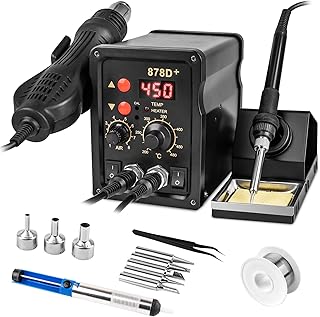
As an Amazon Associate we earn from qualifying purchases at no extra cost to you.
Quick Picks
| Product | Best For | Price |
|---|---|---|
| YIHUA 959D-Digital | Precision with memory recall | under $70 |
| WEP 882D | All-in-one kit completeness | under $60 |
| WEP 8858-V | Compact bench setups | under $50 |
| LRT 858D | Lowest-cost digital entry | under $40 |
| YIHUA 862BD+ | ESD-sensitive board work | under $150 |
| ATTEN ST-862D | High-thermal-mass production jobs | $243 |
| Beaiguna 2 in 1 | Absolute minimum budget | under $40 |
| YIHUA 8786D I | Widest included accessory range | under $90 |
How We Picked
I focused on four things. First, temperature stability: a station that reads correctly at the dial but drifts under load is worse than useless for fine-pitch work. Second, airflow control: the ability to dial a narrow stream for chip resistors and a broad one for QFP packages. Third, recovery time: how fast the element returns to setpoint after pulling heat from a ground plane. Fourth, value beyond the base unit, which includes nozzle selection and whether included accessories are genuinely usable out of the box.
The 8 Best Hot Air Rework Stations in 2026
1. YIHUA 959D-Digital Hot Air Rework Station
The 959D is what I reach for when I need repeatable results on the same job type. Three programmable memory slots let you lock temperature and airflow profiles for common tasks, which saves fiddling with the dial between operations. The brushed aluminum panel feels solid under bench wear, and the 212°F to 932°F range covers everything from delicate SMD reflow to lead-free soldering.
- Memory recall delivers consistent settings across sessions
- Safety shutoff and stable airflow under sustained load
- No soldering iron channel, so you need a second station for through-hole work
Skip this if your bench is tight and you need both tools in a single footprint.
2. WEP 882D 2-in-1 SMD Hot Air Rework Station
The 882D earns its spot because of what ships in the box. Five soldering tips, three hot air nozzles, brass wool cleaner, tweezers, a desoldering pump, and two spools of solder wire: you can open the package and start a rework job immediately. For beginners or anyone assembling a first SMD bench, that completeness removes a real barrier.
- Genuinely usable accessory set, not filler items
- Two-in-1 form factor saves bench space and one purchase
- Airflow adjustment feels less granular than dedicated single-function stations
Skip this if you already own preferred tips and nozzles, or need maximum precision on fine-pitch ICs.
3. WEP 8858-V Hot Air Rework Station Kit
This compact kit is built for people working in small spaces. The integrated nozzle holder keeps three included nozzles within reach without cluttering the bench, and PID control provides stable temperature hold during moderate-duration tasks. The °C/°F toggle and adjustable airflow make it easy to switch between a focused stream for chip resistors and a wider pattern for larger packages.
- Small footprint fits crowded benches without sacrificing core control
- Integrated holder and included nozzles reduce clutter and extra purchases
- Lower wattage means slower recovery on large ground planes
Skip this if your work involves pulling chips from thick, well-heatsinked boards where thermal mass overwhelms a compact element.
4. LRT 858D 700W Digital Hot Air Rework Station
At under forty dollars, the 858D is the cheapest path into digital hot air with real temperature and airflow readouts. The 700W element heats quickly for its class, and the LED display makes it straightforward to dial in settings without guessing. For students, hobbyists, or anyone who needs a backup station that will not strain the budget, this delivers the essential function without pretension.
- Fast heating and clear digital readout for this price tier
- Lead-free operation rating handles higher-temperature alloys
- Build quality and nozzle fit feel noticeably lighter than mid-range options
Skip this if you do production or repeated precision work where thermal consistency across sessions matters more than initial cost.
5. YIHUA 862BD+ SMD ESD Safe 2-in-1 Station
The 862BD+ is the one I recommend when ESD safety is non-negotiable. The 2-in-1 design pairs a regulated hot air unit with a properly grounded soldering iron, meaning you can handle static-sensitive ICs without swapping tools. Temperature control across both channels is tight, and the multi-function display shows what matters without burying you in menus.
- ESD-safe construction protects sensitive components on both channels
- Independent, well-regulated control for each tool side
- Premium price puts it out of reach for casual users
Skip this if you only work through-hole or already have a separate reflow station and do not need ESD grounding on the iron.
6. ATTEN ST-862D Lead-Free Hot Air Gun Soldering Station
The 1000W element makes the ST-862D the heavy hitter here. If you regularly deal with large multi-layer boards, connectors with extensive ground planes, or QFN packages over exposed pads, the extra power translates into faster recovery and more consistent heat delivery. The intelligent digital display provides real-time feedback, and the construction feels built for a workshop running it eight hours daily.
- 1000W output handles high thermal mass tasks that stall lower-wattage stations
- Robust build suited for professional daily use
- Significantly higher price than every other station on this list
Skip this if your work is limited to small surface-mount components on two-layer boards where you will never use the extra power.
7. Beaiguna 2-in-1 Hot Air Rework Soldering Iron Station
At thirty-six dollars this is the lowest-priced 2-in-1 kit here, and independent dual control means you can run the iron and hot air at separate settings without one influencing the other. Auto-sleep and calibration features are welcome at this price, and rapid heat-up means less waiting between tasks.
- Independent dual-system control for simultaneous iron and air use
- Auto-sleep and calibration rarely found under forty dollars
- Lower overall rating reflects inconsistent quality control on some units
Skip this if you need a station you can rely on for precision reflow where thermal drift matters. Treat it as an entry point, not a daily driver.
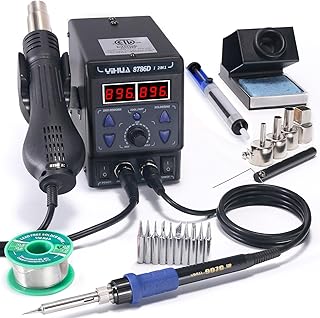
8. YIHUA 8786D I 2-in-1 Hot Air and Soldering Iron Station
The 8786D stands out for accessory breadth. Ten soldering iron tips and four hot air nozzles cover an unusually wide range of package sizes right out of the box. The cool/hot air conversion is a clever feature that lets you blow ambient air to clear flux residue or cool a joint after soldering without waiting for the element to drop.
- Extensive tip and nozzle selection handles most common SMD packages without extras
- Cool air conversion is genuinely useful for cleanup and post-solder cooling
- Bulkier than single-function stations on a crowded bench
Skip this if you already own tips and nozzles and want the smallest possible footprint.
Buying Guide
Temperature Accuracy and Recovery Under Load
A station that displays the right number means nothing if the actual nozzle temperature drifts when heat is drawn away. The practical test is to set your station to a moderate temperature, then press a small copper object against the airflow and watch the display. Good stations recover within seconds and maintain accuracy within a narrow margin. Cheaper units often show sluggish recovery that leaves you guessing. For fine-pitch work, PID-controlled stations like the WEP 8858-V hold better than ones relying on simple thermal cutoff cycling.
Airflow Control and Nozzle Selection
Airflow is your second axis of control after temperature. Too little and heat pools, scorching component bodies before solder melts. Too much and you blow nearby passives off the board or oxidize joints. Look for stations with a smooth adjustment range rather than crude high and low presets. Nozzle selection matters equally. A round nozzle concentrates heat on a single pad while a wide nozzle distributes energy across a QFP body. The more nozzles included, the fewer aftermarket purchases you will need down the road.
Safety Features and Duty Cycle Considerations
Automatic shutoff and sleep functions protect your bench if you step away mid-job. For stations running 700W or higher, verify the unit manages element life with a fan-cooldown cycle after power-off. If you work on ESD-sensitive boards, check that the iron channel has a proper ground path, which the YIHUA 862BD+ addresses by design. Finally, consider your duty cycle. A station rated for continuous professional use will have better thermal cycling tolerance than one built for occasional hobby work, and the price gap reflects that engineering difference.
Our Verdict
The YIHUA 862BD+ is my top pick overall. Its combination of ESD safety, tight independent regulation on both channels, and multi-function display makes it the most complete station here for anyone who needs both tools without compromise. The LRT 858D for under $40 is the best budget option, giving you a functional digital hot air station for less than the cost of a quality set of tweezers. And if you regularly work on thick multi-layer boards with large ground planes, the ATTEN ST-862D wins outright because its 1000W output simply does not stall where lower-wattage units fail.
FAQ
What temperature do I need for lead-free soldering?
Lead-free solder typically requires nozzle temperatures between 650°F and 800°F depending on package size and airflow. Stations listing a maximum above 800°F give you headroom for thicker boards where heat is drawn away quickly by surrounding copper.
Is a 2-in-1 station as good as separate units?
For most hobby and light professional work, a quality 2-in-1 like the YIHUA 862BD+ performs comparably to dedicated units. The tradeoff is that you cannot upgrade one side independently, and a failure in either channel takes the whole station offline.
Do I really need multiple nozzle sizes?
Yes. Using the wrong nozzle causes more damage than most people realize. A nozzle too large heats surrounding components unnecessarily, while one too small concentrates heat unevenly and creates cold joints. Three nozzles minimum covers the common range you will encounter on most boards.
How long do hot air elements last?
Under normal use with proper cool-down cycles, expect several hundred hours of active heating before noticeable output drop. Higher-wattage stations run hotter internally but do not necessarily fail sooner if the fan manages temperature properly during operation.
Part of our stations buying guide hub.