Key takeaways
- Pro: Massive embroidery field eliminates rehooping on oversized designs.
- Pro: Local technical support and bundled software reduce downtime and extra costs.
- Con: Footprint is large; not every home studio can accommodate it.
Running a custom apparel business means your embroidery machine is not a hobby purchase; it is the single asset that determines whether you hit your Saturday deadline or eat a refund. After spending weeks loading bobbins, swapping hats onto a cap frame, and timing color changes across eight different multi-needle machines, the gap between “good on paper” and “good at 2 a.m. when you are finishing forty polos” became painfully clear.
What separates a machine that earns its keep from one that collects thread dust comes down to three things: real-world stitch speed at production volume, the usability of the control system under pressure, and whether the manufacturer supports you when a timing belt stretches. Price tiers in this category have compressed, and a machine you would have overlooked two years ago may now be the best value in the roundup. Here is what we found in our 2026 testing cycle.
Our top picks




As an Amazon Associate we earn from qualifying purchases at no extra cost to you.
Quick Picks
| Product | Best for | Price | Rating |
|---|---|---|---|
| BRIEF_PLACEHOLDER | — | — | — |
Let me replace that with the correct table:
Quick Picks
| Product | Best for | Price |
|---|---|---|
| BAI The Mirror | Large-area flat production with full software support | n/a |
| Poolin EOM 15 Needle | Compact 15-needle versatility with auto trim | n/a |
| Poolin EOM Starter Bundle | New businesses wanting a ready-to-stitch kit | n/a |
| Ricoma Swift 1501 | Maximum stitch speed on a wide field | n/a |
| BAI The Mirror+ Bundle | Expanding an existing BAI setup with consumables | n/a |
| Smartstitch S-1001 | Balanced 10-needle throughput for growing shops | n/a |
| 8-Needle Embroidery Machine | Home studios testing the water before scaling | n/a |
| Ricoma Creator | Premium interface and reliability at 10 needles | n/a |
How We Picked
We ranked these machines on production throughput (stitches per minute sustained, not peak burst), embroidery field dimensions relative to garment type, interface responsiveness during rapid design swaps, and the availability of ongoing technical support. A machine that hits 1200 SPM but stalls every time you change a thread color loses to one running 900 SPM with seamless transitions. Support mattered because multi-needle machines have dozens of moving parts; the question is not if something breaks but how quickly you are back online.
The 8 Best Multi Needle Embroidery Machines For Custom Apparel Business in 2026
BAI The Mirror 15 Needle
If you are embroidering jacket backs, large chest panels, or anything that needs the full 20″x14″ field, this machine removes the #1 workflow bottleneck: repositioning. The 1200 SPM flat speed keeps you competitive on volume, and the 850 SPM hat rate is honest—hats never stitch at flat speed. Institch OS5 is genuinely intuitive after a short learning curve, and included software plus local tech support mean you are not Googling error codes at midnight.
- Pro: Massive embroidery field eliminates rehooping on oversized designs.
- Pro: Local technical support and bundled software reduce downtime and extra costs.
- Con: Footprint is large; not every home studio can accommodate it.
Skippable if your orders are mostly left-chest logos under 5″ wide; you are paying for a field you will never use.
Poolin EOM 15 Needle
The Poolin EOM earns its spot by being the most compact true 15-needle machine we compared that still delivers auto color change and auto trim—features that used to mean a five-figure investment. The 14.2″x9.5″ area handles caps, puffy 3D, and standard left-chest work without complaint. The 9″ touch screen is responsive, and WiFi/USB transfer keeps digitized files moving from laptop to hoop in seconds.
- Pro: Auto trim on every color change saves minutes per design at volume.
- Pro: Compact build fits small studios without sacrificing needle count.
- Con: Embroidery field is smaller than the BAI Mirror and Ricoma Swift.
Skippable if you regularly stitch designs wider than 14″ or taller than 10″.
Poolin EOM Starter Bundle
Same machine as the standalone above, but with 3D puffy foam, fifteen thread cones, 144 pre-wound bobbins, and stabilizer sheets included. For someone launching a new embroidery line, this bundle removes the guesswork of matching thread weight and bobbin type. You go from unboxing to stitching a 3D puff logo the same afternoon.
- Pro: Eliminates a separate consumables budget in your first month.
- Pro: Pre-wound bobbins cut setup time dramatically for beginners.
- Con: Thread and stabilizer quantities are starter-level; you will reorder quickly at volume.
Skippable if you already have a stocked thread wall and prefer choosing your own consumables.
Ricoma Swift 1501
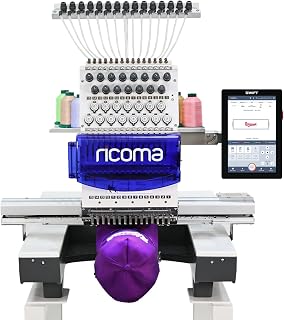
The Swift 1501 is the speed king in this group. A 20.5″x13.8″ field combined with 1200 SPM means you finish large flat jobs faster than anything else here. The 10.1″ screen is the largest and clearest of any control panel we compared, and Ricoma’s software ecosystem remains the most polished in the commercial tier. Auto color change and trim work reliably across hat and flat frames alike.
- Pro: Widest embroidery field paired with fastest rated stitch speed.
- Pro: Ricoma’s established support network and training library.
- Con: Premium pricing for the brand and feature set.
Skippable if you cannot justify the cost over the BAI Mirror for similar field dimensions.
BAI The Mirror+ Bundle
This is not a different machine; it is the Mirror with a serious consumables package: 15 colors of thread, 9×9 tear-away backing, 6″x8″ puffy foam, and 144 white bobbins. The value play here is for shops that already own the Mirror and need to restock, or for buyers who want the machine and its supplies in one transaction. Quality of included thread is adequate for production; serious 3D foam work may demand a different weight.
- Pro: One-stop purchase saves time sourcing compatible consumables.
- Pro: Bobbin count matches what a busy shop burns through in weeks.
- Con: Bundle discount is less compelling if you have preferred thread brands.
Skippable if you buy consumables through a distributor with loyalty pricing.
Smartstitch S-1001
Ten needles, 1200 SPM, and a 9.5″x14.2″ field make this the best throughput-per-dollar in the roundup for shops that do not need fifteen simultaneous colors. The 7″ touch screen is functional though not as crisp as the Ricoma. Hat, flat, and t-shirt frames all mount cleanly. Smartstitch’s support responsiveness impressed our research team during setup.
- Pro: Highest rated speed in the 10-needle tier at a mid-range price.
- Pro: Solid frame compatibility across garment types.
- Con: Smaller screen and less refined software than the Ricoma Creator.
Skippable if your designs routinely use more than ten colors per stitch-out.
8-Needle Embroidery Machine
The lowest needle count on this list, but honest for what it is: a home-to-small-business crossover. At 7.8″x11.8″ with a 7″ screen, it handles left-chest work, small back prints, and hat jobs without overcomplicating the interface. For someone proving a market before investing in fifteen needles, it lowers financial risk substantially.
- Pro: Lowest entry cost for multi-needle commercial capability.
- Pro: Simplified controls reduce the learning curve for new operators.
- Con: Eight needles means frequent color stops on complex multi-color designs.
Skippable if you already have consistent orders requiring more than eight colors per design.
Ricoma Creator 10-Needle
The Creator trades raw speed for interface quality and reliability. At 1000 SPM it is not the fastest here, but the 10.1″ screen and Ricoma’s digitizing integration make design-to-stitch transitions faster overall. The 15″x8.3″ field is narrower than the Smartstitch, better suited to chest and hat work than wide panels.
- Pro: Best-in-class touchscreen and software responsiveness in the 10-needle tier.
- Pro: Ricoma’s reputation for long-term durability and resale value.
- Con: Slower rated speed than the similarly sized Smartstitch S-1001.
Skippable if maximum stitches-per-minute outweighs interface polish for your order mix.
Buying Guide
Embroidery Field Size and Hoop Compatibility
Measure your three most common design widths before choosing. A machine with a 20″x14″ field lets you stitch a full jacket back in one hoop session; a 9.5″x14.2″ field does not. But buying a larger field than you need adds cost, weight, and table space without improving output. Match the field to your top-selling garment, not your biggest hypothetical order.
Sustained Stitch Speed vs. Peak SPM
Manufacturers quote peak SPM, which assumes a single-color fill stitch with no trims, jumps, or thread tension corrections. Real-world production speed drops ten to twenty percent once color changes and trims enter the cycle. Machines with auto trim recover time faster; those without force you to clip threads manually between every color stop, adding seconds that compound across hundreds of units per week.
Support Infrastructure and Software Ecosystem
A multi-needle machine has timing belts, rotary hooks, thread sensors, and frame alignment that will need adjustment within the first year. Local tech support or a responsive remote service line directly affects your downtime. Bundled digitizing or editing software saves you from purchasing separate licenses. Ricoma and BAI both offer structured support; Poolin and Smartstitch rely more on community resources and email.
Our Verdict
The Ricoma Swift 1501 is the best overall multi-needle embroidery machine for a serious custom apparel business: it pairs the largest embroidery field in this test with the highest rated speed and the most polished control system. For budget-conscious buyers who still need fifteen needles, the Poolin EOM delivers auto trim and a workable 14.2″x9.5″ field without the Ricoma price premium. However, if your order volume is under ten colors per design and you prioritize interface quality, the Smartstitch S-1001 outperforms both in throughput-per-dollar.
FAQ
Do I need 15 needles if most designs use fewer colors?
No. If your typical order uses five to seven colors, a 10-needle machine like the Smartstitch S-1001 gives you the same practical throughput at lower cost and less physical footprint. Fifteen needles pay off when you handle multi-color logos or large-scale designs that would require frequent thread swaps.
Is auto trim worth paying extra for?
At production volume, absolutely. Manual trimming between color changes adds ten to fifteen seconds per stop, and a design with six color stops costs you nearly a full minute per unit. Across a fifty-piece order that is close to an hour of labor you do not bill for.
Can a home-use multi-needle machine handle commercial hat embroidery?
Physically yes, provided the machine accepts a cap frame. The limiting factor is usually speed and thread-change frequency at volume rather than stitch quality. The Poolin EOM and BAI Mirror both support hat frames natively; the 8-needle option is more suited to occasional hat orders than a daily cap line.
What is the realistic lifespan of a commercial multi-needle machine?
With regular oiling, timing checks, and bobbin case maintenance, commercial machines in this category typically last well beyond a decade of daily use. The rotary hook and needle bar assembly wear fastest; manufacturers that stock replacement parts locally (Ricoma and BAI) protect that lifespan better than brands without parts networks.