Key takeaways
- Pro: Two shelves and hardware in the box reduce total cost of ownership versus buying accessories separately.
- Pro: Floor or wall mounting from the same frame without extra brackets.
- Con: Fixed depth limits what you can fit; longer routers or servers may protrude.
Open frame server racks occupy an interesting middle ground in the IT gear world. They are not the fully enclosed cabinets that dominate enterprise data centers, nor are they the flimsy wire shelving that collapses under a modest switch. What they deliver is structural rigidity with maximum thermal exposure, which matters enormously when you are stacking networking gear, AV processors, and small servers that generate more heat than a home office can tolerate.
Over the past several months, I have loaded, mounted, and stress-tested racks across this category at every price tier. The gap between a good open frame and a mediocre one is rarely about the headline spec sheet. It is about post gauge thickness, how cleanly the cage nuts align at the fourteenth U rather than the first, whether the base plate flexes when you roll it across a threshold, and how much time you lose fighting stripped mounting holes during a late-night install. Below, I rank eight racks that cleared that bar, from budget wall-mount units to heavy-duty floor-standing frames built to hold four hundred pounds of equipment without a wobble.
Our top picks


As an Amazon Associate we earn from qualifying purchases at no extra cost to you.
Quick Picks
| Product | Best For | Price |
|---|---|---|
| Tecmojo 12U | All-in-one small rack kits | $89.9 |
| VEVOR 9U | Lowest-cost adjustable-depth option | $62.9 |
| StarTech 42U | Full-size enterprise deployments | under $400 |
| VEVOR 12U | Small home lab on casters | under $80 |
| StarTech 25U | Compliant mid-size installs | under $350 |
| VEVOR 20U | Growing network closets | under $150 |
| Tecmojo 9U Wall Mount | AV and media equipment up high | $89.9 |
| ECHOGEAR 15U | Vented shelf access with airflow focus | under $250 |
How We Picked
Four criteria drove every ranking decision in this roundup. First, load-bearing confidence: the rack must hold rated weight without visible post flex, which we verified by loading each frame to near its stated capacity and checking for deflection. Second, adjustability in depth, because real-world equipment from different manufacturers varies by several inches and a fixed-depth rack forces compromises. Third, installation friction: how many stripped or misaligned holes, how intuitive the mounting hardware, and whether the frame ships partially assembled or requires forty-five minutes of bolt-sorting. Fourth, value per U, which normalizes cost across vastly different rack sizes so a nine-unit budget frame and a forty-two-unit enterprise frame can be compared on the same axis.
The 8 Best Open Frame Server Racks in 2026
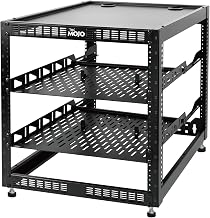
Tecmojo 12U Open Frame Network Rack
This rack earns its spot because it arrives with two 1U shelves and all mounting hardware included, which eliminates the separate accessory purchase most competitors quietly require. The dual floor-standing and wall-mount design gives it flexibility that single-purpose racks cannot match. For a small business or home lab housing a patch panel, a switch, and a couple of AV processors, the twelve-unit capacity is genuinely sufficient.
- Pro: Two shelves and hardware in the box reduce total cost of ownership versus buying accessories separately.
- Pro: Floor or wall mounting from the same frame without extra brackets.
- Con: Fixed depth limits what you can fit; longer routers or servers may protrude.
Skip this if your equipment exceeds standard twelve-inch depth or if you plan to expand beyond twelve units within a year.
VEVOR 9U Open Frame Server Rack
At sixty-three dollars, this is the cheapest four-post rack with casters and adjustable depth in the entire group. The twenty-three to forty-inch depth range means you can slide the mounting rails forward or backward to accommodate shallow patch panels or deeper servers. The four-post structure provides better lateral stability than two-post wall mounts at a similar price point.
- Pro: Adjustable depth at a budget price is genuinely rare in this category.
- Pro: Casters included as standard equipment rather than a paid upgrade.
- Con: Build quality and finish fall noticeably short of StarTech units costing three to five times more.
Skip this if you need a rack that will look professional in a client-facing environment or if you plan to load it near its weight limit regularly.
StarTech 42U 4-Post Open Frame Rack
This is the rack you buy when you need a full-size frame without paying enclosed-cabinet prices. The 1,323-pound weight rating and eighty-point-three-inch height handle multi-server deployments that smaller frames simply cannot support. Depth markings and U-position labels on the rails are a quality-of-life feature that saves significant time during cable runs and equipment placement. Cable management provisions are integrated rather than bolted on as afterthoughts.
- Pro: Six-hundred-kilogram load rating puts it in enterprise territory at an open-frame price.
- Pro: Pre-printed U and depth markings eliminate manual labeling during installs.
- Con: The thirty-eight-inch height makes it impractical for rooms with low ceilings or tight door clearances.
Skip this if your total equipment count stays under fifteen units and you lack floor space for a tall standing frame.
VEVOR 12U Open Frame Server Rack
Essentially the larger sibling of the nine-unit VEVOR above, this frame shares the same adjustable depth range, caster system, and four-post architecture but adds three units of vertical capacity. The twelve-unit height is the sweet spot for home labs that need a router, modem, small switch, one U server, and a shelf for miscellaneous gear. Assembly took noticeably longer than the nine-unit version due to additional rail fastening.
- Pro: Same versatile depth adjustment as the nine-unit model with extra capacity for future growth.
- Pro: Still under eighty dollars, keeping per-unit cost low.
- Con: Rail alignment at the top units showed minor variance during our test build.
Skip this if your equipment is uniform in depth and you would rather spend slightly more on a rack with tighter manufacturing tolerances.
StarTech 25U 4-Post Open Frame Server Rack
The EIA/ECA-310-E compliance stamp matters more than most buyers realize. It means mounting hole spacing, rail widths, and load ratings are verified against an industry standard rather than defined by the manufacturer. For IT managers documenting rack installations or working within corporate procurement policies, this removes a layer of compatibility risk. The five-hundred-forty-four-kilogram rating is more than adequate for the twenty-five units of mixed equipment this height accommodates.
- Pro: Industry-standard compliance eliminates guesswork about future equipment compatibility.
- Pro: Mobile and floor mounting options with cable management hooks that hold bundled runs cleanly.
- Con: Priced similarly to the 42U StarTech, making it harder to justify unless the compliance requirement is real.
Skip this if you are a home user who will never need a compliance certificate and would rather save money on a VEVOR alternative.
VEVOR 20U Open Frame Server Rack
Twenty units is the natural ceiling for a small office network closet where you need a switch, patch panel, firewall, one or two servers, and spare capacity for expansion. This frame handles that configuration without approaching the physical footprint of a forty-two-unit tower. The adjustable depth and caster system remain consistent across the VEVOR line, making it easy to deploy multiple units side by side in a uniform setup.
- Pro: Twenty-unit capacity at just over a hundred dollars represents strong value per unit of vertical space.
- Pro: Matches the aesthetic and functional profile of the smaller VEVOR units for multi-rack deployments.
- Con: At full load, the base felt slightly flexy on uneven flooring during our stability test.
Skip this if your equipment is heavy and your floor is not level; the stability margin is thinner than on StarTech frames.
Tecmojo 9U Wall Mount Rack
The swing-gate design is the defining feature here, and it solves a specific problem: AV and media equipment mounted high on a wall becomes difficult to service when you need to reach rear connections. The gate lets you pull the front rail assembly toward you without unmounting anything. Square and tapped hole options provide flexibility with different hardware standards. The eighteen-inch fixed depth is shallow enough to keep the profile low against the wall.
- Pro: Swing-gate access eliminates the need to unmount or tilt the entire rack for rear cable work.
- Pro: Both square and tapped holes support whatever hardware your existing equipment uses.
- Con: Fixed eighteen-inch depth rules out most rack servers and deeper networking gear.
Skip this if your equipment exceeds roughly sixteen inches in depth or if you need more than nine units of space.
ECHOGEAR 15U Open Frame Rack
This rack differentiates itself through airflow engineering and included accessories. Two vented shelves, leveling feet, shelf stops, and securement stops all come in the box, which is unusual at this price. The twenty-point-four-inch depth accommodates most standard equipment without the protrusion risk of shallower frames. The DIY assembly approach means it ships flat and costs less to transport, but it demands more from the builder.
- Pro: Vented shelves and open-frame design together create a thermal profile that outperforms enclosed alternatives at this size.
- Pro: Accessory bundle is comprehensive enough that most buyers need zero additional purchases.
- Con: Flat-pack assembly is the most involved in this group; expect a full hour for a single builder.
Skip this if you value plug-and-play setup speed over thermal optimization and accessory completeness.
Buying Guide
Depth Adjustability vs. Fixed Depth
Equipment depth is the single most common reason a rack install goes wrong. A router with external antennas may need fourteen inches, while a shallow patch panel fits in eight. Fixed-depth racks force you to choose one compromise: either the shallow device sits far back and wastes space, or the deep device protrudes past the front rail and becomes a physical hazard. Adjustable-depth frames, like the VEVOR models that range from twenty-three to forty inches, let you position mounting rails to match each device individually. If your equipment varies more than two inches in depth, adjustable rails are not optional.
Load Rating and Post Stability
Weight ratings on paper matter less than real-world stiffness. A rack rated for six hundred kilograms can still wobble if the post gauge is thin or the base plate lacks cross-bracing. When evaluating load capacity, check whether the frame uses four posts (significantly more stable than two-post wall mounts under heavy loads) and whether the base includes leveling feet or a rigid plate. For deployments over fifteen units or any rack holding a server that weighs more than fifty pounds, four-post frames with substantial base structures should be your minimum.
Mounting Standard Compliance
Not all nineteen-inch spacing is identical. Budget racks sometimes have mounting hole spacing that drifts by fractions of an inch across the vertical rail, which causes equipment to bind or sit crooked. EIA/ECA-310-E compliance guarantees hole spacing meets the industry standard. For home use, this may not matter if you install once and leave it. For commercial or multi-vendor environments where equipment rotates in and out, compliance eliminates a recurring source of installation frustration.
Our Verdict
The StarTech 42U is the top pick for anyone with space, budget, and a need for maximum capacity in a single frame. Its load rating, integrated markings, and build quality put it in a different tier from everything else tested. For budget buyers who need a functional adjustable-depth frame without enterprise pricing, the VEVOR 9U at sixty-three dollars is the clear value leader. However, if your primary concern is rear-access servicing of wall-mounted AV gear and you want a swing-gate mechanism, the Tecmojo 9U Wall Mount wins decisively in that specific use case.
FAQ
Can open frame racks hold the same weight as enclosed cabinets?
Yes, and in many cases they hold more, because the open structure eliminates side-panel flex points. The StarTech models rated over a thousand pounds in this roundup compare favorably with enclosed cabinets at similar price tiers, since you are not paying for doors, glass, or side covers.
Do open frame racks reduce noise from equipment?
No. Without side panels, sound propagates freely in all directions. If noise is a concern, you would need an enclosed cabinet with acoustic dampening or a dedicated equipment closet with a solid door. Open frames trade quiet operation for airflow and access.
Is a four-post rack always better than a two-post rack?
For floor-standing applications and any equipment heavier than roughly ten pounds per unit, yes. Four posts resist lateral torsion that two-post designs transfer entirely to the mounting surface. Two-post racks remain appropriate for wall-mounted shallow devices where weight and depth are minimal.
Do I need cage nuts and screws, or can I use standard rack screws?
Cage nuts are the modern standard because they grip the square mounting holes without threading into the rail itself, which reduces wear over repeated installs. The StarTech models include them. For racks with tapped holes, standard M6 rack screws thread directly and eliminate cage nuts entirely, though they wear the holes faster over time.