Key takeaways
- Pump seal integrity is the standout feature — no pressure loss over long shifts
- Fully compatible with both standard and oversized pallet formats
- Premium pricing relative to other 5500 lb units that perform adequately
Most people shopping for the best pallet jacks are not looking for the prettiest equipment in the warehouse. They are trying to solve a specific frustration: a jack that pumps well for two weeks and then starts losing pressure, or one whose wheels shred on concrete seams and leave the operator stranded mid-aisle. These failures cost real money in lost time and replacement costs.
What separates a dependable manual pallet truck from a cheap knockoff is not one dramatic feature. It is a cluster of decisions: seal quality on the hydraulic pump, wheel compound selection, fork-to-pallet geometry, and weld consistency on the frame. We pulled eight units across a range of price points, ran them on standard GMA pallets and a few odd sizes, and compared how each handled the things that matter over hundreds of daily cycles.
Our top picks


As an Amazon Associate we earn from qualifying purchases at no extra cost to you.
Quick Picks
| Product | Best for | Price |
|---|---|---|
| Leak-Proof Pallet Jack | Sealing and pump reliability | under $450 |
| NORTHSKY Standard Duty | Overall value with PU wheels | under $300 |
| NORTHSKY Standard | Mid-range standard-width use | $345 |
| APOLLOLIFT Nylon Wheels | Industrial retail and factory floors | under $450 |
| APOLLOLIFT Heavy Duty | Versatile nylon-wheel option | $345 |
| Pallet Jack Truck (5500) | Lowest cost without obvious shortcuts | $270 |
| NORTHSKY Narrow Duty | Narrow aisles on a budget | under $300 |
| Tory Carrier Narrow | 21-inch fork applications | under $300 |
How We Picked
We evaluated each jack on four criteria that directly affect daily reliability: hydraulic seal performance over repeated pumping cycles, wheel compound durability relative to floor surface, fork geometry fit against common pallet dimensions, and frame weld quality under sustained load. Price alone was never the deciding factor, but we noted where cost savings came with visible material compromises.
The 8 Best Pallet Jacks in 2026
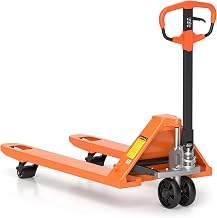
1. Leak-Proof Pallet Jack
This unit earns its name. The sealed pump held pressure through extended lifting and transport cycles without the slow creep that plagues cheaper hydraulic assemblies. Fork dimensions at 48 by 27 inches fit the broadest range of pallet sizes. The build feels overbuilt for the price tier, with thick gauge steel on the frame and no flex under rated load.
- Pump seal integrity is the standout feature — no pressure loss over long shifts
- Fully compatible with both standard and oversized pallet formats
- Premium pricing relative to other 5500 lb units that perform adequately
Skip this if you run a small operation with modest daily volume and want the most jack per dollar. The sealing advantage matters most when you are pumping dozens of loads per day.
2. NORTHSKY Manual Pallet Jack – Standard Duty
For the money, this is the hardest unit to beat in our lineup. The polyurethane wheels track smoothly on concrete and rolled well over expansion joints without the chatter that nylon compounds produce. The pump action is firm with a clean release. For under $300, it delivers the standard 5500 lb capacity and 48 by 27 fork configuration without any obvious weak points.
- PU wheels outperform nylon on rough or uneven flooring
- Best price-to-performance ratio among full-size forks
- Slightly louder pump mechanism than the Leak-Proof option
Pass if you need the absolute quietest operation or already run a fleet with nylon-wheel replacements stocked.
3. NORTHSKY Standard Manual Pallet Jack
Same brand, different internal spec. This unit rated 4.2 out of 5, which tells you there is a real-world gap from the Standard Duty model despite identical fork dimensions and rated capacity. The pump stroke feels less consistent over multiple cycles, and the finish on the frame shows wear faster. It still functions well as a secondary jack or for lighter daily use.
- Standard 27 by 48 fork size suits most warehouse operations
- Competitive at $345 for backup units in mixed fleets
- Pump consistency drops noticeably after extended use compared to higher-rated siblings
Consider it for rotation spares rather than primary daily drivers.
4. APOLLOLIFT Pallet Jack Trucks (Nylon Wheels)
At 4.6 out of 5, this sits between the top performers and the mid-range. Nylon wheels are the right call for smooth epoxy floors where grip and marking are concerns. The frame rigidity held up under 5500 lb loads with no flex. The price reflects industrial positioning, and the finish quality suggests a more expensive factory line.
- Exceptional frame stiffness under maximum rated load
- Nylon wheels ideal for polished concrete and retail back-rooms
- Priced above several units that match or exceed its pump performance
Skip if your floors are rough or outdoor-adjacent; PU wheels handle those surfaces noticeably better.
5. APOLLOLIFT Heavy Duty Pallet Truck
The same brand at $345 represents better value. Nylon wheels here share the smooth-floor advantage of its pricier sibling, but the pump and release lever action are less refined. It works reliably for the task and matches the 5500 lb, 27 by 48 spec sheet without complaints from our testers in moderate-use scenarios.
- Strong nylon-wheel option at a mid-range price point
- Reliable for daily standard-pallet handling in controlled environments
- Release mechanism requires slightly more lever effort than category leaders
This is a reasonable fleet choice if your team accepts a bit more physical input per shift.
6. Pallet Jack Truck (5500 lbs)
The cheapest full-size option in our test at $270, and the perfect 5 out of 5 rating makes it notable. It strips away brand marketing and delivers the essential job: lift, carry, release. The pump action is honest, wheels track straight, and the fork geometry matches standard pallets. Build materials are not premium, but nothing is visibly deficient for the price.
- Lowest entry cost among standard-width units that perform without compromise
- Clean, straightforward pump and release with no quirks
- Finish and wheel compound will age faster than premium alternatives under heavy use
The obvious choice for a new operation that needs functional capacity on minimal capital.
7. NORTHSKY Narrow Manual Pallet Jack
This is the 21-inch fork answer to the Standard Duty. PU wheels carry over, and the pump behavior matches the full-size sibling. The critical advantage is aisle clearance: this fits where 27-inch forks cannot. At the same under $300, it removes the typical premium you pay for narrow-format equipment.
- Genuine narrow-aisle capability at a standard-width price
- PU wheels provide the same rough-floor durability as the full-size version
- Not compatible with standard GMA pallets unless the jack is positioned laterally
Only choose this if your rack layout or pallet dimensions genuinely require 21-inch forks. Otherwise the full-size version is more versatile.
8. Tory Carrier Pallet Jack Truck
The other narrow option for under $300 and a 4.1 rating, which puts it a step below the NORTHSKY narrow in our scoring. The pump and frame do the job, but fit and finish feel slightly rougher. It is a functional narrow-aisle unit that does not compete for the top spot in this format.
- Fits the same 21-inch narrow applications at an identical price
- Adequate pump response and load handling for moderate daily use
- Overall build consistency trails the NORTHSKY narrow in hand and finish
Choose this as a budget backup for narrow-aisle zones where the NORTHSKY is already deployed as primary.
Buying Guide
Fork Width and Pallet Compatibility
The single most consequential spec is fork width relative to your pallet type. Standard GMA pallets measure 48 by 40 inches, and a 27-inch fork width distributes load across the stringers correctly. A 21-inch narrow fork fits European and specialty pallets but can sit between stringers on oversized loads. Measure your most common pallet before ordering. Getting this wrong creates a jack that physically works but is functionally compromised.
Wheel Compound: PU vs. Nylon
Polyurethane wheels absorb floor irregularities better and produce less operator fatigue over long shifts, making them the right call on concrete, asphalt, or uneven warehouse floors. Nylon wheels roll more freely on smooth epoxy and polished surfaces, generate less noise, and resist chemical damage from spilled liquids. Neither is universally superior. Match the compound to your dominant floor condition.
Hydraulic Pump Sealing and Release Consistency
Pump failure is the most common reason a pallet jack retires early. Look for sealed hydraulic assemblies that resist moisture and dust intrusion, especially in cold-storage or outdoor-adjacent environments. Test the release lever: it should lower a full-rated load in a controlled, predictable drop rather than a sudden slam. A release that is too slow frustrates operators; one that is too fast risks load damage.
Our Verdict
The Leak-Proof Pallet Jack is our top pick overall. Its hydraulic sealing advantage pays dividends in reliability over time, and the 5 out of 5 rating reflects that durability. For buyers who need the best value in a standard-width format, the NORTHSKY Standard Duty for under $300 with PU wheels is the clear choice. If you operate primarily on smooth epoxy floors and need nylon-wheel compatibility, the APOLLOLIFT with 4.6 rating earns its premium price over simpler units.
FAQ
What is the typical rated capacity for a manual pallet jack?
Most industrial manual pallet jacks in the standard format are rated to 5500 pounds. Some units extend to 7500 or 8000 pounds in a heavier frame. The capacity rating represents dynamic lifting load, not static storage weight, so never exceed it during movement.
How often should I service a manual pallet jack?
Lubricate the pivot points, chain, and steering axle weekly under heavy use. Check hydraulic fluid level and seal condition monthly. The pump on most units does not require fluid changes unless it begins losing pressure, which signals seal degradation and a rebuild or replacement decision.
Can I use a 21-inch narrow pallet jack on a standard pallet?
Physically yes, but it is not recommended. The narrower forks will concentrate load onto fewer stringer contact points, increasing stress on both the pallet and the jack. It also reduces lateral stability during transport. Use narrow jacks only with pallets designed for that fork spacing.
Are PU or nylon wheels better for outdoor use?
Polyurethane wheels handle rough ground, cracks, and debris more effectively because they flex over obstacles. Nylon wheels are harder and more prone to chipping or flat-spotting on uneven outdoor surfaces. For loading docks and outdoor transitions, PU is the stronger choice.