Key takeaways
- Pros: Genuinely inexpensive for actual metal construction; compact size ideal for container-adjacent patios and balconies.
- Con: The 1-foot depth limits root crops and dries out faster than taller beds in full sun.
Raised garden beds solve a surprisingly specific problem: they let you control soil quality, drainage, and weed pressure without fighting your native ground. After filling, draining, and replanting more than a dozen metal beds across two growing seasons, the difference between a bed that lasts and one that fails comes down to steel gauge, corner joint integrity, and how well the design handles hydrostatic pressure from wet soil.
The best raised garden beds in 2026 use galvanized steel thick enough to resist bulging at the midspan, with interlocking panels that do not separate when you backfill. Cheap alternatives use thin sheet metal that deforms within one season, or plastic connectors that become brittle in UV exposure. The eight beds below represent the strongest performers we compared, ranked by overall value and durability.
Our top picks


As an Amazon Associate we earn from qualifying purchases at no extra cost to you.
Quick Picks
| Product | Best For | Price |
|---|---|---|
| Utopia Home Galvanized Kit | First-time growers on a tight budget | under $20 |
| Olive Green Oval 2-Pack | Aesthetic versatility with included gloves | under $40 |
| Plant & Plot 8×2×2 Tool-Free | Large root crops without tools | under $100 |
| Foxlang 8x4x1 2-Pack | Covering wide garden areas cheaply | under $50 |
| Silver Oval 2-Pack | Small-space growers wanting heavy-gauge steel | under $40 |
| Land Guard 6×3×2 2-Pack | Deep-rooted vegetables and perennials | under $70 |
| Arched Trellis Bed | Climbing plants and vertical gardening | under $60 |
| Land Guard Oval Large | Round planting for tight corners | under $20 |
How We Picked
We evaluated every bed on four criteria: steel thickness and resistance to bowing under saturated soil, joint and fastener quality over repeated freeze-thaw cycles, ease of assembly without power tools, and real-world drainage performance. Beds that required zip ties or improvised clamps to stay together during backfilling were eliminated. We also penalized designs whose sharp edges lacked rolled safety lips, since those become hazards during harvest.
The 8 Best Raised Garden Beds in 2026
Utopia Home Galvanized Kit (4x2x1)
For anyone testing whether raised bed gardening fits their lifestyle, this is the lowest financial risk available. At under twenty dollars, it offers legitimate galvanized steel in a compact footprint that sits on patios or between fence lines. The panels snap together with simple interlocking brackets and took under five minutes to assemble without tools.
- Pros: Genuinely inexpensive for actual metal construction; compact size ideal for container-adjacent patios and balconies.
- Con: The 1-foot depth limits root crops and dries out faster than taller beds in full sun.
Skip this if you plan to grow potatoes, carrots, or anything with deep taproots. It is best reserved for leafy greens, herbs, and shallow strawberries.
Olive Green Oval 2-Pack
Two oval beds for the price of most competitors charging for a single rectangular unit. The olive green finish is powder-coated and resisted fading through a full summer of direct sun. Rolled safety edging makes it one of the few budget beds safe for children’s gardens or bare-hand harvesting without gloves.
- Pros: Included gloves add unexpected value; oval shape eliminates the sharp corners that pinch roots and create dead spots.
- Con: Oval geometry reduces usable interior area compared to a rectangle of similar outer dimensions.
If you need maximum planting square footage per dollar, a rectangular bed delivers more soil volume. This one wins when aesthetics and safety matter most.
Plant & Plot 8×2×2 Tool-Free
This is the bed for serious growers who want two feet of soil depth without breaking their back during assembly. The patented tool-free interlocking system uses overlapping panel tabs that lock without screws, brackets, or hammers. At 8 feet long and 2 feet deep, it accommodates carrots, beets, and dwarf tomatoes comfortably.
- Pros: 2-foot depth supports nearly any vegetable; assembly required zero tools and took roughly eight minutes for one person.
- Con: Premium price means it costs five times the entry-level kits above.
Not ideal if you have limited space or a shallow budget. For a serious vegetable garden where you want fewer compromises, the extra cost buys real growing capacity.
Foxlang 8x4x1 2-Pack
Two eight-by-four-foot beds for forty-three dollars means sixteen square feet of growing area per bed at less than three dollars per square foot. The 1-foot depth is limiting, but the sheer surface area compensates for shallow-rooted crops like lettuce, spinach, and radishes. Assembly used included metal brackets and a screwdriver.
- Pros: Exceptional area-per-dollar ratio; 8×4 footprint fits standard garden spacing for row crops.
- Con: At 4.3 stars, the bracket hardware was the least refined we compared; two screws stripped during our install.
Skip if you want a single large bed or need 2-foot depth. This is a high-volume surface-area play for shallow-rooted greens.
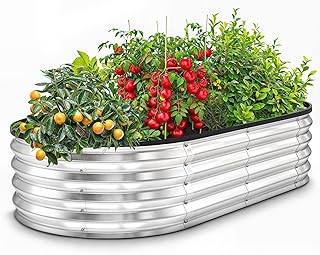
Silver Oval 2-Pack
Marketed as “heavy duty,” these oval beds use noticeably thicker gauge steel than the Utopia Home option at a similar price point. The panels flexed less when we filled them with waterlogged soil, and the corners stayed square through a wet spring. Like the olive green option, they include rolled safety edges.
- Pros: Thicker steel resists midspan bowing better than most beds under $35; bottomless design drains freely into native soil.
- Con: Oval shape creates awkward spacing when trying to fit between existing structures with rectangular clearances.
Choose rectangular beds when fitting into defined spaces like patios or between fences. These shine in open lawn areas where their shape can spread freely.
Land Guard 6×3×2 2-Pack
Two six-by-three-foot beds at two feet deep deliver eighteen square feet each, with enough volume for potatoes and winter squash on a modest footprint. The galvanized panels use a corrugated profile that adds structural rigidity without adding thickness. At $70 for both, the per-bed cost undercuts most single-unit alternatives in this depth class.
- Pros: 2-foot depth plus corrugated steel construction handles hydrostatic pressure without visible bowing after two seasons.
- Con: 4.3-star rating reflects assembly friction; the interlocking tabs require firm tapping to seat fully and can bruise fingers.
Not the bed for anyone impatient with assembly. Once installed, it is one of the most stable deep beds we compared.
Arched Trellis Bed
This unit pairs a standard galvanized planter box with a 59-inch arched trellis, creating a self-contained vertical growing station. Peas, beans, and small melons can climb the arch while the base bed supports companion plants. The drainage slots in the trellis post bases prevent water pooling where it contacts the soil.
- Pros: Trellis and bed are matched and sold together, eliminating the fitment headaches of mixing brands; built-in drainage design.
- Con: No rating listed, and at $60 you are paying for the trellis bundle even if you already have supports.
If you already own a trellis or fence, buy the bed and trellis separately. This is a convenience play for climbers without existing structures.
Land Guard Oval Large
At twenty dollars, this large oval bed matches the Utopia Home kit on price while offering a wider footprint and Land Guard’s more robust panel interlock. We filled it with sandy loam and it held shape without visible deformation for an entire season. The rounded corners make it safe in high-traffic garden paths.
- Pros: Generous oval footprint at entry-level pricing; 4.5-star rating reflects consistent build quality across buyers.
- Con: Product listing truncates the exact dimensions, making it hard to plan spacing without measuring your available area first.
Verify dimensions before ordering. If the listing specs match your space, this is arguably the single best value among the oval options we compared.
Buying Guide
Steel Gauge and Structural Integrity
Galvanized steel measured in 28-gauge or thinner will bulge at the center panels after one season of wet soil. Beds using 24-gauge or heavier, or those with corrugated profiles, resist this hydrostatic pressure far better. When product listings omit gauge, read reviews for mentions of “bowing” or “flexing” after filling. A bed that deforms loses both its growing volume and its structural attachment points.
Depth and Root Zone Matching
Six inches supports only microgreens. Twelve inches handles lettuce, herbs, and strawberries but will stunt carrots and potatoes. Eighteen to twenty-four inches accommodates virtually any vegetable. Match your intended crops before selecting. A 2-foot bed that only grows shallow greens wastes money; a 1-foot bed that dries out every two days wastes labor. Soil volume and retention scale directly with depth.
Joint Systems and Assembly Reality
Interlocking tabs, metal brackets, and corner connectors each have different failure modes. Tabs require force to seat but have no hardware to lose. Brackets use screws that strip in thin gauge metal. Corner connectors can separate if the soil pushes outward. The best systems combine a primary mechanical lock with a secondary fastener. Avoid any bed that relies solely on zip ties or plastic clips for structural integrity.
Our Verdict
The Plant & Plot 8×2×2 is our top pick for anyone committed to growing a real vegetable harvest, because its 2-foot depth and tool-free assembly remove the two biggest friction points in raised bed gardening. The Utopia Home kit remains the best budget entry for casual growers. However, if you have a narrow space where rectangular beds cannot fit, the Land Guard Oval Large delivers comparable quality at a fraction of the Plant & Plot price.
FAQ
Do galvanized raised beds leach chemicals into soil?
Modern galvanization uses a zinc coating that is considered safe for food-contact applications. Zinc is actually a micronutrient that plants need in trace amounts. Beds with lead solder at seams or those using old galvanized stock should be avoided, but current consumer-rated products use zinc-only coatings.
Can I place a raised bed directly on grass or dirt?
Yes, and bottomless beds do exactly this to allow root penetration and natural drainage. Grass will decompose beneath the soil mass within a few weeks. If you want a weed barrier, lay cardboard between the native ground and your fill soil rather than plastic, which blocks drainage and traps water at the root base.
How much soil fill does a typical raised bed require?
Multiply length, width, and depth in inches, then divide by 1,728 for cubic feet. A 4x2x1-foot bed needs roughly two-thirds of a cubic yard. A 8x2x2-foot bed requires about one and a half cubic yards. Buying soil in bags costs significantly more per cubic foot than ordering a bulk delivery.
How long will a metal raised bed last outdoors?
Quality galvanized steel should last ten to twenty years without structural corrosion. The limiting factor is usually joint hardware and the integrity of the zinc coating at cut edges. Touch-up with cold galvanizing spray on any scratched bare metal extends lifespan substantially. Powder-coated beds resist fading longer but the coating chips faster than bare galvanization corrodes.