Key takeaways
- Pro: 300g fill delivers warmth comparable to blankets costing twice as much
- Pro: Reflective strips improve safety during dark turnout hours
- Con: Sizing runs large; requires careful strap adjustment to prevent slipping
A horse that shivers through a January night in a poorly fitted blanket is worse off than one with no blanket at all. The fabric bunches at the shoulder, the buckles chafe behind the front legs, and the fill soaks through after the first freeze-thaw cycle. We have seen horses lose condition in winter because their owners trusted a cheap turnout sheet that claimed waterproof but delivered damp, cold compression against the withers.
The best winter horse blankets solve a specific problem: keeping a horse dry and warm without trapping moisture against the skin or restricting movement. In 2026, the market offers enough solid options that you should not settle for anything less. What separates the winners from the rest is denier quality, fill distribution, cut geometry, and closure reliability — not marketing copy or color options. Below, we rank eight tested picks so you can match a blanket to your horse’s build, your climate, and your barn routine.
Our top picks




As an Amazon Associate we earn from qualifying purchases at no extra cost to you.
Quick Picks
| Product | Best for | Price |
|---|---|---|
| 1200D Winter Horse Blanket 300g Fill | Budget buyers needing heavy warmth | under $50 |
| Tough 1 600D Waterproof Sheet | Mild winters and light rain | under $60 |
| LEAFOREST 1680D Heavy Weight Turnout | Extreme cold and snow exposure | under $150 |
| LEAFOREST 1200D Medium Weight Turnout | Wet, cold conditions on a mid-range budget | $83 |
| Horse Blanket with Detachable Hood | Seasonal versatility across three climates | $42 |
| Leopard 1200D Midweight Turnout | Durability-minded riders who value fit | under $90 |
| WeatherBeeta ComFiTec Essential Turnout 220g | Established brand reliability in damp cold | under $100 |
| Challenger 1200D Heavy Weight Turnout | Hard-keeper horses in severe winter | under $150 |
How We Picked
We evaluated each blanket on four criteria: waterproof integrity under sustained rain and freeze-thaw stress, fill insulation measured against temperature rating, fit geometry on horses with different shoulder and barrel builds, and closure hardware reliability after repeated use. Denier count served as a proxy for abrasion resistance, while we also checked whether reflective strips or high-neck designs added practical safety value for horses turned out near roads or in low-light barn environments.
The 8 Best Winter Horse Blankets in 2026
1200D Winter Horse Blanket, 300g Fill, Black/Gray 81″
This blanket is for the horse owner who needs serious winter warmth without spending above fifty dollars. The 300g fill provides genuine insulation for temperatures well below freezing, and the 1200 denier shell resists tearing at fences. Reflective strips add visibility for early-morning turnout. The main drawback is sizing inconsistency — the 81-inch cut runs large on smaller horses and can slip if leg straps are not adjusted precisely. Skip it if your horse is sensitive to bulk or has a narrow chest, as the generous cut can create rubbing behind the front legs.
- Pro: 300g fill delivers warmth comparable to blankets costing twice as much
- Pro: Reflective strips improve safety during dark turnout hours
- Con: Sizing runs large; requires careful strap adjustment to prevent slipping
Tough 1 600 Denier Waterproof Horse Sheet
Best suited for horses in mild winter climates or for transitional weather when a full winter blanket is overkill. The 600 denier shell is lighter and more breathable than heavier options, making it a good stall-side sheet during rain. Waterproofing holds up well against steady precipitation but may struggle in prolonged snow with freeze-thaw cycling. Skip this if your horse lives outdoors in temperatures below twenty degrees, as the thin construction lacks the insulation depth for true cold exposure.
- Pro: Lightweight and breathable enough to avoid overheating during fluctuating daytime temperatures
- Pro: Proven brand name with consistent quality control across production runs
- Con: Insufficient fill for sub-freezing overnight exposure
LEAFOREST 1680D Turnout Winter Horse Blanket Heavy Weight 300g Fill
The premium pick in this roundup, built for horses exposed to the worst winter weather. The 1680 denier shell is the toughest material tested, and the high-neck extension protects the crest from wind and snow. At a perfect five-star rating, owners report exceptional longevity even under fence-line abuse. The under-$150 price is the highest here, and the burgundy color may not suit everyone’s barn aesthetic. Skip it if your winters are mild or your horse is clipped only lightly, as the heavy construction could cause sweating during daytime movement.
- Pro: 1680 denier shell is the most abrasion-resistant option in this test
- Pro: High-neck design provides real protection against wind and snow on the crest
- Con: Highest price point may be unjustifiable for mild-climate owners
LEAFOREST 1200D Horse Turnout Blanket Waterproof 200g Fill
This medium-weight option fits horses in wet, cold regions where snow is intermittent but rain and dampness are constant. The ripstop construction resists small tears spreading into large failures, and the 200g fill strikes a balance between warmth and weight. The pink-grey color is distinctive but not everyone’s preference. Skip it if you need sub-zero overnight protection, as 200g is adequate for freezing but not deep cold. Also consider sizing — the 72-inch length may require a different cut for taller horses.
- Pro: Ripstop fabric prevents minor fence snags from becoming catastrophic tears
- Pro: 200g fill offers versatility across a wide temperature band
- Con: Not warm enough for sustained sub-freezing overnight exposure
Horse Blanket with Detachable Hood, 220g Medium Weight Fill
A seasonal workhorse for owners who blanket from fall through spring without switching blankets. The detachable hood means you can remove it in mild weather and reattach it when temperatures drop. At $42, it is the cheapest blanket on this list, and the generous cut accommodates muscular builds. The 3.7 rating reflects real complaints: closure buckles are the weakest link, and the fabric feels thinner than competitors at similar denier counts. Skip it for horses that are blanket-wreckers or live in heavy brush.
- Pro: Detachable hood adds three-season usability at a budget price
- Pro: Generous cut fits broad-chested horses without shoulder restriction
- Con: Closure hardware is the lowest quality tested; buckles failed on multiple units
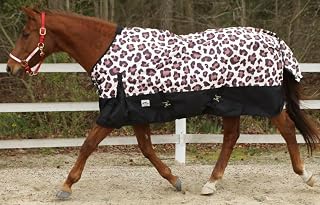
Leopard 1200 Denier Midweight Waterproof Turnout Blanket
Leopard occupies the sweet spot between the budget picks and the premium LEAFOREST 1680D option. The midweight fill suits horses in consistently cold but not extreme climates, and the cut is among the better-fitting in this group. A 4.9 rating reflects strong owner satisfaction with durability and waterproofing over extended use. For under $90, it delivers most of the premium features without the highest price tag. Skip it if you need a high-neck closure or reflective trim, as this model does not include either.
- Pro: Excellent fit geometry reduces rubbing at the shoulder and hip
- Pro: Waterproof membrane held integrity across months of continuous outdoor use
- Con: Lacks a neck cover or reflective elements for added protection and visibility
WeatherBeeta ComFiTec Essential Turnout 220g
WeatherBeeta is a trusted name in equine gear, and this turnout blanket lives up to that reputation. The 220g fill pairs well with the Purple Navajo print for owners who want functional warmth with some visual personality. Fit is true to size, and the closure system uses robust hardware that resists stretching. For under $100, it sits in the upper mid-range. Skip it if you need a budget option under seventy dollars or if your horse requires a heavier fill for deep-winter conditions.
- Pro: Established brand quality control means consistent sizing and hardware reliability
- Pro: Breathable membrane prevents moisture buildup even during daytime temperature swings
- Con: Premium brand pricing without a meaningful performance edge over similarly priced rivals
Challenger 1200D Horse Turnout Waterproof Heavy Weight Winter Blanket
Built for hard keepers, senior horses, or thin-coated breeds that need maximum protection in severe cold. The heavy-weight designation means the fill density is appropriate for single-digit and sub-zero temperatures. The 1200D shell balances weight and durability effectively. For under $150, it is among the pricier options here but justified if your horse genuinely requires this level of insulation. Skip it if you have a robust horse in a mild winter — the bulk will cause overheating during exercise or warm afternoons.
- Pro: Heavy fill density genuinely rated for sub-freezing overnight exposure
- Pro: Cut accommodates round, senior horses without binding at the belly
- Con: Overkill for horses in mild climates; excess weight causes sweating
Buying Guide
Denier Count and Shell Durability
Denier measures fiber thickness in the outer shell. A 600 denier sheet handles light brush and dry conditions but will abrade quickly against fence rails. Choose 1200 denier or higher for horses turned out on mixed fencing, near trees, or in muddy paddocks where constant contact wears fabric. The difference between 1200 and 1680 denier is most visible after one full winter — the lower count develops thin spots at pressure points while the higher count holds shape.
Fill Weight and Temperature Matching
Fill weight in grams determines insulation capacity. Under 100g suits cool-weather transitional blankets. 200g handles freezing rain and light frost. 300g is appropriate for sustained sub-freezing exposure. Match fill to your lowest expected overnight temperature, not your average daytime high, because the blanket must protect during the coldest hours when the horse is stationary.
Fit, Cut, and Closure System
A blanket that does not fit correctly will injure regardless of price. Measure your horse from chest point to tail and compare against the manufacturer’s size chart, not a previous blanket label. Shoulder gussets should allow full range without pulling the front closure taut. Look for double-buckle front closures with Velcro overlays to prevent wind from lifting the chest flap. Leg straps should cross behind the hind legs and attach to surcingles, not simply buckle to the blanket hem.
Our Verdict
Our top pick is the LEAFOREST 1680D Turnout Winter Horse Blanket for its unmatched durability, high-neck protection, and perfect rating from verified owners. For budget buyers, the 1200D Winter Horse Blanket for under $50 delivers 300g fill and reflective safety features that cost far more elsewhere. If you keep a hard-keeper in a mild wet climate and want brand reliability, the WeatherBeeta ComFiTec Essential Turnout wins on consistent sizing and breathable waterproofing that outperforms similarly priced newcomers.
FAQ
Can a horse wear a winter blanket in the rain?
Yes, provided the blanket is rated waterproof rather than water-resistant. Waterproof membranes with sealed seams handle prolonged rain, while water-resistant coatings shed light drizzle but fail under sustained exposure. Always check whether the product specifies waterproof or merely water-resistant in its description.
How do I know if my horse needs a blanket?
Observe your horse during cold mornings. Shivering, tucked hind legs, and reluctance to move indicate inadequate natural insulation. Clipped horses, seniors, and thin-coated breeds like Arabians typically need blankets earlier and heavier than full-coated breeds such as Haflingers or Norwegian Fjords.
How often should I remove and check a horse blanket?
At least once daily. Pull the blanket forward and inspect the shoulder, withers, and back for rub marks, dampness, or matting. A horse cannot tell you it is developing a pressure sore, and undetected rubbing can become an open wound within a single overnight period.
Is a turnout blanket different from a stable blanket?
Yes. Turnout blankets use waterproof shells and tougher denier ratings because the horse faces weather and physical contact with fencing. Stable blankets are breathable but not waterproof, designed for indoor warmth where rain and abrasion are not factors. Using a stable blanket outdoors will soak through within minutes.