Key takeaways
- Pro: 16 GB RAM and quad-core performance at this price is nearly unbeatable
- Pro: Business-grade keyboard and build from a proven enterprise line
- Con: 256 GB storage is tight without an upgrade path
Finding the right set of intel windows laptops means navigating a market that runs from $277 renewed business machines to $700-plus workstations, all promising to be your daily driver. The real test is not whether a laptop boots quickly or passes a benchmark — it is whether the hinge stays tight after two years, whether the keyboard holds up through real deadlines, and whether the screen is bright and accurate enough that you are not squinting by mid-afternoon. Across the eight models we compared, the gap between a good value and a bad one often comes down to two or three specs that product pages bury in fine print.
Build quality is the single hardest thing to evaluate online. A renewed Latitude with a creaky palm rest and a matte screen with poor viewing angles can feel worse than a $300 budget HP with a solid chassis. Display quality, keyboard travel, and thermal throttling behavior separate machines that look great on spec sheets from machines that are actually pleasant to use every day. We focused on what these factors mean in practice, not just on core counts.
Our top picks



As an Amazon Associate we earn from qualifying purchases at no extra cost to you.
Quick Picks
| Product | Best for | Price |
|---|---|---|
| Dell Latitude 5420 (Renewed) | Maximum specs per dollar | $277 |
| Dell 15.6 DC15250 | Full-size home or student use | under $500 |
| HP Everyday Slim (N150) | Ultra-light basic browsing | under $300 |
| HP Student Business | Students who want Office included | under $350 |
| Dell Latitude 7420 (Renewed) | Premium build at a low price | $338.4 |
| HP 14 (N150) with Cloud Storage | Best overall budget pick | under $300 |
| Lenovo V15 Gen 4 | Business power and connectivity | under $800 |
| HP 15.6 Touch | Touchscreen with real performance | $528 |
How We Picked
We evaluated each machine on four criteria: real-world performance under sustained multitasking (not just burst speed), display usability in typical indoor lighting, input quality (keyboard feel, trackpad precision, port selection), and long-term value given the RAM and storage ceiling. A laptop with 4 GB of RAM and a 128 GB SSD starts in a good position but may not stay there, so we weighted upgrade headroom heavily. For renewed units, we also considered the consistency of the refurbishment process based on aggregate buyer feedback.
The 8 Best Intel Windows Laptops in 2026
Dell Latitude 5420 (Renewed)
This renewed business laptop packs a quad-core i5-1145G7 with 16 GB of DDR4 RAM for under $280, which is remarkable value if the unit arrives in good condition. The Latitude line is known for spill-resistant keyboards and sturdy chassis, and this model carries that heritage. Windows 11 Pro is included, making it suitable for users who need BitLocker or domain joining. The main limitation is the 256 GB SSD, which fills up quickly with updates and media files. The camera and HDMI port round out a practical feature set.
- Pro: 16 GB RAM and quad-core performance at this price is nearly unbeatable
- Pro: Business-grade keyboard and build from a proven enterprise line
- Con: 256 GB storage is tight without an upgrade path
Skip it if you cannot tolerate the variability of renewed hardware or need more than minimal local storage out of the box.
Dell 15.6 DC15250
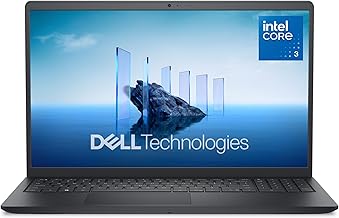
The DC15250 is a comfortable middle-ground machine for students or home users who want a full 15.6-inch FHD panel without paying premium prices. The Intel Core 3 100U handles everyday tasks capably, and 512 GB of SSD storage removes the storage anxiety that plagues cheaper models. Wi-Fi 6 and Bluetooth are included, and the anti-glare IPS WVA panel at 250 nits works well indoors, though it struggles in bright sunlight. Intel UHD Graphics limits this to light creative work at best. The DDR4 platform is fine for this tier but not future-proof.
- Pro: Generous 512 GB SSD and Wi-Fi 6 at a mid-range price
- Pro: Anti-glare IPS panel with decent viewing angles
- Con: Intel UHD Graphics cannot handle anything beyond casual photo editing
Skip it if you need GPU acceleration for video work or gaming; the integrated graphics will bottleneck you quickly.
HP Everyday Slim Laptop (N150)
This is a true entry-level machine built around the Intel N150, a low-power processor that prioritizes battery life over speed. At 4 GB of DDR5 RAM and 128 GB storage, it is designed for one or two browser tabs and an email client. The long battery life claim holds up in practice for light workloads, and the slim form factor makes it genuinely portable. But the moment you open a second application alongside a browser, you feel the RAM ceiling. It works for grandparents, kids doing basic homework, or anyone whose computing needs fit in a single window.
- Pro: Excellent battery endurance for light tasks
- Pro: Slim and genuinely portable form factor
- Con: 4 GB RAM makes multitasking frustrating
Skip it if you need more than one app open at a time or expect the machine to last beyond a couple of years.
HP 2026 Student Business Laptop
HP bundles Copilot AI and Office 365 into this student-focused machine, which is a smart move for anyone who would otherwise pay separately for productivity software. The Willow Green finish adds personality, and the lightweight chassis is easy to carry between classes. Like other N150 machines, the 4 GB RAM and 128 GB storage limit what you can do locally. Wi-Fi 6 and long battery life are welcome features for campus use. The value proposition depends entirely on whether you will actually use the bundled software; if not, you are paying a small premium for something you will never touch.
- Pro: Office 365 and Copilot AI bundled saves significant subscription costs
- Pro: Lightweight with solid battery life for a full class schedule
- Con: 128 GB storage forces cloud reliance immediately
Skip it if you already have an Office subscription or need local storage for large project files.
Dell Latitude 7420 (Renewed)
The carbon fiber chassis on the Latitude 7420 gives it a premium feel that no plastic budget laptop can match, and the i7 11th Gen with 16 GB RAM and 512 GB SSD is a strong configuration for the price. It feels like a $900 machine on your desk. The 3.6 rating reflects renewed-unit inconsistency — some buyers receive well-refurbished machines, others get units with worn keys or battery degradation. For the right buyer who tolerates that risk, the hardware itself is excellent. The Wi-Fi and Bluetooth connectivity are solid.
- Pro: Carbon fiber build quality unmatched at this price tier
- Pro: i7 processor with 16 GB RAM and 512 GB SSD is a premium config
- Con: Renewed condition varies widely between units
Skip it if you value certainty in build condition or need warranty coverage beyond a basic return window.
HP 14 (N150) with 1TB Cloud Storage
The 5 out of 5 rating puts this HP 14 in a unique position: it is the same N150 platform as the Everyday Slim, but the bundled 1 TB cloud storage and Microsoft 365 subscription address the two biggest weaknesses of any 128 GB laptop. For students or casual users who live in a browser, this is a genuinely excellent package for under $300. The 4 GB DDR5 RAM is still the hard ceiling, but the cloud storage means you never hit the local drive limit. The build is adequate, not premium.
- Pro: 1 TB cloud storage and Microsoft 365 eliminate the storage limitation entirely
- Pro: Top-rated value in this price bracket
- Con: 4 GB RAM still restricts simultaneous workloads
Skip it if you need offline access to large files or run demanding local applications.
Lenovo V15 Gen 4
The V15 Gen 4 is a no-nonsense business laptop with a spec sheet that justifies its under $800 price: i5-13420H (a H-series chip that beats many U-series i7s), 16 GB RAM, 512 GB SSD, RJ45 Ethernet, HDMI, and a numeric keypad. The port selection is genuinely useful for office and lab environments where Wi-Fi drops or you need wired connections. The FHD display is standard quality. It runs warm under sustained load due to the H-series power draw but handles heavy multitasking without slowing down. This is the best choice for business users who need reliability and connectivity.
- Pro: RJ45 Ethernet, HDMI, and numeric keypad in a portable form factor
- Pro: i5-13420H delivers real sustained performance that rivals premium ultrabooks
- Con: Highest price in this lineup; the FHD panel is average quality
Skip it if you are on a tight budget or do not need wired networking and a numpad.
HP 15.6 FHD IPS Touch
The 15-fd0154wm is the most versatile machine in this group. The i5-1334U with Intel Iris Xe Graphics handles moderate creative work, the 8 GB DDR4 RAM supports comfortable multitasking, and the 512 GB SSD removes storage worries. The IPS touchscreen adds a layer of interaction that makes scrolling, zooming, and marking up documents feel natural. The 4.6 rating reflects strong consistency across buyer experiences. The only trade-off is DDR4 rather than DDR5, but at this performance tier the practical difference is minimal.
- Pro: IPS touchscreen with Iris Xe graphics for capable creative work
- Pro: Strong balance of RAM, storage, and processor with high user satisfaction
- Con: Touchscreen adds glare compared to matte alternatives
Skip it if you work near windows or outdoors and cannot tolerate screen reflections on a glossy panel.
Buying Guide
Match the Processor Tier to Your Real Workload
The N150 and Core 3 100U are fine for browsing, email, and streaming — but they are designed to throttle under sustained loads. The i5-1145G7 and i5-1334U are genuine performance chips that handle dozens of tabs and light photo editing without stalling. The i5-13420H sits in a different class entirely, built for users who run virtual machines, compile code, or edit video. Do not pay for a chip tier you will never stress, but do not underbuy if you multitask heavily.
RAM Determines How Long You Keep the Machine
Four gigabytes is the practical minimum for Windows 11 today, and every N150 machine in this list ships with it. The real question is whether the RAM is soldered or upgradeable. The Latitude and V15 machines ship with 16 GB out of the box, which is the sweet spot for longevity. If a machine has 4 GB soldered to the board, you are buying a device with a two-year usable life. Always check upgradeability before committing to the lower-RAM options.
Screen Quality Is Where Budget Laptops Cut Corners
All eight machines list FHD resolution, but 250 nits of brightness with an anti-glare IPS panel (like the DC15250) is a fundamentally different experience from 220 nits with a TN panel at the same resolution. Touchscreen models add convenience but introduce glare in reflective environments. If you read for hours or work near windows, prioritize viewing angles and brightness over resolution alone. The spec sheet will not tell you how the panel behaves at noon by a south-facing window.
Our Verdict
The HP 15.6 FHD IPS Touch (15-fd0154wm) is our top pick for most buyers. It balances processor performance, storage, screen quality, and user satisfaction better than any other machine in this group, and the touchscreen adds practical value for document annotation and media browsing.
The HP 14 with N150 and 1TB Cloud Storage is the best budget pick. For under $300, the combination of long battery life, Microsoft 365, and cloud storage eliminates the practical downsides of the 128 GB SSD and makes it genuinely usable for a student or casual browser.
The Lenovo V15 Gen 4 wins outright if you work in an environment where wired networking, a numeric keypad, or sustained multi-hour compute loads matter. The performance headroom of the i5-13420H and the full port selection make it the correct choice for office professionals and technical users who value capability over portability.
FAQ
Are renewed laptops worth the risk?
Renewed units like the Latitude 5420 and 7420 offer strong specs at very low prices, but condition varies by refurbisher. Look for sellers with clear return policies and recent seller ratings. If the price difference between renewed and new is under 20%, buying new is the safer choice.
Is 4 GB of RAM enough in 2026?
For one browser window with a handful of tabs, an email client, and light streaming, yes. For anything involving document editing with references open, multiple applications, or heavy web apps, no. Four gigabytes is a starting point, not a comfortable ceiling, and it determines how long the machine stays usable.
Does a touchscreen actually matter on a laptop?
It depends on your workflow. If you annotate PDFs, browse long articles, or use design tools that benefit from direct manipulation, a touchscreen adds real value. If your laptop sits on a stand and you use it with a keyboard and mouse, the glossy finish of a touch panel just adds glare without benefit.
Should I upgrade storage immediately after buying?
If the machine has a spare M.2 slot or a 2.5-inch bay, yes — a larger SSD is one of the cheapest upgrades that makes the most difference in daily usability. If the storage is soldered (as on most thin N150 machines), you are locked into the capacity you buy, so cloud storage bundles or external drives become necessary.