Our Top Picks
The best lab centrifuge for most small labs, classrooms and workshops is a benchtop model whose speed, rotor and tube capacity match the method you run, and among these ten listings the range runs from compact 6-tube mini units to 8- and 12-tube benchtop machines with stored programs. Titles quote RPM and xg figures that are the seller’s claims, and several listings are near-duplicates of each other. Check the rotor, tube ratings and safety features on the product page before you buy.
Top picks at a glance

ONiLAB Lab PRP Centrifuge, 6X15ml/10ml/7ml/1.5-5ml, 300-5000RPM, Max 2600×g | LCD Digital Desktop Centrifuge, 30sec-99min Timer, Two Quick Start Programs for Efficient PRP Separation


As an Amazon Associate we earn from qualifying purchases. Product prices and availability are accurate as of the date/time indicated.

LAB FISH LC-8S Centrifuge, 8x2/5/10/15ml Tubes



As an Amazon Associate we earn from qualifying purchases. Product prices and availability are accurate as of the date/time indicated.

NEWTRY Mini Centrifuge Machine, Electric Lab Desktop Benchtop Centrifuges | 10ml x 6 Rotor Capacity, 300-4000r/min Speed Control, 0-60min Timer, Max. 1790xg, 110V Plug, Easy Operation


As an Amazon Associate we earn from qualifying purchases. Product prices and availability are accurate as of the date/time indicated.

Desktop Electric Lab Laboratory Centrifuge Machine Lab Medical Practice w/Timer and Speed Control - Low Speed,4000 RPM, Capacity 20 ML x 6-110v by CALU LUKY


As an Amazon Associate we earn from qualifying purchases. Product prices and availability are accurate as of the date/time indicated.

JOANLAB LC500-6 Lab Centrifuge, 500-4000RPM, 2146xg


As an Amazon Associate we earn from qualifying purchases. Product prices and availability are accurate as of the date/time indicated.

Maccx Lab PRP PRF Benchtop Low Speed Centrifuge Machine,300-5000RPM | Rotor for 1.5-5mL/7mL/10mL/15mL/ x6 Tubes, Max. RCF 2600xg Low Speed PRF Benchtop Centrifuge, CEN-001


As an Amazon Associate we earn from qualifying purchases. Product prices and availability are accurate as of the date/time indicated.

LAB FISH LC-6S Centrifuge, 6x2/5/10/15ml Tubes


As an Amazon Associate we earn from qualifying purchases. Product prices and availability are accurate as of the date/time indicated.

ONiLAB Professional PRP Centrifuge Machine 15mLx8, 10mL/7mL/1.5-5mlx 12, Lab Benchtop Centrifuge, 3 Preloaded Programs for Fast Operation,Store 9 Programs, 30sec-99min,300-4500rpm(Max. 2490xg)


As an Amazon Associate we earn from qualifying purchases. Product prices and availability are accurate as of the date/time indicated.

LACHOI Lab Mini Centrifuge Machine LCD 100-12000RPM 99mins Timer 7245×g RCF


As an Amazon Associate we earn from qualifying purchases. Product prices and availability are accurate as of the date/time indicated.

LAB FISH LC500-6 Lab Centrifuge, 500-4000RPM, 2146xg | 9 quick programs, digital display, 2/5/10/15/50ml tubes, imbalance protection, lid lock, PRP plasma prep


As an Amazon Associate we earn from qualifying purchases. Product prices and availability are accurate as of the date/time indicated.
| Model | Key point from the title | Price tier | Best for |
|---|---|---|---|
| ONiLAB Lab PRP Centrifuge (6-tube) | 300-5000RPM, 2600xg max, 2 quick programs | Mid-range | Small PRP-style spins with presets |
| LAB FISH LC-8S | 8 tube positions, 2/5/10/15ml | Mid-range | More samples per run |
| NEWTRY Mini Centrifuge | 6x10ml, 300-4000r/min, 1790xg | Budget | Entry-level teaching and light use |
| CALU LUKY Desktop Centrifuge | 6x20ml, 4000 RPM, timer and speed control | Budget | Larger tubes on a tight budget |
| JOANLAB LC500-6 | 500-4000RPM, 2146xg | Premium | Routine 6-tube spins |
| Maccx CEN-001 | 300-5000RPM, 2600xg, 6 tubes | Mid-range | Wide speed range for the cost |
| LAB FISH LC-6S | 6 tube positions, 2/5/10/15ml | Mid-range | Straightforward 6-tube work |
| ONiLAB Professional PRP | 8x15ml and more, 9 stored programs, 2490xg | Premium | Higher throughput with presets |
| LACHOI Lab Mini | 100-12000RPM, 7245xg, LCD | Budget | Small-tube, high-speed work; check rotor |
| LAB FISH LC500-6 | 9 quick programs, imbalance protection, lid lock | Premium | Safety features and presets |
Why a benchtop centrifuge sits at the centre of so many workflows
A centrifuge separates components of a liquid by spinning tubes so denser material moves outward. Labs use them to pellet cells, clarify solutions, separate layers in a sample and prepare materials for later steps. Teaching labs, small research groups, hobbyist biology spaces and workshops often settle on a compact benchtop unit because it uses little bench space and runs from a standard outlet.
Benchtop and floor-standing models differ in size, capacity and speed. Floor-standing machines typically take bigger volumes and heavier rotors, and some can run much faster or cool the chamber. A benchtop unit like the ones here is built for smaller loads, and for that reason it is the format most readers should compare first. If your method asks for refrigeration, very high speed or large bottles, you are in a different class of equipment from what these listings describe.
It also helps to know what is changing in the category. Digital displays, stored programs, lid locks and imbalance sensing have moved down into cheaper models, and online marketplaces now carry many lightly differentiated brands. That means the same specifications can appear under several names, which is why we flag near-duplicate listings below. This is general context, not a forecast, and you should read each product page carefully.
How we picked these
We read each supplied listing title for rotor capacity, speed range, maximum xg, timer, programs and safety wording, then grouped them by tube count and use. Nobody on the team used or measured these units. Our basis is published specifications, manufacturer documentation and buyer reviews, and wherever a title is silent we say "check the listing" and do not fill in the gap.
The ten listings, one at a time
ONiLAB Lab PRP Centrifuge, 6X15ml/10ml/7ml/1.5-5ml, 300-5000RPM, Max 2600xg, LCD Digital Desktop
The title states six tube positions with several tube sizes, a 300-5000 RPM range, a maximum of 2600 xg, an LCD, a 30-second to 99-minute timer and two quick start programs. It is marketed for PRP separation, which is a medical-adjacent use, so decisions about suitability belong to qualified professionals and the rules that apply to you.
It suits someone who wants a simple digital interface with a couple of presets and a broad speed range. A scenario: a small lab running the same six-tube spin every day, where a one-touch preset reduces setup mistakes.
- Pro: wide speed range with an LCD and a long timer.
- Pro: quick start programs for repeat spins.
- Con: tube sizes are described in a dense string, so confirm adapters are included.
- Con: the title does not describe safety features such as lid locking.
Check the listing for rotor type, noise and whether it has imbalance detection. Question to ask: does the rotor take the exact tubes you use?
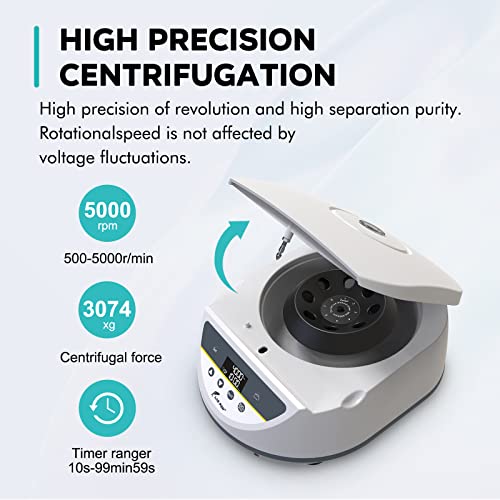
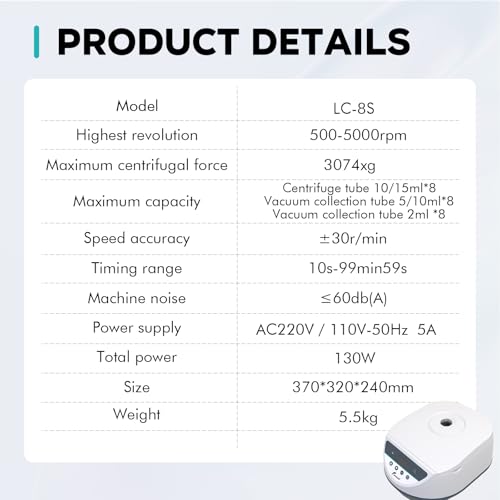
LAB FISH LC-8S Centrifuge, 8×2/5/10/15ml Tubes
A short title: eight positions that accept 2, 5, 10 and 15 ml tubes. There is no speed, xg or timer information, so the product page has to answer almost everything.
It could suit a lab that wants to run more samples per cycle than a six-tube model allows. Eight positions help when samples come in even numbers, because balanced loads need pairs.
- Pro: eight tube positions.
- Pro: several tube sizes named.
- Con: no speed range in the title.
- Con: the title says nothing about displays or safety features.
Check the listing for maximum RPM and xg, the timer and lid lock. Question to ask: what are the top speed and the rotor’s maximum load per tube?
NEWTRY Mini Centrifuge Machine, 10ml x 6 Rotor, 300-4000r/min, 0-60min Timer, Max 1790xg, 110V
The title reads: six 10 ml tubes, 300-4000 r/min, 0-60 minute timer, 1790 xg maximum, 110V plug and easy operation. It sits in the budget tier and gives enough numbers to calculate the rotor radius if you want to (see the worked example).
It suits teaching and light routine spins where a modest force is enough. A classroom demonstration of separating a sample is a fair scenario.
- Pro: clear specifications at a low price tier.
- Pro: a speed control range down to 300 for gentle spins.
- Con: maximum force is lower than some peers.
- Con: no mention of lid lock or imbalance protection.
Check the listing for tube adapters and noise. Question to ask: is the 10 ml figure for standard conical tubes or a special type?
Desktop Electric Lab Laboratory Centrifuge Machine Lab Medical Practice w/ Timer and Speed Control, 4000 RPM, 20 ML x 6, 110V, CALU LUKY
This low-speed machine accepts six 20 ml tubes and tops out at 4000 RPM, with a timer and speed control. The title does not give xg, so you cannot assume force from RPM without knowing the rotor radius.
It could suit a budget workshop that needs larger tubes. The phrase medical practice is a seller description and does not establish that the device is approved for any clinical use.
- Pro: 20 ml capacity per tube.
- Pro: low entry price tier.
- Con: no xg figure stated.
- Con: no mention of safety interlocks.
Check the listing for rotor radius, a certificate and lid latching. Question to ask: what is the xg at the top speed and the tube rating?
JOANLAB LC500-6 Lab Centrifuge, 500-4000RPM, 2146xg
The title gives a 500-4000 RPM range, 2146 xg, and a six-tube model code. In the premium tier, it competes with the LAB FISH LC500-6 below, which has the same model code and the same quoted speed and force.
It suits routine six-tube spins where you want a mid-range force. Because the two LC500-6 listings look near-identical, read both pages to see which one clearly lists the features you need.
- Pro: 2146 xg is plenty for many low-speed methods.
- Pro: simple model naming.
- Con: minimal feature detail in the title.
- Con: near-duplicate of another listing.
Check the listing for the programs, the safety features and the warranty. Question to ask: how does it differ from the LAB FISH LC500-6?
Maccx Lab PRP PRF Benchtop Low Speed Centrifuge, 300-5000RPM, 1.5-5mL/7mL/10mL/15mL x6, Max RCF 2600xg, CEN-001
Six tube positions for various tube sizes, a 300-5000 RPM range and a 2600 xg ceiling, labelled low speed and PRP/PRF oriented. It sits in the mid-range and is close in numbers to the ONiLAB 6-tube unit.
It could suit a lab that wants the higher speed ceiling of the 5000 RPM class without a premium price tier. The title does not mention programs or a timer, so look at the page.
- Pro: wide RPM range.
- Pro: several tube sizes stated.
- Con: no timer or program information in the title.
- Con: no mention of safety features.
Check the listing for timer range and lid lock. Question to ask: are tube adapters for the smaller sizes included?
LAB FISH LC-6S Centrifuge, 6×2/5/10/15ml Tubes
The six-position sibling of the LC-8S, with the same tube sizes and no other numbers in the title. It is in the mid-range tier.
It suits a lab that wants simplicity and fewer samples per run than the eight-tube sibling. If you routinely run four or six tubes, the smaller rotor can be enough.
- Pro: straightforward six-tube layout.
- Pro: same tube range as the larger LC-8S.
- Con: no speed, xg or timer data in the title.
- Con: no stated safety features.
Check the listing for all performance numbers. Question to ask: does it make sense to buy the eight-tube LC-8S for the extra capacity?
ONiLAB Professional PRP Centrifuge Machine 15mLx8, 10mL/7mL/1.5-5mlx12, 300-4500rpm, Max 2490xg
This premium listing mentions 15 ml x 8 and a second set of smaller tubes x 12, three preloaded programs and storage for nine, a 30-second to 99-minute timer, 300-4500 rpm and a maximum of 2490 xg. The title is ambiguous about whether the rotor takes 8 or 12 tubes, or has two rotor options.
It suits someone who needs higher throughput and stored programs. Because it targets PRP use, the same professional and regulatory caveats apply as with the first ONiLAB listing.
- Pro: presets and nine stored programs.
- Pro: higher throughput than six-tube models.
- Con: unclear rotor wording.
- Con: premium tier.
Check the listing for rotor options. Question to ask: which rotor ships by default, and are the others sold separately?
LACHOI Lab Mini Centrifuge Machine LCD 100-12000RPM 99mins Timer 7245xg RCF
A mini centrifuge with an LCD, a 100-12000 RPM range, a 99-minute timer and 7245 xg. The title lacks the tube capacity and rotor type, so it is the least clear on what it holds. Mini units of this kind are often meant for small tubes, but check the listing before you assume.
It could suit quick spins of small tubes at high speed. The numbers in the title also imply a small rotor radius, which is consistent with a compact machine.
- Pro: highest quoted xg in the set.
- Pro: budget tier with an LCD.
- Con: tube type and capacity not in the title.
- Con: a high speed machine needs careful balance and certified tubes.
Check the listing for rotor details and safety features. Question to ask: what tubes is it rated for, and is there a lid lock?
LAB FISH LC500-6 Lab Centrifuge, 500-4000RPM, 2146xg, 9 Quick Programs, Digital Display, Imbalance Protection, Lid Lock
The most safety-oriented title: it lists nine quick programs, a digital display, imbalance protection and a lid lock, along with 2/5/10/15/50 ml tubes, 500-4000 RPM and 2146 xg. It also mentions PRP plasma prep, with the same professional-judgement caveat.
It suits a lab that values presets and protective features, and it is a near-duplicate of the JOANLAB LC500-6 in speed and force. If the safety wording is accurate, this title is the more informative of the two.
- Pro: lid lock and imbalance protection are named.
- Pro: nine quick programs for repeat tasks.
- Con: premium price tier.
- Con: 50 ml tube support should be confirmed with the rotor.
Check the listing for what the imbalance protection does and the rotor specification. Question to ask: is the lid lock mechanical or electronic, and what happens during a power cut?
Choosing a centrifuge: what matters most
Rotor, tube size and capacity
Start with the tubes you run. The titles use 1.5 ml up to 50 ml, in six, eight or twelve positions. A rotor has a maximum load per position, and a tube has its own rating, so both must fit your sample. Use tubes that are rated for the speed you plan to use, and avoid cracked or old plastic.
RPM versus xg
RPM is the spin rate; xg is the force. Protocols are normally written in xg. The relationship is RCF = 1.118 x 10^-5 x radius (cm) x RPM^2. This is why two machines at 4000 RPM can deliver different force. Look for an xg figure in the title or ask the seller for the rotor radius.
Timers, programs and controls
Some titles give a 30-second to 99-minute timer, others 0-60 minutes. Stored programs are helpful for repeat tasks and reduce keystroke errors. Quick start programs are fine if the preset matches your method; otherwise manual control is more flexible.
Safety features and safe use
Balance the rotor, close the lid, and never open it while spinning. A lid lock and imbalance detection reduce risk but do not replace good practice. Wear eye protection when handling samples; our guides to lab safety goggles for science students and a comparison of two goggle options cover that side. Follow the manufacturer’s instructions and your lab’s safety procedures, and treat biological samples according to the rules that apply to you.
Worked example: matching a method that calls for 1500 xg
Assume a protocol that asks for 1500 xg for 10 minutes. The NEWTRY title lists 4000 r/min and 1790 xg, which implies a radius near 10 cm (1790 divided by 1.118 x 10^-5 x 4000^2). At 10 cm, 1500 xg needs about 3660 RPM. For a rotor at 12 cm, the figure would be about 3340 RPM. These radii are inferred estimates from title numbers, not measurements, and the real rotor radius must come from the manufacturer.
| Spec concept | What to look for | Why it matters |
|---|---|---|
| Maximum xg | Above your method’s requirement | Ensures the rotor can reach the force needed |
| Rotor and tubes | Positions, tube sizes, adapters | Defines what you can run per cycle |
| Speed control | RPM range and steps | Gentle spins need low-speed control |
| Timer | Range such as 30 seconds to 99 minutes | Matches the method’s run time |
| Safety | Lid lock, imbalance protection | Reduces risk if a load is uneven |
| Power | 110V plug and outlet type | Must match your supply |
Mistakes buyers make
The first mistake is buying on RPM alone. Two machines with the same RPM can produce different xg because the rotor radius differs, and your method probably uses xg. The second mistake is skipping the tube rating: a tube that is not rated for the speed can crack and create a mess and a hazard.
Third, buyers assume that a near-identical listing is the same product. The two LC500-6 titles show the problem, since the quoted speeds match but the extra features may not. Fourth, many ignore balance, and an uneven load will shake the machine or damage the rotor.
Fifth, buyers read PRP or medical wording as proof that a device is suitable for clinical use. It is not, and any such use belongs with qualified professionals and applicable rules. Last, they forget supply details such as the 110V plug.
Which one for which use
For teaching and light use on a small budget, look at the NEWTRY and the CALU LUKY. For small high-speed tubes, the LACHOI needs its rotor details confirmed. For six-tube PRP-style presets, compare the ONiLAB 6-tube and the Maccx. For more samples per run, the LAB FISH LC-8S and the ONiLAB Professional are the candidates. For safety features, the LAB FISH LC500-6 has the most explicit title. Between the two LC500-6 listings, choose the one that lists what you need.
Related guides
- Rechargeable Electric Toothbrush With Travel Case
- Countertop Water Filters Without Installation
- Skin Lifting And Tightening Devices
Frequently asked questions
What is the difference between RPM and xg (RCF)?
RPM counts how many times the rotor turns each minute, while xg, also called relative centrifugal force, describes the force on the sample and depends on both speed and rotor radius. Protocols are usually written in xg so they can be repeated on different machines. If a method gives xg, convert it for your rotor using the manufacturer’s chart or the standard formula.
Are benchtop centrifuges suitable for every lab task?
No. Benchtop models like those here cover low-speed tube spins, but high-speed or refrigerated work, large volumes and certain sample types call for different equipment. Match the instrument to the method, check the rotor and tube ratings, and ask the manufacturer or your lab supervisor if a protocol asks for something these listings do not state.
Why do some listings say PRP or PRF?
PRP and PRF refer to plasma preparations that are made by spinning blood samples. Several titles here use those terms for their programs and rotors. We cannot give medical advice, and a listing’s wording does not establish that a device is suitable or permitted for clinical use, so follow the rules that apply to you and consult qualified professionals.
How do I keep a centrifuge balanced?
Place tubes opposite each other with matching volume and weight, use the same tube type, and use a balance tube when you have an odd number. Never run a rotor that is loaded unevenly or damaged, and do not open the lid while it is spinning. Always follow the manufacturer’s instructions for the specific rotor and the lab’s safety procedures.
Do the listed timers and speed ranges mean the same thing across brands?
Not always. Ranges such as 300-5000RPM or 100-12000RPM describe what the controller can set, but the usable maximum depends on the rotor and the tubes. Timers run from 30 seconds to 99 minutes in some titles, but not in others. Compare each range against what your protocol demands.
Is a higher xg always better?
No. Higher force is useful only if your method needs it, and too much can damage delicate samples or exceed a tube’s rating. The titles here run from 1790 xg to 7245 xg, but most low-speed tasks sit well inside that range. Start from the protocol and the tube’s stated limit and choose the machine that meets it.