A condenser microphone is a precision instrument that will faithfully record everything you did not want. That sensitivity is exactly why studios use them on vocals, acoustic guitars and drum overheads — the diaphragm is light enough to respond to fast transients and quiet detail. It is also why a condenser in an untreated bedroom picks up the refrigerator, the road, and the reflection of your own voice bouncing off the wall behind the microphone.
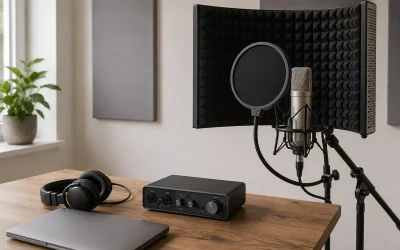
So the honest advice about condensers is that the microphone is only half the purchase. The other half is a cardioid pattern pointed away from your worst reflective surface, a pop filter for plosives, a shock mount for floor vibration, and ideally something soft behind the singer. Get that right and a modestly priced large-diaphragm condenser produces recordings that hold up. Get it wrong and an expensive one sounds worse than a dynamic. This guide compares XLR studio condensers and one USB option, and explains where each fits.
Our top picks


As an Amazon Associate we earn from qualifying purchases at no extra cost to you.
Quick Comparison
| Product | Best For | Standout Feature | Watch Out For |
|---|---|---|---|
| Lewitt LCT 540 S | Extremely quiet detailed capture | Exceptionally low self-noise | Reveals every flaw in an untreated room |
| RØDE NT1 Signature | Vocals with everything included | Shock mount, pop filter and cable supplied | Needs an interface with phantom power |
| Audio-Technica AT2020 | Home studio workhorse | Reliable cardioid response at a fair price | No shock mount or pop filter included |
| Mackie EM-91C | Budget large-diaphragm recording | Large capsule warmth at entry-level cost | Less refined top end than premium mics |
| FIFINE K669B | Recording without an interface | USB connection with no extra hardware | Fixed preamp limits future upgrades |
| Behringer C-2 Pair | Stereo and instrument recording | Matched pair for overheads and acoustics | Small diaphragms are unflattering on vocals |
How to Choose
- Large or small diaphragm: Large diaphragms flatter voices with warmth and body. Small diaphragms track transients more accurately, which suits acoustic guitar, cymbals and stereo pairs.
- You need phantom power: XLR condensers require 48 volts from an interface or mixer. Confirm your interface supplies it before ordering anything with an XLR connector.
- Self-noise sets the floor: Low self-noise matters when recording quiet sources. Anything under about 10 dBA is exceptionally quiet; under 18 dBA is fine for most work.
- Budget for mounting: A shock mount isolates floor and desk vibration and a pop filter stops plosives hitting the capsule. Neither is optional for serious vocal recording.
- Treat the room, not just the signal: A duvet behind the singer or a reflection filter does more for a condenser recording than any plugin applied afterwards.
Top Picks Reviewed
Most Detailed: Lewitt LCT 540 S
Remarkably low self-noise means this captures whispered vocals and delicate acoustic detail with a black background where cheaper microphones would give you hiss. For close, intimate recording it is in a different class.
That sensitivity is unforgiving. Every room reflection, mouth noise and passing car arrives in the recording too, so it demands a treated space to justify itself.
Best Complete Vocal Package: RØDE NT1 Signature
Supplied with a shock mount, pop filter and XLR cable, this removes the classic mistake of buying a good microphone and then recording plosives straight into it. The capsule is smooth and forgiving on vocals, with a gentle presence lift that suits singing and speech.
It needs an interface supplying 48 volts of phantom power. Factor that into the budget if you are starting from a bare laptop.
Best Workhorse: Audio-Technica AT2020
The AT2020 has been the default first studio condenser for years because it does everything competently — vocals, acoustic guitar, voiceover — with a cardioid pattern that rejects the rear reasonably well and a build that survives being knocked about.
It ships alone. A shock mount and pop filter are separate purchases, and you will want both before recording vocals seriously.
Best Budget Large Diaphragm: Mackie EM-91C
A large-diaphragm capsule at an entry-level price gives you the fuller, warmer character that small-capsule USB microphones cannot produce, which flatters spoken word and singing alike.
The top end is less refined than premium condensers, sounding slightly harder on bright sources. In a mix that is easily managed with gentle EQ.
Best Without an Interface: FIFINE K669B
If you do not own an interface and do not want one, this metal-bodied cardioid condenser records straight into a laptop over USB and sounds surprisingly capable on close vocals and voiceover.
The preamp and converter are fixed inside the microphone. You cannot upgrade one part of the chain later without replacing everything.
Best Stereo Pair: Behringer C-2
A matched pair of small-diaphragm condensers is the practical way into stereo recording — drum overheads, acoustic guitar in stereo, room ambience or a choir. Matched capsules keep the stereo image stable.
Small diaphragms are accurate rather than flattering. On lead vocals they sound thin compared with a large-diaphragm microphone.
Frequently Asked Questions
Do condenser microphones need phantom power?
XLR condensers do — 48 volts supplied by an audio interface or mixer. USB condensers draw power over the USB connection instead, which is part of why they are simpler to use.
Why does my condenser sound echoey?
It is hearing your room. Move closer to the microphone, put something soft behind you and behind the mic, and angle the capsule away from the most reflective wall.
Large or small diaphragm for vocals?
Large diaphragm. It gives the warmth and body listeners associate with recorded vocals. Small diaphragms are better for accurate instrument and stereo capture.
Do I need a pop filter?
For vocals, yes. Plosive consonants push a blast of air at the diaphragm that produces a low thump no amount of EQ fixes cleanly. A filter or singing slightly off-axis prevents it.
Final Thoughts
Pick a large-diaphragm cardioid condenser for voices and a small-diaphragm pair for stereo instrument work, then spend whatever is left on a shock mount, a pop filter and something soft behind the singer. A condenser rewards a good room more than almost any other piece of gear, and punishes a bad one just as reliably.