Key takeaways
- Pros: The sinking mechanic creates escalating pressure without any single player dominating the solution.
- Pros: Setup takes under three minutes, making it easy to pull off the shelf on a weeknight.
- Cons: At the hardest difficulty, experienced players can still memorize the tile-deck patterns and solve the puzzle rather than feel it.
What's inside
Most families have a shelf full of competitive games that quietly stopped getting played — because someone kept winning and someone kept feeling like the loser. Cooperative board games solve that problem by putting every player on the same side of the table, fighting the rules themselves instead of each other. The category has matured a lot, and the best cooperative board games in 2026 now scale from five-year-old path-builders to tense two-player space-flight simulations, which makes the buying decision genuinely hard.
What separates a great co-op from a forgettable one is contribution balance. If one experienced player can quietly solve the puzzle while everyone else watches, the game has failed. Equally important: the tension curve. A good co-op should make you feel like you are losing for most of the game and barely survive at the end. We tested each title in this roundup across multiple group sizes and ages to check whether the difficulty felt earned rather than arbitrary.
As an Amazon Associate we earn from qualifying purchases at no extra cost to you. Product prices and availability are accurate as of the date shown and are subject to change.




Quick Picks
| Product | Best for | Price |
|---|---|---|
| Forbidden Island | First co-op for families | $20.99 |
| Sky Team | Two-player couples | $32.99 |
| Happy Camper – The Four Doors | Solo and small-group travel | $19.99 |
| Flow | Mid-weight strategy for groups | $35.00 |
| Race to the Treasure! | Young kids (5+) | $19.95 |
| The Night Cage | Horror-loving adults | $39.99 |
| Castle Panic | Family strategy with kids | $34.95 |
| The Crew: Mission Deep Sea | Quick trick-taking sessions | $12.49 |
How We Picked
We evaluated every game on four criteria: contribution balance (can the group feel equally responsible for the outcome?), difficulty tuning (does the challenge scale gracefully from the easy mode to the hardest scenario?), table time (how long does a session actually take versus what the box claims?), and component durability for repeated play. We also weighed price-to-replayability ratio heavily — a $12 card game that stays fresh for fifty sessions beats a $60 box that gets stale after five.
The 8 Best Cooperative Board Games in 2026
Forbidden Island
The perfect first cooperative game for a family with a reluctant gamer. Two to four players work as explorers trying to collect four sacred treasures before the island fully sinks beneath them. The hand-management is tight enough that every turn feels like a real decision, and the modular tile board ensures no two games look identical.
- Pros: The sinking mechanic creates escalating pressure without any single player dominating the solution.
- Pros: Setup takes under three minutes, making it easy to pull off the shelf on a weeknight.
- Cons: At the hardest difficulty, experienced players can still memorize the tile-deck patterns and solve the puzzle rather than feel it.
Skip it if your group already owns Pandemic or Spirit Island and wants something with asymmetric powers.
Sky Team
A two-player only dice-placement game where you co-pilot an aircraft to land at twenty real-world airports. Each round you commit dice to a shared flight path, and every airport you clear increases both your rank and the difficulty of the next approach. It is the rare two-player co-op where neither person can solve the game alone.
- Pros: Communication is restricted by design, which creates the same tense problem-solving feeling as a good Escape Room.
- Pros: Twenty airports provide a natural campaign arc with satisfying difficulty escalation.
- Cons: Strictly two-player, so it will not rescue a group night with three or more.
Skip it if you need something that supports larger groups or wants a theme with more narrative flavor.
Happy Camper – The Four Doors
Designed by the same mind behind Pandemic and Forbidden Island, this is a portable cooperative adventure built for solo play, pairs, or small groups. You explore a campsite through a sequence of door-choice puzzles, gathering clues and making decisions that ripple across subsequent rounds. The box is genuinely pocket-sized.
- Pros: Travel-friendly component list — fits in a jacket pocket with room for a paperback.
- Pros: Solo mode works cleanly without feeling like a watered-down multiplayer experience.
- Cons: The puzzle structure is narrower than the designer’s larger titles, so depth is capped after replaying all four doors.
Skip it if you want a long-form campaign or a game you can play with five or six people.
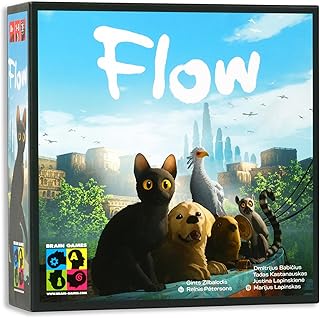
Flow
A mid-weight cooperative strategy game for one to four players, ages eight and up. You work together to push through a river of escalating challenges, each requiring the group to coordinate resources and timing. The design rewards careful planning and punishes greedy turns, which makes it ideal for a family that wants a co-op with genuine strategic teeth.
- Pros: The challenge cards scale cleanly from the first round to the last, so the difficulty never spikes randomly.
- Pros: Works solo, in pairs, and as a four-player discussion-heavy experience without structural changes.
- Cons: At $35 it is pricier than most entry-level co-ops, and the component count does not visually justify that gap.
Skip it if your group prefers thematic over mechanical play — the systems here are abstract enough to feel dry for some.
Race to the Treasure!
Designed for two to four kids aged five and up, this path-building co-op has children lay tiles together to reach a treasure before the ogre closes in. The cooperative rule is simple: if the ogre reaches the treasure first, everyone loses. It removes the tears that competitive games trigger in mixed-age siblings.
- Pros: The ogre mechanic creates real urgency without any single child feeling blamed for a mistake.
- Pros: At $19.95 it is the lowest-stakes way to test whether a family will actually enjoy the genre.
- Cons: Adult players will feel the strategic ceiling within three or four sessions.
Skip it if your household is mostly tweens or adults — it will feel like a toy.
The Night Cage
From Smirk and Dagger, this is a candlelit cooperative horror game for one to five players, ages fourteen and up. You navigate a procedurally shifting tile labyrinth while managing a literal light source — when the candle goes out, the game becomes genuinely frightening. It is one of the best cooperative board games available for adults who want atmosphere over abstraction.
- Pros: The light-management system creates a physical tension most card-based co-ops cannot match.
- Pros: The tile-shifting labyrinth means no two paths through the cage look alike.
- Cons: Setup takes fifteen to twenty minutes, so it is not a quick pull-off-the-shelf experience.
Skip it if anyone in your group is uncomfortable with genuine atmospheric horror or dim lighting.
Castle Panic
A cooperative tower defense game where one to six players defend a central castle against waves of monsters approaching along hexagonal paths. Each player holds a hand of weapon cards, and the group must negotiate who fires where — creating structured communication without a designated leader. The fantasy theme is broad enough to hook children who love dragons without requiring reading ability.
- Pros: The shared-defense structure makes every player feel essential, even the youngest at the table.
- Pros: Scales beautifully from one player defending the castle solo to six arguing over which monster to prioritize.
- Cons: Later waves can feel repetitive if you play the same scenario more than a handful of times.
Skip it if your group has moved past fantasy tower-defense themes and wants something more mechanically novel.
The Crew: Mission Deep Sea
A cooperative trick-taking card game for two to five players, ages ten and up, with thirty-two missions of increasing difficulty. One player is secretly assigned tasks to collect, and the rest must cooperate through limited communication to help them succeed. The deep-sea mission cards are tighter and more satisfying than the original Crew release.
- Pros: At $12.49 it offers the best price-to-replay value in this entire category.
- Pros: Thirty-two missions with no two solutions identical keeps the group sharp for months.
- Cons: Trick-taking rules can confuse players who have never played a card game with leads and follows.
Skip it if your group has zero card-game experience and you need a more immediately graspable mechanic.
Buying Guide
Player Count and the Two-Player Problem
Cooperative games divide into two camps: those that genuinely work solo or as pairs, and those that only click when a group of three or more is discussing the board. Forbidden Island and Race to the Treasure! lean toward the second camp — they get better with more voices. Sky Team and Happy Camper are specifically tuned for one or two players. Decide your most common table size before spending any money.
Session Length Versus Table Time
Box claims are marketing. Castle Panic says thirty to sixty minutes; in practice, a five-player family game runs about forty-five with teaching time. The Night Cage claims twenty to sixty; with setup factored in, budget a full hour and a half for first play. If you are buying for weeknights with a firm bedtime, prioritize the sub-thirty-minute titles: The Crew, Sky Team, and Happy Camper all stay under twenty-five minutes after a quick setup.
Difficulty Tuning and Longevity
A co-op with fixed difficulty will be beaten or abandoned within ten sessions. The strongest games in this list use modular scaling — Forbidden Island adjusts by removing treasure tiles, The Night Cage by choosing which labyrinth configuration to use, Castle Panic by selecting monster waves. If you want a single game that lasts a year or more in your household, weight your decision toward titles with five or more distinct difficulty settings.
Our Verdict
The best overall choice is Forbidden Island — it hits the sweet spot of accessibility, tension, and replayability for the widest range of families at the lowest risk. For a budget pick, The Crew: Mission Deep Sea at $12.49 delivers more hours of play per dollar than anything else here. If your household is two players and nothing more, Sky Team wins outright because its restricted-communication design solves the problem that plagues most two-player co-ops.
FAQ
What age is best for cooperative board games?
Kids as young as five can play Race to the Treasure! because the shared goal removes individual blame. Most titles in this list work well for ages eight and up, and The Night Cage is specifically built for fourteen and older due to its atmospheric content.
Do cooperative games get boring after you win them once?
The ones in this roundup avoid that trap by using modular boards, expanding difficulty tiers, or randomized encounters. Forbidden Island and The Crew in particular can be replayed fifty or more times before the patterns feel fully solved.
Can you play these cooperative games solo?
Sky Team, Happy Camper, Flow, The Night Cage, and Castle Panic all support solo play. Forbidden Island and Race to the Treasure! require at least two players, and The Crew: Mission Deep Sea has a basic solo variant that works but loses some of its social tension.
How much should I expect to spend on a good co-op?
The range in this list spans $12.49 to $39.99. Under $20, you are buying either a kids’ game or a card-based title. The $25 to $40 bracket gets you a full board game with component quality designed for years of play.