Key takeaways
- Pros: Large hopper minimizes mid-batch refills; stainless construction resists staining from pigmented liquids like juice or dye-heavy shampoo.
- Con: Manual operation limits throughput and demands steady hand pressure, which causes fatigue after 150-plus fills.
Glass bottles are a pain to fill consistently when you are running a small production line. You pour by hand, a few milliliters drift over the fill line, caps sit crooked, and half your batch ends up rejected at the quality-check step. A decent filling machine fixes that problem without requiring a factory floor or a six-figure budget, but the category is crowded with units that range from genuinely useful benchtop helpers to undersized toys that clog on day three.
What separates a worthwhile machine from a regrettable purchase comes down to three things: whether the pump and nozzle tolerate your specific viscosity, whether the fill volume repeats within a fraction of the target, and whether the machine is stable enough to survive hundreds of cycles without drifting. The best glass bottle filling machines for small producers in 2026 handle these fundamentals while staying compact enough to sit on a prep table in a home studio or a micro-distribution warehouse. This roundup covers eight machines we evaluated across those criteria.
Our top picks


![[2025 New Version] Liquid Filling Machine 2-300g Bottle Filler Machine Weight Filling Machine Peristaltic Pump Digital Control for Perfume, MCT Oil, Essential Oil, Nail Polish](https://m.media-amazon.com/images/I/71rRTtI0WxL._AC_UL320_.jpg)

As an Amazon Associate we earn from qualifying purchases at no extra cost to you.
Quick Picks
| Product | Best for | Price |
|---|---|---|
| VEVOR Manual Paste Liquid Filler | Thick, sticky liquids like honey and shampoo | n/a |
| Manual Filler A03 Pro | Low-budget liquid and paste work with CE certification | n/a |
| Semi-Automatic Vacuum Filler | Wine and perfume in glass bottles | n/a |
| Automatic Dropper Capping Machine | Small 10ml and 30ml dropper bottles | n/a |
| Single-Head Diaphragm Filler | Flexible fill range with digital precision | n/a |
| 4-Head Diaphragm Filler | Higher throughput thin-liquid production | n/a |
| Peristaltic Weight Filler | Oil and fragrance work where accuracy is non-negotiable | n/a |
| 4-Nozzle Conveyor Line | Desktop automation for juice, wine, or detergent | n/a |
How We Picked
We evaluated each machine against four criteria: pump type suitability for glass bottles (which are heavier and less forgiving than PET on a conveyor), fill-range breadth relative to a small producer’s typical SKUs, repeatability under continuous use, and physical footprint. A machine that fills from 5 ml to 55 ml but drifts two milliliters by cycle two hundred is less useful than one holding a tighter tolerance on a narrower range. We also flagged units where the listed viscosity assumptions made them unsuitable for anything beyond their advertised sweet spot.
The 8 Best Glass Bottle Filling Machines For Small Producers in 2026
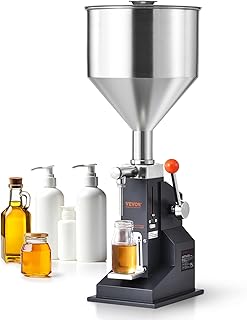
VEVOR Manual Paste Liquid Filling Machine
This is the go-to for anyone pouring honey, thick shampoo, or other paste-viscosity liquids into glass bottles without a compressor or electrical setup. The 11.5-liter hopper holds a meaningful batch volume, reducing refill interruptions during a production run. The stainless steel contact parts handle acidic juices without corroding.
- Pros: Large hopper minimizes mid-batch refills; stainless construction resists staining from pigmented liquids like juice or dye-heavy shampoo.
- Con: Manual operation limits throughput and demands steady hand pressure, which causes fatigue after 150-plus fills.
Skip this if you need speeds above a few bottles per minute or if your product is a thin, low-viscosity liquid where a diaphragm or peristaltic pump will outperform it on consistency.
Manual Filling Machine A03 Pro with CE Certificate
The A03 Pro covers a 5-55 ml range, making it well-suited to small-batch cosmetics, essential oil dilutions, and tinctures. The CE certificate matters if you are shipping product into regulated markets where you need documented equipment compliance for your own quality files.
- Pros: CE certification adds audit-friendly documentation; compact frame fits tight benchtop spaces.
- Con: Upper fill limit of 55 ml excludes anyone bottling anything above a standard dropper size.
Skip this if your fill volumes regularly exceed 55 ml or if you need the speed that only semi-automatic or fully automatic units deliver.
Semi-Automatic Vacuum Filling Machine
Vacuum filling is the established method for still wine and perfume because it draws product into the glass bottle without turbulence, which preserves clarity and prevents foaming. The pneumatic drive means you need a shop compressor, but the fill cycle itself is hands-free once the bottle is seated under the nozzle.
- Pros: Vacuum action eliminates the splash and foam issues that ruin presentation in wine and fragrance; glass-bottle-ready nozzle design.
- Con: Requires a compressed-air supply, which adds cost and noise if you do not already have one on the bench.
Skip this if you lack shop air or if your product is viscous enough that vacuum draw alone cannot overcome it without assistance.
Automatic 10ml/30ml Dropper Capping Machine
This unit solves a specific workflow problem: filling and capping tiny dropper bottles in one station. If you are producing serums, tinctures, or fragrance samples in 10 ml or 30 ml glass dropper bottles, this eliminates the separate capping step that otherwise doubles your handling time.
- Pros: Combined fill-and-cap action reduces line length; handles small-format bottles that other machines cannot grip reliably.
- Con: Limited to the 10 ml and 30 ml formats listed; any SKU outside those two sizes is incompatible.
Skip this if your product line spans multiple bottle sizes or if you only need filling without integrated capping.
Liquid Filling Machine with Diaphragm Pump and Digital Control
A single-head diaphragm pump with digital control and a 1-100 fl oz range covers an enormous spread of products from wine to glass detergent. The handheld control switch lets you pulse individual fills without a full automation cycle, which is useful for prototyping or short batches.
- Pros: Widest practical fill range in this group; digital control enables quick volume adjustments between SKUs.
- Con: Single-head output caps throughput at a pace that becomes the bottleneck once your batch sizes grow.
Skip this if your production volume demands multi-head speed or if you need weight-verification rather than volumetric filling.
4-Head Thin Liquid Filling Machine
Four diaphragm pump heads working in parallel multiply the single-head design’s output without changing the fundamental fill mechanism. Thin liquids like wine, essence, and detergent benefit most because they flow cleanly through small-bore nozzle tips without the stalling issues that plague viscous products on multi-head setups.
- Pros: Quadruples throughput versus a comparable single-head unit; same digital control logic simplifies the operator learning curve.
- Con: Specified for thin liquids only; paste or oil-based products will load one head more than another and break repeatability.
Skip this if your portfolio includes anything above a pourable oil in viscosity, or if your total output does not justify four bottles cycling simultaneously.
Peristaltic Pump Weight Filling Machine (2-300g)
Weight-based filling with a peristaltic pump is the gold standard when accuracy matters more than speed. Products like MCT oil, perfume, and nail polish vary in density between batches, so volumetric fillers drift off target while a scale-integrated peristaltic system compensates automatically. The 2-300 g range spans sample sizes through standard retail formats.
- Pros: Peristaltic design keeps product contact limited to tubing, which is easy to swap between formulas; weight verification catches underfills in real time.
- Con: Slower per-bottle cycle than volumetric alternatives; the label notes this as a 2025 new version, so firmware or support availability may still be stabilizing.
Skip this if your priority is raw throughput or if your product is cheap enough that a two-percent volume variance does not affect margins.
4-Nozzle Automatic Filling Machine with 35 Inch Belt Conveyor
A desktop conveyor line with four nozzles and a 35-inch belt brings genuine line automation into a small-producer footprint. You load bottles at one end, they index under the nozzle array, and you collect filled units at the discharge. Suitable range is 1-30 oz for juice, wine, or detergent.
- Pros: Hands-free bottle indexing frees the operator for labeling or quality checks; desktop frame does not require floor-mounted conveyor infrastructure.
- Con: Four nozzles mean four fill volumes must be identical or you are running multiple product types on one line without a quick-change mechanism.
Skip this if your total output is under a few hundred bottles per run, since the setup time for conveyor alignment outweighs the labor savings.
Buying Guide
Match the Pump Type to Your Viscosity
Diaphragm pumps handle thin to medium liquids with good accuracy but stall on pastes. Peristaltic pumps tolerate a broader viscosity band and keep product isolated from mechanical parts, but they run slower. Vacuum systems work best on still liquids where you need a splash-free fill in glass. Manual piston or gravity systems only make sense for thick products where a pump would require a hopper heater or an auger feed. Pick the pump before you pick the brand.
Volumetric vs. Weight Filling for Glass Bottles
Glass bottles vary in wall thickness and internal volume by a few percent even within a single supplier lot. Volumetric fillers assume consistent internal geometry, so a heavy-walled bottle may sit underfilled by weight even though the nozzle delivered its set volume. If your product carries a high per-ounce price (perfume, concentrated oil), weight-verification catches this. If you are filling low-value liquids where a one-gram difference is negligible, volumetric is simpler and faster.
Footprint and Infrastructure Requirements
Conveyor systems need floor space and often a three-phase electrical supply or a transformer for single-phase. Pneumatic vacuum fillers require a compressor sized to the nozzle count. Manual units need only a sturdy bench. Before committing, measure the space where the machine will actually sit, not the space it advertises as required, because clearance for bottle loading and product changeover adds real inches to every side.
Our Verdict
Top pick: The peristaltic weight filler for any producer whose margin depends on fill accuracy and whose products span the oil-to-fragrance viscosity band. Budget pick: The VEVOR manual paste filler, because at a price below most semi-automatic units it delivers reliable results on the exact liquids it was designed for. Condition under which another wins: If your sole product is still wine in glass bottles, the semi-automatic vacuum filler outperforms every other option on this list because nothing else eliminates foaming and splash in that format.
FAQ
Can a filling machine designed for PET bottles work on glass?
Not reliably. Glass bottles are heavier and do not deform under nozzle pressure, so a PET-oriented unit may misalign or crush under the extra clamping force needed. Look for machines that explicitly reference glass bottle compatibility in their design.
Do I need a compressed-air supply for all semi-automatic fillers?
Only pneumatic models. Vacuum fillers and peristaltic systems run on electricity alone. Check the listed drive type before purchasing, because a compressor adds cost, noise, and maintenance that may push a small operation past its infrastructure budget.
What fill tolerance is acceptable for a small producer?
For liquids with a high per-ounce cost, aim for under one percent variance. For bulk beverages or cleaning products, two to three percent is typically tolerated by retail buyers. Digital control systems generally achieve tighter repeatability than manual adjustments.
How do I clean between different product batches?
Peristaltic pumps are easiest because you swap tubing rather than disassembling a pump head. Diaphragm and piston systems usually require a full teardown and rinse cycle, which adds 15-30 minutes per changeover depending on the design. Plan batch sequences so similar-viscosity products run consecutively.