Key takeaways
- Pro: Highest GPM in this roundup, meaning noticeably faster flatwork cleaning.
- Pro: Long 50-foot hose and five nozzle tips included in the box.
- Con: The 3.8 rating reflects reported reliability concerns and inconsistent engine behavior across units.
Most people shopping for commercial pressure washers are trying to solve one of two problems: they have a job that a homeowner-grade machine cannot finish in a reasonable time, or they have a machine that started failing after the first hundred hours of work and they need something that will not leave them stranded mid-shift. The difference between a good commercial pressure washer and a bad one is almost never about the headline PSI number. It is about whether the pump survives heat, whether the engine has parts available in your zip code, and whether the hose and fittings can take real abuse without weeping or splitting.
What separates a genuinely professional-grade unit from a big-box “commercial” label is build quality and serviceability. A welded steel frame that bolts together versus a cheap sheet-metal cage. A triplex pump you can rebuild versus a wobble plate you throw away. Engine options that mean something, not just a generic label. In this roundup, we compared and ranked eight machines that occupy the messy middle between prosumer and full commercial, where most real buyers actually end up shopping.
Our top picks


As an Amazon Associate we earn from qualifying purchases at no extra cost to you.
Quick Picks
| Product | Best For | Price |
|---|---|---|
| Simpson PowerShot 4400 PSI | High-volume flatwork and large-area jobs | under $900 |
| Simpson PowerShot 3500 PSI | Overall value for professional contractors | under $700 |
| Simpson Aluminum Series 4200 PSI | Corrosion resistance in wet climates | $1329.99 |
| Giraffe Tools Grandfalls Pro | Permanent wall-mount residential or light-commercial setups | under $700 |
| Zep Professional Truck Trailer Washes | Dedicated wash-bay chemical and program integration | under $80 |
| Westinghouse WPX4400 | Maximum flow rate for the money | $1033.75 |
| VEVOR Gas Pressure Washer | Budget gas-powered cleaning for side jobs | under $350 |
| Simpson PS60869 PowerShot 4000 PSI | Balanced power and Honda reliability | $999 |
How We Picked
We ranked these machines on four criteria that matter most for commercial pressure washers in real-world use. First, pump quality and serviceability: a triplex pump from a known manufacturer with available rebuild kits is worth significantly more over its life than a sealed unit. Second, engine brand and parts availability, because downtime on a job site costs more than the machine itself. Third, flow rate (GPM) relative to price, since GPM is what actually cuts cleaning time on flatwork and large surfaces. Fourth, frame and fitting durability under vibration and transport, which is where budget machines consistently fail first.
The 8 Best Commercial Pressure Washers in 2026
Simpson PowerShot 4400 PSI (PS60843)
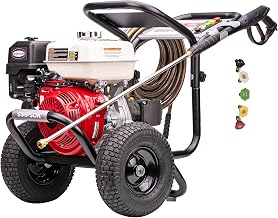
This is the machine you buy when you have a lot of square footage to cover and you cannot afford to spend the whole day on one driveway. The 4.0 GPM rating puts it at the top of this list for raw cleaning throughput, and the 50-foot hose means fewer repositioning breaks on large jobs. The welded steel frame handles transport and vibration well, and the AAA Triplex Pump is rebuildable.
- Pro: Highest GPM in this roundup, meaning noticeably faster flatwork cleaning.
- Pro: Long 50-foot hose and five nozzle tips included in the box.
- Con: The 3.8 rating reflects reported reliability concerns and inconsistent engine behavior across units.
Skip this if you value long-term reliability over raw power and do not want to spend hours troubleshooting or filing warranty claims. The CRX engine is not a known quantity with a deep parts network like Honda.
Simpson PowerShot 3500 PSI (PS3228)
The most rational purchase in this list for a working professional who does a mix of house washing, deck cleaning, and light flatwork. The Honda GX200 engine is the reason to buy it: it starts reliably, parts are everywhere, and mechanics know how to fix it blindfolded. For under $700 with a 4.5 rating, it represents the best value-to-reliability ratio here. The 25-foot MorFlex hose is flexible enough to avoid the kinked-rubber problem that ruins cheaper setups, and the AAA Triplex Pump is a known rebuildable unit.
- Pro: Honda engine with unmatched serviceability and resale value.
- Pro: Highest user rating in this roundup at 4.5 out of 5.
- Con: Lower GPM than the 4400 PSI model means longer cycle times on big driveways.
Skip this if your primary work is large-format flatwork where every minute saved is money earned. The 2.5 GPM will feel sluggish compared to a true high-flow unit.
Simpson Aluminum Series 4200 PSI (ALH4240)
Built for operators in coastal, humid, or winter-road-salt environments where a steel frame becomes a rust project within two seasons. The aluminum frame sheds weight and refuses corrosion entirely, which also makes it easier to load and unload repeatedly. The CAT Triplex Pump is a premium name that signals real durability, and the Honda GX390 gives you the upper end of the GX small-engine family. The $1329.99 price stings, but for the right operator it pays for itself in not replacing a corroded frame.
- Pro: Aluminum frame eliminates the single biggest long-term failure mode on steel pressure washers.
- Pro: CAT Triplex Pump paired with a Honda GX390 is a proven, serviceable combination.
- Con: The 4 out of 5 rating and premium price mean it only makes financial sense for high-utilization operators.
Skip this if you store your machine in a dry garage and do moderate seasonal work. The corrosion benefit does not justify the cost premium for casual commercial use.
Giraffe Tools Grandfalls Pro
A fundamentally different product that solves a different problem. This is an electric wall-mount unit with a retractable 100-foot hose and a 1800W brushless motor. It is designed to be mounted and left in place, eliminating the setup and teardown that eats time on a fixed property. The 3700 PSI and 1.6 GPM are modest for cleaning, but the convenience factor on a residential or light-commercial site where you do frequent touch-up work is real.
- Pro: Retractable 100-foot hose means full coverage without dragging a cart across finished surfaces.
- Pro: Wall-mounted footprint keeps the machine out of the way entirely when not in use.
- Con: 1.6 GPM is genuinely low for anything beyond light cleaning, and the electric motor will not keep up with a gas unit on demanding jobs.
Skip this if you need a portable machine or do more than occasional touch-up cleaning. It is a convenience product, not a workhorse.
Zep Professional Truck Trailer Washes (R08035)
This is not a pressure washer. It is a professional cleaning program and chemical set designed for truck and trailer wash bays, and it appears in this roundup because many operators shopping for commercial pressure washers actually need the right chemical and process to pair with their existing equipment. The under-$80 price reflects its role as a supplemental product, not a primary machine. It pairs with any high-pressure system to deliver consistent results on fleet surfaces.
- Pro: Purpose-built formulation for automotive and fleet surfaces that generic detergents damage or fail to clean.
- Pro: Very low entry cost relative to the productivity it adds when matched to existing equipment.
- Con: It is not a pressure washer, so it is useless on its own.
Skip this entirely if you still need to buy your actual pressure washer first. It is a finishing product for an established operation.
Westinghouse WPX4400
On paper, this is the most aggressive spec sheet for the money in this list: 4400 PSI and 4.2 GPM for just over a thousand dollars. That flow rate is genuinely competitive with machines priced significantly higher. Westinghouse assembles solid units at price points that undercut established brands, and this is their attempt at a high-output commercial machine. The five-nozzle set and spray gun with wand are standard fare.
- Pro: 4.2 GPM at this price is exceptional raw cleaning power per dollar.
- Pro: Competitive build for the money with a solid 4 out of 5 user rating.
- Con: Parts availability and pump rebuild options are less established than Simpson or CAT-based systems, which matters when the pump eventually needs attention.
Skip this if you need a machine that a local small-engine shop can service without calling a distributor. For operators in rural areas, parts access is a real constraint.
VEVOR Gas Pressure Washer
The under-$350 price is the headline here, and VEVOR is the brand that consistently delivers on paper at a fraction of established pricing. 3600 PSI and 2.6 GPM with a copper pump is a respectable entry for a side-business operator or someone who needs a backup gas unit without committing four figures. The quick-connect nozzles are a convenience that older machines charge extra for.
- Pro: Lowest gas-powered price in this roundup by a wide margin, with specs that compete at double the cost.
- Pro: Copper pump is better than the aluminum options common at this tier.
- Con: VEVOR’s quality control varies batch to batch, and the 4.1 rating likely reflects both excellent units and disappointing ones.
Skip this if you need reliability on a daily commercial schedule. It is an excellent gamble for light commercial or personal use at this price, but not a fleet machine.
Simpson PS60869 PowerShot 4000 PSI
This is the Goldilocks option: Honda GX270 power, 3.5 GPM flow, AAA Triplex Pump, 50-foot Monster Hose, and a price that undercuts the 4400 PSI model. The GX270 sits in the sweet spot of the Honda engine family for this pressure range, providing more torque than the GX200 at a cost that is still reasonable. For professionals who want proven components and balanced specs without paying the premium of the aluminum series, this is the pick.
- Pro: Honda GX270 engine gives you parts availability and familiarity that CRX or unknown-brand engines cannot match.
- Pro: The 3/8-inch Monster Hose is more durable and less prone to kinking than thinner commercial lines.
- Con: At $999, you are paying a premium over the Westinghouse for name-brand engine and pump confidence.
Skip this if budget is your absolute primary constraint or if you have already invested in the VEVOR and it is working. But for long-term professional use, the engine choice here is the right call.
Buying Guide
PSI Versus GPM: Why Flow Rate Matters More
PSI is pressure, and GPM is volume. A 4000 PSI machine at 1.6 GPM will feel weak on a driveway because you are moving too little water to carry away dirt. The machines that actually cut job time are the ones at 3.5 GPM or higher. When comparing specs, weight flow rate at roughly a 2-to-1 ratio against pressure. If two units are within 500 PSI of each other, buy the one with higher GPM.
Engine Brand Is a Serviceability Decision
A Honda engine costs more because you can buy parts at any small-engine shop in the country, and most mechanics know the platform. A CRX or unbranded engine costs less upfront but creates a dependency on a single distributor for spares. If your machine goes down on a Wednesday and you cannot fix it by Thursday, you have lost a full day of revenue. Choose the engine brand that matches the parts infrastructure in your region.
Pump Type and Rebuildability
Triplex plunger pumps (AAA, CAT, and similar) are the commercial standard because they last longer and can be rebuilt with a seal kit for a fraction of replacement cost. Wobble plate pumps are cheaper to manufacture and typically cannot be rebuilt. If a machine does not tell you what pump is inside, assume the worse answer. The pump is the single component that determines whether your machine lasts three years or fifteen.
Our Verdict
The Simpson PowerShot 3500 PSI (PS3228) is the top pick for most professional buyers in this category. It combines the Honda engine, a rebuildable pump, the highest user rating, and a price that leaves money in your pocket. For budget-conscious operators who need gas power without the name premium, the VEVOR for under $350 is the best value bet if you accept some variance in quality control. And if your work is primarily large-area flatwork where time on the job is the bottleneck, the Westinghouse WPX4400 at 4.2 GPM will out-produce both of them.
FAQ
What is the minimum GPM for commercial pressure washing?
For genuine commercial work on flat surfaces like driveways, parking lots, and building sides, 2.5 GPM is the practical floor. Below that you are moving water too slowly to carry debris away, which means pass after pass with no visible progress. For house washing and light detailing, 2.0 to 2.5 GPM can be adequate.
Do I need a triplex pump over a wobble plate?
For anything beyond occasional use, yes. Triplex pumps handle continuous duty cycles, run cooler, and accept chemical injectors properly. Wobble plate pumps are designed for intermittent residential use and typically cannot be rebuilt when they wear. The difference over two years of commercial use is the difference between a tool and a consumable.
Can I use an electric pressure washer for commercial work?
Only for specific fixed-location applications where convenience and low noise outweigh power needs, like the Giraffe Tools unit in this list. Most commercial jobs require gas because electric motors at this price point cannot deliver enough GPM to compete with a modest gas engine, and you are tethered to an outlet or generator regardless.
How long should a commercial pressure washer last?
A well-maintained commercial pressure washer with a triplex pump and Honda engine should deliver five to ten years of regular professional use, with a pump rebuild typically needed somewhere in that window. Budget or consumer-class machines rated for residential use often fail within one to two seasons of commercial duty because they were never designed for continuous high-load operation.