Key takeaways
- Pro: Top handles make relocation a one-person job.
- Pro: Translucent panels allow visual monitoring without disassembly.
- Con: At 6U, you run out of space the moment you add a third device.
What's inside
The hardest part of building a home lab is not the software. It is the physical mess. You start with a Raspberry Pi, a cheap switch, and a USB audio DAC. Three months later you have a mini NAS, a second Pi, a PoE injector, and a tangle of power adapters that looks like a bird’s nest behind your monitor. A small server rack turns all of that into something organized, ventilated, and actually enjoyable to work on. But not every rack deserves to sit on your desk. Some are so flimsy that a single Ethernet cable pull loosens a mounting screw. Others are too shallow to fit anything with a rear connector that sticks out more than a few millimeters.
What separates a good rack from a mediocre one comes down to a handful of concrete things: depth clearance for cabling, whether the frame flexes under weight, how many 1U slots you can actually use without fighting adjacent equipment, and whether the design accounts for the specific form factor you are buying into. In 2026, the 10-inch mini rack category has matured enough that you can find real mounting quality at prices that would have seemed absurd a few years ago, but the range between the best small server racks for home labs and the ones you will return is wider than most buyers expect.
As an Amazon Associate we earn from qualifying purchases at no extra cost to you. Product prices and availability are accurate as of the date shown and are subject to change.




Quick Picks
| Product | Best for | Price |
|---|---|---|
| Tecmojo 6U Mini Rack | Tiny desk-top networking | $69.9 |
| Tecmojo 9U Mini Rack | Mid-size 10-inch labs | $119.9 |
| GeeekPi 8U RackMate T1 | Audio/video integration | $119.99 |
| 10-Inch 6U Rack with PDU | All-in-one power setup | $99.99 |
| Tecmojo 12U Open Frame | 19-inch wall mounting | $89.9 |
| Tecmojo 12U with Casters | Mobile 19-inch setups | $109.9 |
| GeeekPi 12U RackMate T2 | Maximum 10-inch capacity | $149.99 |
| GeeekPi RackMate TT | Ultra-compact hybrid formats | $69.99 |
How We Picked
We evaluated these racks on four criteria that matter most at this scale: structural rigidity under realistic loads (a switch, a Pi, and a small DAC should not make the frame bow), usable depth for rear-facing connectors and cable routing, mounting flexibility for your physical constraints (desktop, shelf, or wall), and whether the included hardware and accessories are compatible with the most common 10-inch boards people actually buy. Price-to-utility ratio was a tiebreaker, not a primary driver.
The 8 Best Small Server Racks For Home Labs in 2026
1. Tecmojo 6U Network Rack (10 inch, $69.9, 4.5/5)
This is the entry point for anyone who has outgrown stacking equipment on a shelf but has very little to rack yet. The 6U height fits a switch, a single mini PC, and a patch panel without wasting space. The translucent side panels are genuinely useful because you can check link LEDs without opening anything, and the top handles let you slide the whole rack off a desk for cleaning without disconnecting a single cable.
- Pro: Top handles make relocation a one-person job.
- Pro: Translucent panels allow visual monitoring without disassembly.
- Con: At 6U, you run out of space the moment you add a third device.
Skip this if your lab already includes more than two 1U items or if you plan to expand within a few months.
2. Tecmojo 9U Network Rack (10 inch, $119.9, 4.6/5)
The 9U variant solves the capacity problem without jumping to the taller, more visually dominant 12U format. It sits at a height where you can still keep it on a standard desk without it feeling like a piece of server-room furniture. The same handle and panel design carries over, and the rating edges up to 4.6/5, likely because owners appreciate the headroom without paying a premium for unneeded slots.
- Pro: Good capacity-to-footprint ratio for desk-top labs.
- Pro: Consistent build quality with the brand’s wider lineup.
- Con: The 7.87-inch depth still limits rear cable routing for gear with deep connectors.
Skip this if you need more than three or four devices, or if your equipment requires generous rear clearance.
3. GeeekPi 8U Network Rack, DeskPi RackMate T1 (10 inch, $119.99, 4.6/5)
If your home lab doubles as an A/V hub, the RackMate T1 ecosystem is the strongest reason to choose this over the Tecmojo options. GeeekPi sells dedicated shelves, fan panels, and accessory brackets that slot directly into this frame, so you can build a mixed IT and audio setup without 3D-printing your own adapters. The white finish keeps it looking clean in a living room context.
- Pro: Rich accessory ecosystem designed specifically for this frame.
- Pro: Clean aesthetic suits open, visible placements.
- Con: The 8U height is an odd middle ground that may not align neatly with your existing shelf spacing.
Skip this if you already own Tecmojo 10-inch accessories and do not want to mix ecosystems.
4. 10-Inch Mini Server Rack, 6U with Rack PDU (6U, 7.87-inch depth, $99.99, 4.8/5)
At a 4.8 rating, this carries the highest score in the entire roundup, and the integrated PDU is the reason. You get power distribution built into the rack itself, which eliminates the separate power strip that most home labbers clip to the side of their existing setup. For a 6U unit, that is a meaningful convenience that reduces clutter on the desk surface.
- Pro: Built-in PDU removes the need for an external power bar.
- Pro: Highest owner rating in this group at 4.8/5.
- Con: You sacrifice two usable 1U slots compared to the Tecmojo 9U at a similar price.
Skip this if you already have a reliable rack PDU and would rather maximize height for equipment.
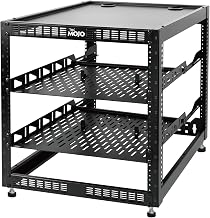
5. Tecmojo 12U Open Frame Network Rack (19 inch, $89.9, 4.5/5)
This is the gateway to standard 19-inch gear for anyone who has decided their home lab is graduating from 10-inch boards. The open-frame construction means airflow is unrestricted and you can reach every cable from the rear without unmounting anything. It includes two 1U shelves and all necessary hardware out of the box, so you are not hunting for M6 nuts at a hardware store.
- Pro: Open design gives unrestricted rear access and excellent ventilation.
- Pro: Ships with shelves and mounting hardware, no extra purchases needed.
- Con: Floor-standing or wall-mounted means it demands more physical presence than a desk-top unit.
Skip this if you are committed to 10-inch equipment or need something that fits beside a monitor.
6. TECMOJO 12U Open Frame with Casters (19 inch, $109.9, 4.3/5)
For renters, people who vacuum under their equipment, or anyone who reconfigures their lab regularly, the casters on this frame are not a gimmick. You roll the entire rack away from the wall, work on the rear, and roll it back without unbolting anything from the floor. The 4-post design keeps it rigid even when fully loaded.
- Pro: Mobility for maintenance and reconfiguration without tools.
- Pro: 4-post frame offers better rigidity than 2-post alternatives at this price.
- Con: Carries the lowest rating in this roundup at 4.3/5, with some owners reporting minor shelf-rail alignment issues.
Skip this if your setup is in a fixed position and you prefer maximum stability over flexibility.
7. GeeekPi 12U Network Rack, DeskPi RackMate T2 (10 inch, 10.23-inch depth, $149.99, 4.7/5)
The standout spec here is the 10.23-inch depth, which is a full inch deeper than every other 10-inch option on this list. That extra inch means rear-facing power bricks, long HDMI connectors, and patch cables with molded strain relief actually clear the back of the frame. It is the most capable 10-inch rack available, and the 4.7 rating reflects how well that added depth is received by owners.
- Pro: Deepest 10-inch frame here, solving rear-clearance headaches.
- Pro: T2 ecosystem compatibility with existing DeskPi accessories.
- Con: The extra depth makes it less discreet on a bookshelf than shallower competitors.
Skip this if visual profile matters more than cable clearance, or if your equipment all has flat rear connectors.
8. GeeekPi DeskPi RackMate TT (10-inch 3U / 7-inch 5U, 7.87-inch depth, $69.99, 4.7/5)
This is a clever hybrid that solves a specific problem: fitting tiny boards like the Raspberry Pi Zero or Orange Pi alongside 10-inch gear. The 7-inch section accommodates small form-factor devices that would otherwise waste a full 1U slot. At the same price as the Tecmojo 6U, you get a dual-format design and a 4.7 rating that speaks to how well the concept works in practice.
- Pro: Dual-format design reduces wasted space on tiny devices.
- Pro: Ties the lowest price in this roundup while holding a high rating.
- Con: Total usable height is modest, so you will outgrow it quickly as your lab scales.
Skip this if all your equipment is already 10-inch format and you do not own any sub-10-inch boards.
Buying Guide
Depth is the spec that kills most buyers
Every 10-inch rack here shares a 7.87-inch depth except for the GeeekPi T2 at 10.23 inches. That difference matters more than the rating gap suggests. Measure the rear overhang of your actual devices (power brick, connector, cable bend radius) before choosing. If your switch has an inline power supply that protrudes two inches from the back, a 7.87-inch frame will force the cable out at a severe angle or prevent the rack lid from closing.
10-inch versus 19-inch: a one-way decision
Moving from 10-inch to 19-inch gear is straightforward. Moving from 19-inch back to 10-inch is a downgrade in options. The two open-frame 19-inch racks in this list are the right call if you have already invested in standard equipment or plan to buy used enterprise gear. For a fresh build, the 10-inch format keeps your footprint desk-friendly and your noise profile room-friendly.
Accessory ecosystems compound over time
Once you commit to a brand’s mounting standard, every future shelf, fan panel, cable organizer, and faceplate needs to be compatible. Tecmojo and GeeekPi are the two ecosystems represented here, and neither shares parts with the other. If you expect to add accessories within a year, buy into the ecosystem that offers the shelves and panels you will need, not just the rack.
Our Verdict
The top pick is the GeeekPi 12U DeskPi RackMate T2. Its 10.23-inch depth eliminates the single most common frustration with 10-inch racks, and the 4.7 rating confirms that owners agree. If you need the most headroom for a compact footprint, it wins on the spec that actually affects daily usability.
The budget pick is the GeeekPi DeskPi RackMate TT at $69.99. It ties the lowest price in this group, earns a 4.7 rating, and its dual-format design means you are not wasting height on tiny boards.
However, if your lab has already graduated to 19-inch equipment, the Tecmojo 12U Open Frame at $89.9 is the better buy. No 10-inch rack can serve that transition as well.
FAQ
Do 10-inch racks fit Raspberry Pi clusters with active cooling?
Yes, but only if the cooler does not exceed the 10-inch width or protrude past the rear edge. Measure your fan and heatsink assembly against the rack’s internal width before ordering, because most 10-inch cases are designed around the board outline, not tall add-on coolers.
Can I wall-mount any of these 10-inch mini racks?
The Tecmojo and GeeekPi models are designed for desk or shelf use. The 12U open-frame models from Tecmojo explicitly support wall mounting. If you need a rack on a wall, go with the 19-inch open-frame options or plan to build a mounting plate for the 10-inch units yourself.
Is the built-in PDU on the 6U rack worth the trade-off?
If your setup sits on a desk without easy access to a power outlet behind it, the integrated PDU saves you a separate strip and its associated cable clutter. The cost is two fewer 1U slots, so evaluate whether you value the height or the convenience more.
How loud are these racks compared to open shelving?
The closed 10-inch models can trap heat slightly, which may cause your equipment’s fans to run faster than on an open shelf. The open-frame 19-inch models have no such issue. If noise matters, the open design or a fan-modified closed rack will keep your lab quieter.