
Key takeaways
- Twelve distinct builds in one box keeps interest alive across weeks
- Under-fifteen-dollar price makes it low-risk for a first purchase
- Solar-only power means outdoor use only; indoor windowsill play disappoints
What's inside
Finding the best robot kit for kids is harder than it looks because the category spans everything from snap-together plastic robots for seven-year-olds to programmable Arduino vehicles that demand basic coding literacy. The wrong choice wastes money and, worse, a child’s patience. A kit that is too simple bores a ten-year-old within an afternoon; one that is too complex produces frustration and a pile of unopened components gathering dust in a closet.
What separates the genuinely good options from the forgettable ones comes down to three things: the age range the manufacturer honestly supports, the quality of the instruction manual, and whether the finished build does something that holds a child’s attention beyond day one. We compared published specifications, current prices, and recurring themes from owner reviews to narrow the field to eight kits worth considering in 2026.
As an Amazon Associate we earn from qualifying purchases at no extra cost to you. Product prices and availability are accurate as of the date shown and are subject to change.


Quick Picks
| Product | Best for | Price |
|---|---|---|
| Sillbird 12-in-1 Solar Robot | First robot kit for ages 8-13 | $14.97 |
| BeAndge Robotics STEM Kit | Crafts-and-robotics hybrid for ages 8-12 | $16.99 |
| ELEGOO UNO R3 Smart Robot Car | Kids ready to learn coding with Arduino | $55.99 |
| Sillbird Remote Control Robot Kit | Kids who want a driven robot immediately | $53.99 |
| STEM Kits 8-12 Boy Toy Gift | Budget birthday gift for ages 6-9 | $18.99 |
| Sillbird Building Robot Kit RC | Repeat Sillbird buyer wanting remote control | $53.99 |
| Robot Arm Kits | Kids ages 8-16 interested in mechanical engineering | $19.99 |
| STEM Kits 5-in-1 for Ages 6-12 | Younger children who want variety in one box | $19.99 |
How We Picked
We filtered for four criteria: honest age targeting (many kits list 8-13 but the instructions read like they expect a high-schooler), build-to-play ratio (how much fun the finished product delivers versus how much assembly labor it demands), included features at the listed price (remote controls, solar panels, and programmability all affect value), and the consistency of owner satisfaction across reviews, particularly whether complaints cluster around broken parts or poor documentation versus minor gripes.
The 8 Best Robot Kit For Kids in 2026
Sillbird 12-in-1 Solar Robot Building Kit
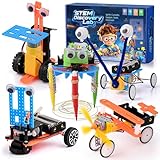
This kit is the obvious entry point for kids who have never assembled a robot before. The twelve configurations snap together using pre-cut plastic parts and a small screwdriver, so a single afternoon yields a working solar-powered walker, bug, or boat. Owners consistently praise the variety as a value driver at this price. The manual uses large illustrations that younger builders can follow without adult help.
- Twelve distinct builds in one box keeps interest alive across weeks
- Under-fifteen-dollar price makes it low-risk for a first purchase
- Solar-only power means outdoor use only; indoor windowsill play disappoints
Skip this if your child already owns several construction sets and craves something that responds to input beyond sunlight.
BeAndge Robotics STEM Kits for Kids
BeAndge positions this as a hybrid craft-and-engineering package, which suits kids who enjoy painting and decorating as much as building. The included robot model is smaller and simpler than the Sillbird solar set, but the accessory pack of craft materials broadens the creative scope. Owner reviews highlight the packaging presentation as a strong gift-ready quality. The build itself takes less time, which benefits younger or less patient children.
- Craft accessories extend play well past assembly day
- Gift-box presentation requires zero wrapping effort
- The single robot model feels limiting compared to multi-config kits at similar prices
Skip this if you want a robot with multiple build modes or remote control functionality.
ELEGOO UNO R3 Smart Robot Car Kit V4
This is the most technically demanding kit on the list and the only one with a genuine programming pathway. The UNO R3 board is fully Arduino-compatible, meaning a motivated kid can move from following pre-written sketch files to writing basic C-like code within a few sessions. The camera module adds object-detection fun. Owner feedback praises documentation depth and community tutorials available online. The price reflects the electronics payload.
- Real programmability gives a genuine STEM ceiling well beyond this age range
- Camera and sensor modules keep the car interactive after initial coding
- Assembly requires solder-free but still detailed wiring; parents of age-8 kids report needing significant help
Skip this if you want a set-and-forget toy; the learning curve demands a parent willing to supervise early sessions.
Sillbird STEM Robot Building Kit with Remote Control
Sillbird’s remote-control line trades the twelve-model variety for a single, more articulated robot that walks, gestures, and responds to an IR remote. For kids who want a companion they can direct rather than a project they assemble once, this delivers more sustained interactive play. Owners note the remote range is modest but adequate indoors. Build time is longer than the solar kit due to more joints and a motor module.
- Interactive remote play extends engagement well past build day
- Durable joint construction holds up to rough handling better than snap-only kits
- Only one model to build; no replay variety after assembly
Skip this if your child prefers the satisfaction of multiple builds over directing one robot around a room.
STEM Kits for Kids Science 8-12 Boy Toy
This kit markets to a wide age range from six through nine and leans into that younger end with chunkier parts and a shorter build. The price sits at the lower-middle of the list, and owners appreciate the included experiment guide that pairs the robot with simple science demos. Assembly is straightforward enough that a seven-year-old can finish with light adult supervision. The finished robot is basic—primarily a walking model with limited interaction.
- Youngest age targeting makes it appropriate for six- and seven-year-olds
- Experiment guide adds educational content beyond the robot build itself
- Older kids in the listed age range may find the single walking model underwhelming
Skip this if your child is ten or older; the complexity level will bore them quickly.
Sillbird Building Robot Kit with Remote Control (Ages 8-12)
Essentially a variant of the fourth entry on this list, this version targets the younger slice of Sillbird’s remote-control audience. The model is slightly smaller and the remote layout is simplified. Owners who bought both versions note the practical difference is minimal; the younger targeting means a marginally easier build at the cost of a less ambitious finished robot. Price is identical to the older-kid version.
- Simplified remote controls suit kids closer to age eight
- Build complexity is reduced, shortening total assembly time noticeably
- At the same price as the age-13 version, the downgrade feels like a missed opportunity for families with mixed-age kids
Skip this if you have an older sibling who might also want the robot; buy the 8-13 version instead.
Robot Arm Kits for Ages 8-16
This kit is structurally different from everything else here: instead of a walking robot or a car, you build a mechanical arm that grips, lifts, and rotates through cable or gear actuation. The broad age range works because the concept appeals across it—a nine-year-old gets a grabber toy, a fifteen-year-old gets a first lesson in linkage mechanics. Owners praise the unique factor and the visible engineering. The arm has limited autonomous function; it is operated manually.
- Mechanical-arm concept is genuinely novel compared to walking robots and cars
- Wider age ceiling means the kit stays relevant as the child matures
- No electronics, no programming; the experience is purely mechanical play
Skip this if your child wants a robot that moves on its own or responds to code.
STEM Kits for Kids Ages 6-12, 5-in-1 Robot Building Science Kit
The five-build format splits the difference between the twelve-model Sillbird and the single-robot kits, offering a reasonable variety-to-price ratio at just under twenty dollars. Each configuration is simpler than a Sillbird solar model, which makes sense for the six-year-old entry point. Owners note the pieces are interchangeable enough that kids invent their own hybrid forms, extending play value. Build quality is adequate but the plastic feels thinner than premium kits.
- Five distinct models provide variety without overwhelming a younger builder
- Interchangeable parts encourage free-form invention beyond the manual
- Plastic thickness and snap-fit tolerances feel budget-grade next to Sillbird or ELEGOO
Skip this if you want build quality that survives months of rough play; the lighter plastic does not age as well.
Buying Guide
Match Complexity to Actual Age, Not Listed Age
Manufacturers routinely list 8-13 or 6-12 ranges because those numbers sell on Amazon, but a kit with forty small parts and a twelve-step folding mechanism is not genuinely accessible to a seven-year-old regardless of the box text. A reliable heuristic: if the manual requires reading paragraphs of English and following numbered diagrams with arrows, assume the true minimum age is three years above what the listing claims. For younger children, prioritize kits with pre-punched holes, snap-only connections, and large illustrated steps.
Decide Between Build-Once and Interactive Play
Some kits deliver ninety percent of their value during assembly and five percent during play. Others invert that ratio. Remote-control robots and programmable cars are interactive-first: the build is a hurdle and the payoff is ongoing control or coding. Solar and craft kits are build-first: the reward peaks at completion and fades quickly after. Knowing which experience your child will actually return to matters more than the number of included models.
Check What the Kit Needs That It Does Not Include
Battery-powered and programmable kits often ship without the correct cells, an SD card, a USB cable, or even a screwdriver. At under-twenty-dollar prices, omissions are expected. At fifty-dollar prices, most owners expect full kit completeness. Before purchasing, scan the specification list for the phrase “not included” or “requires separately” and budget for those extras so the child is not stuck on day one.
Our Verdict
The top pick is the ELEGOO UNO R3 Smart Robot Car Kit V4 at $55.99. No other kit on this list offers a genuine progression from guided assembly to independent coding, and that ceiling makes it the single best value over a multi-year span. For families wanting an affordable first purchase, the Sillbird 12-in-1 Solar Robot at $14.97 remains the default recommendation; nothing else approaches its variety-per-dollar ratio. The one scenario that shifts the ranking: if your child is under eight and you want a gift that will not collect frustration tears, the STEM Kits 5-in-1 for Ages 6-12 at $19.99 is the most age-appropriate option here.
FAQ
Do kids need coding experience to use the ELEGOO kit?
No. The kit ships with ready-made sketch files that you upload to the UNO board in a few clicks, so the car drives and reacts immediately after assembly. Coding experience becomes relevant only when your child wants to modify or write new programs from scratch.
Are solar robots slower than battery-powered ones?
Generally yes, and they are entirely weather-dependent. A solar walker under a bright outdoor sun moves reliably, but cloud cover or a dim living room renders it nearly motionless. If your child plans indoor play most of the time, a battery-powered or remote-control kit is a better fit.
Can two kids share one robot kit simultaneously?
Only the multi-model kits like the Sillbird 12-in-1 allow easy sharing because one child can build a different configuration than the other. Single-robot kits become a competition over the finished toy, and remote-control models work best with two remotes, which none of these kits include.
Is a higher price always better quality in robot kits?
Not linearly. The gap between a $15 kit and a $20 kit is mostly part count and included accessories. The jump to $50-plus reflects electronics—motors, circuit boards, sensors—that genuinely increase complexity and durability. A $55 kit is not three and a half times better than a $15 kit, but the electronics inside it represent a different product category entirely.


