
Best noise cancelling headphones with wire comparisons should start with a question nobody asks in a shop: what stops working when you plug in? Touch controls, microphones and app equalisation often switch off. This guide compares seven models on wired behaviour, latency and cable type.
As an Amazon Associate we earn from qualifying purchases.
By Daniel Foster
🛒 Best Price Today on Amazon
Prime members get fast, free shipping on everything above, plus member-only deals. New members get a 30-day free trial — cancel anytime.
What Changes the Moment You Plug In
The best noise cancelling headphones with wire remove latency and compression, and a cable can also bypass the internal processor entirely. That single design decision determines whether your microphone still works, whether the equaliser applies and whether the touch panel responds.
Latency, Cable Type and Retained Functions: The Deciding Numbers
Four things decide a best noise cancelling headphones with wire shortlist: measured latency in wired mode, connector type, which functions survive the switch, and whether the battery is still required.
Bluetooth latency typically runs 100 to 250 ms depending on codec, which is fine for music, mostly fine for video, and unusable for instruments or precise editing. A cable brings that effectively to zero.
Analog 3.5 mm connections generally bypass internal processing, so the built-in microphone and equaliser stop working. USB-C connections keep the processor in the chain, preserving both, which matters for desk calls.
Space and Fit: Desk Setups and Cable Management
Using the best noise cancelling headphones with wire at a desk needs a cable long enough to move without pulling, typically 4 to 5 ft (1.2 to 1.5 m), and a socket position that does not press against a chair back when you lean.
Detachable cables reduce socket wear and can be replaced when they fail. Right-angle plugs are gentler on both the headphone socket and a laptop port than straight plugs, particularly on a crowded desk.
Where Wired Actually Wins
Instruments, video editing and rhythm games are the clear cases, where any delay is audible. Recording is another, since analog monitoring avoids the codec chain entirely.
Shared workspaces are a quieter case. A wired connection cannot be hijacked by a colleague’s pairing attempt or drop when someone walks between you and a laptop, which removes a daily irritation in open offices.
Beyond that, a cable is battery insurance and compatibility insurance. Older gear, mixing desks, gym equipment and aircraft entertainment systems all still use analog sockets that Bluetooth cannot reach without an adapter.
What Wired Does Not Fix
Cancellation still needs power on consumer headphones, so a flat battery means passive isolation only. Sound quality gains over a good codec are also smaller than many expect for ordinary music listening.
A cable also does nothing for comfort or fit, which decide far more of the listening experience than connection type. A poorly sealing pair sounds thin wired or wireless.
Cables introduce microphonics, the rustling sound of the cable brushing clothing, which is transmitted up to the earcups. Clipping the cable to a shirt reduces it noticeably.
Best Noise Cancelling Headphones With Wire: Seven Models
Each best noise cancelling headphones with wire entry below notes what survives in wired mode. Specifications are manufacturer-stated and combined with recurring themes in owner reports rather than measurements taken by us.
Sennheiser Accentum Plus
Offers hybrid cancellation, roughly 50 hours of battery and a 3.5 mm cable in the box, with wired listening available while the battery holds charge.
The analog connection bypasses the microphone, so calls need Bluetooth. Battery life and sound balance are strong for the price.
Technics EAH-A800
Around 50 hours of battery with cancellation on, a detachable 3.5 mm cable and a light, well-padded design intended for long sessions.
Brand presence is lower than the major names and accessories are less widely stocked. Call quality and comfort are its standout features.
JBL Tour One M2
Adaptive cancellation with a 3.5 mm cable included, app-based personalisation and a folding design that packs efficiently for travel.
App settings do not apply in analog wired mode. Feature coverage relative to price is the reason it appears on many lists.
Bowers and Wilkins PX7 S2e
A premium model with USB-C wired audio as well as 3.5 mm, keeping the internal processing active over USB, plus aptX Adaptive support wirelessly.
It is expensive and the app is simpler than rivals. Sound quality in both wired modes is the main argument.
Beyerdynamic Lagoon ANC
A closed-back model with hybrid cancellation, a detachable cable and a hearing-profile calibration that tunes output to your ears.
It is an older design and battery life trails newer models. Passive isolation from the deep cups is better than most when unpowered.
Anker Soundcore Life Q30
A long-serving budget option with multiple cancellation modes, roughly 40 hours of battery and a 3.5 mm cable, plus a folding case.
Build materials are basic and the microphone is average. As a wired-capable backup pair, the value is difficult to beat.
Philips Fidelio L4
A premium model with adaptive cancellation, a 3.5 mm cable and USB-C audio support, with a metal and leather build aimed at desk use.
Availability varies by region and the price sits near flagship level. Wired flexibility plus build quality is the appeal.
| Model | Cable options | Mic when wired | Battery | Main trade-off |
|---|---|---|---|---|
| Sennheiser Accentum Plus | 3.5 mm | No, analog only | ~50 hrs | Calls need Bluetooth |
| Technics EAH-A800 | 3.5 mm detachable | No | ~50 hrs | Lower brand presence |
| JBL Tour One M2 | 3.5 mm | No | ~50 hrs | App off in analog mode |
| B and W PX7 S2e | 3.5 mm and USB-C | Yes over USB-C | ~30 hrs | Price |
| Beyerdynamic Lagoon ANC | 3.5 mm detachable | No | ~45 hrs | Older design |
| Soundcore Life Q30 | 3.5 mm | No | ~40 hrs | Basic materials |
| Philips Fidelio L4 | 3.5 mm and USB-C | Yes over USB-C | ~40 hrs | Regional availability |
Cable inclusion and connector type vary between regions and listings, so confirm what ships in the box before ordering.
Getting the Most From a Cable
Owning the best noise cancelling headphones with wire is only useful if you know which mode to use for which task.
Choosing Analog or USB-C
Use analog for aircraft entertainment, older gear and instrument monitoring where zero latency matters most. Use USB-C at a desk, where keeping the microphone and equaliser active is more valuable.
If a model offers only one, match it to your main use. A USB-C-only headphone on a plane needs an adapter, and an analog-only model loses its microphone for computer calls.
Cable Care and Replacement
Detachable cables are consumables. Crackling when the cable is moved means the conductor or plug is failing, and continuing to use it risks damaging the headphone socket, which is a far more costly repair.
Coil cables loosely rather than tightly around the headphones, since sharp bends at the plug are where conductors break. A right-angle plug survives desk use better than a straight one.
Buying Timing
Audio gear is heavily discounted late in the year. Amazon runs Prime Big Deal Days in early October, with Black Friday and Cyber Monday in late November as the peak window.
Older models with strong wired support often remain excellent buys long after release, since wired behaviour rarely improves between generations. Discounts vary and cannot be promised.
Frequently Asked Questions
Questions about wired operation.
Does the microphone work over a 3.5 mm cable?
Usually not, since analog connections bypass the internal processor. USB-C connections generally keep the microphone working.
Is wired listening lossless?
Analog wired listening avoids Bluetooth compression, and USB-C can carry lossless digital audio. Whether you can hear the difference depends on the source material.
Does ANC drain the battery when wired?
Yes. Cancellation requires power regardless of how audio reaches the headphones, so wired listening with ANC on still uses battery.
What is that rustling sound from the cable?
Microphonics, caused by the cable brushing clothing and transmitting vibration to the earcups. Clipping the cable to a shirt reduces it substantially.
See More:
- Best iced coffee maker
- Best single-serve coffee maker without pods
- Best coffee maker percolator
- Best rated pod coffee maker
- Best evaporative humidifier
Choosing for Cable Use
The best noise cancelling headphones with wire depend on which socket you use most. Desk and call use favours the Bowers and Wilkins PX7 S2e or Philips Fidelio L4 with their USB-C audio support.
Flights and older equipment favour any model with a proper 3.5 mm cable, where the Technics EAH-A800 and Sennheiser Accentum Plus offer long battery life alongside it. Carry a spare cable and replace it at the first crackle.
Our top picks


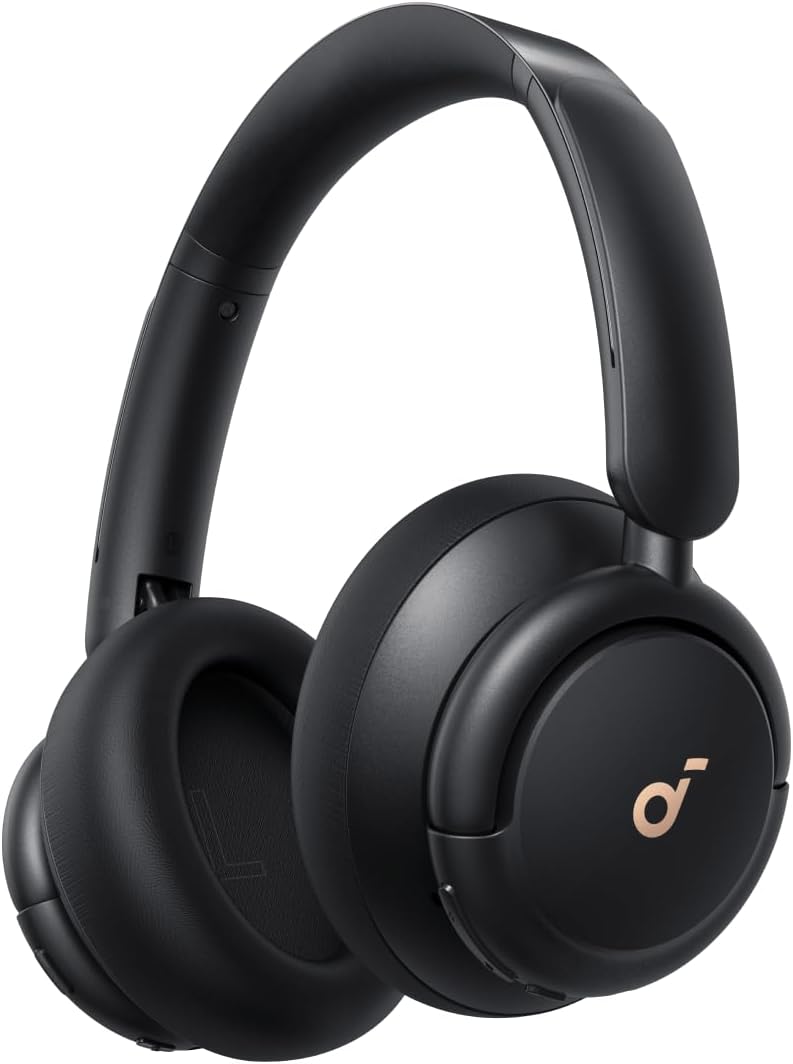 Soundcore by Anker Q30 Hybrid Active Noise
- Age Range Description: Adult
- Warranty Description: 18-month warranty
- Customer Package Type: With protective packaging
Three ANC modes target transport, outdoor, or indoor noise
Up to 70 hours of playtime with ANC switched off
Protein leather earcups with memory foam add comfort
Only an 18-month warranty is included
ANC mode reduces playtime to about 50 hours
 Audio-Technica ATH-M20x Professional Studio Monitor Headphones
- Advanced build quality and engineering
- 40 mm drivers with rare earth magnets and…
- Tuned for enhanced low frequency performance
As an Amazon Associate we earn from qualifying purchases at no extra cost to you.

Write Your Review
No reviews yet. Be the first to share your experience!