The most common sustain pedal complaint is that it works backwards — press it and the sound stops, release it and everything rings. That is not a fault. It is a polarity mismatch, because manufacturers never agreed on whether a closed switch should mean pedal down or pedal up. A pedal with a physical polarity switch solves it in one flick; a pedal without one can only be fixed by holding it down while the keyboard powers on, which you will forget every single time.
The second thing worth knowing is the difference between a switch and a continuous pedal. A switch reports on or off, which covers pop, rock and most beginner repertoire. A continuous pedal reports how far down it is, which enables half-damper technique where the dampers rest lightly on the strings and sustain bleeds rather than snapping on. Classical teachers ask for this early. Beyond that, the deciding factors are footprint style and whether the thing stays put on your floor. Here is how the options compare.
Our top picks




As an Amazon Associate we earn from qualifying purchases at no extra cost to you.
Quick Comparison
| Product | Best For | Standout Feature | Watch Out For |
|---|---|---|---|
| M-Audio SP-2 | Piano-style feel under the foot | Heavy chassis with a real piano pedal shape | Polarity is set by the keyboard, not a switch |
| RockJam 6.35mm Pedal | Mixed gear collections | Polarity switch with a long 5.9-foot cable | Lighter body slides on hard floors |
| On-Stage KSP100 | Simple universal replacement | Straightforward universal compatibility | Compact footprint feels small underfoot |
| Casio SP3 | Casio keyboard owners | Direct match for Casio inputs | Small switch style, unlike a piano pedal |
| Soraco Universal Pedal | Working across many brands | Polarity switch with a quarter-inch plug | Cable length is adequate rather than generous |
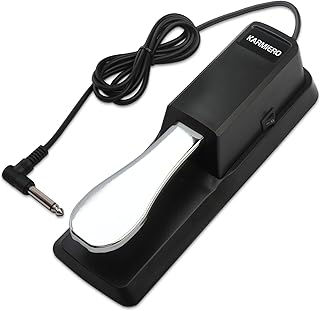
| karmiero Universal Pedal | Budget replacement with grip | Anti-slip base with polarity switching | Build is lighter than premium pedals |
How to Choose
- Polarity switch first: A physical switch means the pedal works on any keyboard immediately. Without one you are relying on the instrument to detect polarity at power-on, which is easy to get wrong.
- Switch or continuous: A footswitch handles on-off sustain for pop and early classical work. Half-damper technique needs a continuous pedal and a keyboard input that supports it.
- Weight and grip: Light pedals travel across laminate floors as you play. Look for a heavy chassis or a genuinely effective anti-slip base.
- Pedal shape: Piano-style pedals mimic the surface and throw of an acoustic damper pedal. Small square footswitches work but feel nothing like the real thing.
- Cable length: Standing keyboards and stage setups need more reach than a desk. Anything under about a metre and a half becomes limiting fast.
Top Picks Reviewed
Best Feel: M-Audio SP-2
The SP-2 is shaped and weighted like an acoustic piano’s damper pedal, which matters more than people expect — the throw distance and the surface angle are what your foot learns. It is heavy enough to stay planted and the rubber base keeps it from wandering during a long piece.
There is no polarity switch on the body, so it relies on the keyboard reading the pedal state correctly at power-on. On most instruments that works; on a few it means remembering not to press it while switching on.
Best All-Rounder: RockJam 6.35mm Pedal
A polarity switch plus a generous 5.9-foot cable makes this a safe purchase when you own several keyboards or do not know which polarity yours expects. The quarter-inch plug fits essentially every digital piano input.
The lighter body slides on smooth flooring. The rubber base helps, but on polished laminate you may find it drifting forward over an hour.
Simplest Replacement: On-Stage KSP100
When a bundled footswitch dies, this is the uncomplicated replacement — universal compatibility, no configuration, no menu diving. It does the one job reliably.
The footprint is small, so your foot has less surface to find without looking down. Players used to a piano-style pedal will notice.
Best Brand Match: Casio SP3
If your instrument is a Casio, buying the matching pedal removes polarity and compatibility questions entirely. It plugs in and behaves correctly with no thought required.
It is a compact switch-style pedal rather than a piano-shaped one, which is fine for casual playing and less satisfying for classical repertoire.
Best Cross-Brand Compatibility: Soraco Universal Pedal
Designed to work across Yamaha, Casio, Roland, Korg and others with a polarity switch and a standard quarter-inch plug, this is the pedal to buy when the keyboard it will live with keeps changing.
The cable is workable rather than long. For a seated home setup it is fine; for a stage rig you may want an extension.
Best Budget Option: karmiero Universal Pedal
Polarity switching and an anti-slip base at a low price covers the two things that actually matter for a first pedal, and the quarter-inch plug fits standard sustain inputs.
The construction is lighter than premium pedals. It will do the job for home practice; it is not what you would take to gigs every week.
Frequently Asked Questions
Why does my pedal work in reverse?
Polarity mismatch between the pedal and the keyboard. Flip the polarity switch if the pedal has one. If it does not, hold the pedal down while switching the instrument on so it calibrates the other way.
What is half-damper pedalling?
Partial depression that lets the dampers touch the strings lightly, producing partial sustain rather than full on or off. It needs a continuous pedal and a keyboard input that reads pedal position, not just a switch.
Will any sustain pedal work with any keyboard?
Almost. Nearly all use a quarter-inch jack, and a polarity switch handles the main incompatibility. Continuous pedals need matching support on the instrument to do anything more than switch.
How do I stop the pedal sliding away?
Use a heavier pedal, put a rubber mat or piece of grip tape under it, or choose a model with a proper anti-slip base. Sliding pedals are almost always a floor-surface problem rather than a design flaw.
Final Thoughts
Buy a pedal with a polarity switch unless you are matching your keyboard’s own brand accessory, and pay attention to weight if you have hard floors. If your teacher has started talking about half-damper technique, step up to a continuous pedal and check your instrument supports it — the expressive difference is genuinely worth the upgrade.