Key takeaways
What's inside
air purifier placement guide principles require strict attention to room volume, CADR ratings, and 360-degree perimeter clearance. We analyze airflow dynamics, acoustic output, and optimal positioning across different floor plans to ensure your device eliminates particulate accumulation effectively without dead zones or motor strain.
As an Amazon Associate we earn from qualifying purchases.
By Daniel Foster
Fundamentals of Indoor Airflow and Clean Air Delivery Rates
Mastering residential ventilation requires careful evaluation of volumetric airflow dynamics and particulate removal metrics across different room sizes. Evaluating performance parameters ensures that filtration systems operate at maximum efficiency without generating excessive motor strain or acoustic disturbance.
Decisive Category Metrics: CADR and Room Sizing
Clean Air Delivery Rate serves as the definitive benchmark for evaluating performance, measuring cubic feet per minute or cubic meters per hour for smoke, dust, and pollen. Selecting verified models requires balancing airflow volume against static pressure resistance created by dense internal media matrices.
Understanding proprietary filtration technologies combining mechanical fibers with electrostatic charging chambers helps capture microscopic pollutants effectively. This hybrid configuration captures airborne particulate down to 0.1 microns while permitting looser fiber weaves to minimize operational power draw.
Space and Spatial Fit: Calculating Air Changes per Hour
Sizing any air cleaning device correctly depends entirely on calculating room volume rather than relying on generalized marketing claims or aesthetic appeal. Proper execution of an air purifier placement guide strategy demands measuring actual room dimensions before positioning units permanently.
Compact hardware suited for small bedrooms cannot effectively process the air volume of open living spaces without experiencing severe volumetric starvation. Ensuring at least four to five air changes per hour guarantees consistent particulate reduction for allergy relief and background clearance.
Real-World Energy Consumption and Acoustic Profiles
Acoustic output dictates whether filtration equipment can reside comfortably in master bedrooms or nurseries without causing sleep disruption. Modern brushless fan motors operate between whisper-quiet sleep modes and higher decibel levels during rapid boost filtration cycles.
Analyzing variable fan speeds reveals how electrical draw fluctuates between minimal wattage baselines and peak power consumption during heavy particulate loading. Following a proper air purifier placement guide helps mitigate vibration transmission across hard flooring surfaces.
Optimal Room Layout Strategies and Clearance Rules
Strategic positioning within residential layouts determines how effectively airborne contaminants are drawn toward intake channels and processed. Proper spatial distribution prevents stagnant air pockets and ensures uniform particulate capture across every corner of the room.
Perimeter Airflow Mechanics and Wall Clearances
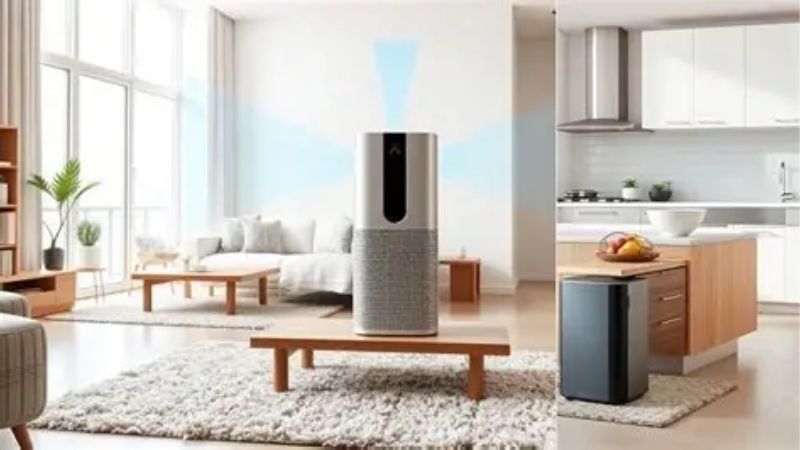
Cylindrical and tower filtration units draw ambient air through 360-degree intake grilles, requiring sufficient perimeter clearance from vertical boundaries. Maintaining at least twelve inches of unobstructed space around the chassis preserves optimal intake velocity and prevents motor overheating.
Placing units too close to solid walls severely restricts airflow volume and forces internal fan assemblies to work harder against restricted static pressure. Utilizing an air purifier placement guide prevents premature mechanical wear and sustains manufacturer-rated CADR performance.
Avoiding Obstructions from Drapery and Heavy Furniture
Heavy drapery, upholstered sofas, and oversized furniture frequently obstruct intake pathways and disrupt directional discharge airflow patterns. Homeowners must avoid tucking filtration devices into tight alcoves or behind large entertainment centers that block continuous air circulation.
Unobstructed discharge louvers ensure purified air reaches the breathing zone rather than bouncing directly off solid barriers and creating turbulence. Every professional air purifier placement guide emphasizes central open-floor positioning for maximum particulate removal efficacy.
Multi-Room Circulation and Central Hallway Positioning
Positioning heavy-duty units near central hallways or common living junctions facilitates cross-room air exchange and broad particulate reduction. While single-room placement targets specific sleeping quarters, central corridor placement assists secondary airflow distribution.
Balancing open-concept floor plans requires matching high-CADR machines with strategic placement near primary pollutant sources like kitchens or entryways. Throughout this air purifier placement guide, we stress that doorways and archways heavily influence overall room air turnover rates.
Seasonal Air Quality Shifts and Strategic Market Context
Environmental factors and seasonal climate shifts introduce fluctuating particulate loads that demand adaptive room positioning and maintenance. Understanding regional weather patterns helps homeowners anticipate indoor air quality challenges throughout changing annual cycles.
| Room Profile | Recommended CADR | Minimum Clearance | Air Changes (ACH) |
|---|---|---|---|
| Compact Bedroom | 141 cfm (240 m³/h) | 12 inches (30 cm) | 4.8 ACH |
| Mid-Sized Living | 250 cfm (425 m³/h) | 12 inches (30 cm) | 4.8 ACH |
| Open Concept Great Room | 410 cfm (697 m³/h) | 18 inches (45 cm) | 4.8 ACH |
| Personal Office Space | 65 cfm (110 m³/h) | 10 inches (25 cm) | 4.0 ACH |
Wildfire Smoke Incursions and Summer Particulate Spikes
Summer wildfire smoke incursions trigger severe regional spikes in ambient PM2.5 concentrations, necessitating continuous high-speed filtration. During heavy smoke events, relocating portable units directly into primary bedrooms or living quarters maintains essential breathing zone safety.
Purchasing replacement filters and spare pre-filters ahead of seasonal smoke surges prevents shipping delays and emergency price markups. Reviewing an established air purifier placement guide ensures your equipment is positioned to handle maximum particulate stress without failure.
Winter Closed-Window Respiratory Protection Dynamics
Winter weather forces homeowners to seal residential windows tightly, leading to reduced natural ventilation and increased indoor allergen accumulation. Continuous indoor occupancy during colder months requires running filtration devices on medium baselines to reduce suspended particulate counts.
As outlined in our air purifier placement guide, cold-weather heating systems often stir up settled dust, making elevated placement or directional tilting beneficial. Maintaining proper clearance from heating vents prevents thermal interference with internal particle optical sensors.
Filter Replacement Economics and Maintenance Upkeep
Ongoing filter replacement costs represent a mandatory operational expense that buyers must budget for prior to purchasing high-capacity filtration units. Authentic replacement filters ensure certified particle capture efficiency while preventing motor strain from degraded media blocks.
Reviewing professional air purifier placement guide recommendations also highlights the importance of cleaning optical sensor ports every three months. Vacuuming external sensor intake channels prevents dust accumulation and eliminates false air quality readings over time.
See More:
- Best eyeshadow blender brush
- Best frozen foods for air fryer
- Best frozen food for air fryer
- Best way to reheat steak in air fryer
- Best air fryer recipes book
Conclusion: Final Recommendations for Clean Living Spaces
Summarizing our final thoughts, mastering every air purifier placement guide rule ensures your filtration investment operates at peak mechanical efficiency. Matching verified CADR ratings with correct wall clearances and open-floor positioning creates a consistently breathable indoor living environment.
Concluding our comprehensive air purifier placement guide, always verify actual room dimensions and budget for routine filter replacements before finalizing choices. Proper spatial arrangement guarantees long-term durability and clean air across every seasonal change without unexpected hurdles.