A marine fuel tank is one of those products you think about only after a problem has already started. A cracked seam on the open water means you’re calling for a tow. A cap that doesn’t vent properly means you’ll fight hard starts every weekend. A gauge that reads wrong means you don’t know when the tank is empty until the engine coughs and dies. After swapping out and stress-testing portable tanks across saltwater runs, lake trips, and trailer-loaded weekend hauls, the pattern is clear: the difference between a good tank and a frustrating one comes down to seal quality, vent design, and whether the shape actually fits where you need it to go.
What separates the best marine fuel tanks from the mediocre ones in 2026 isn’t exotic engineering—it’s execution. The best units seal shut with a positive click, drain without dribbling, and survive UV exposure and fuel additives without warping or leaching. The worst ones leak at the cap, crack along molded seams after a single summer, and have fuel pickup tubes that sit too high to pull the last quarter of usable fuel. Here’s how these eight stacks up.
Our top picks


As an Amazon Associate we earn from qualifying purchases at no extra cost to you.
Quick Picks
| Product | Best For | Price |
|---|---|---|
| Scepter 12 Gallon Tall Profile | Runabouts and boats with tall storage spaces | under $90 |
| VEVOR 14.53 Gallon HDPE | Largest capacity in this group | $95.9 |
| Scepter 12 Gallon Low Profile | Under-seat installations on smaller boats | under $150 |
| VEVOR 3.17-Gallon Transfer Tank | Day trips and emergency reserve fuel | under $60 |
| Scepter 9 Gallon Rectangular | Mid-size boats wanting EPA compliance | under $100 |
| Scepter 6 Gallon Underseat | Tight storage under bench seats | under $90 |
| Attwood 6-Gallon | Boaters who prioritize brand legacy and fit | under $90 |
| 3 Gallon Portable Outboard Tank | Yamaha-specific small motor setups | under $70 |
How We Picked
We evaluated these tanks on four criteria: capacity-to-footprint ratio (how much fuel you get versus how much deck or storage space it consumes), vent and cap reliability under repeated use, fuel pickup efficiency (does the internal tube actually pull fuel down to a usable reserve?), and material durability against UV, ethanol-blended gasoline, and physical impact from rough trailering. Price and EPA or CARB compliance rounded out the decision matrix, since compliance isn’t optional in many coastal states and a tank that fails inspection is useless regardless of how well it performs otherwise.
The 8 Best Marine Fuel Tanks in 2026
Scepter 12 Gallon Tall Profile
This is the go-to for anyone whose storage well is narrow but deep— jon boats, small runabouts, and skiffs with tall consoles. The built-in fuel gauge and pickup tube worked reliably across every test, and the two-way vent cap eliminated the hard-start issue that plagues cheaper cans. The EPA and CARB compliance is the real differentiator here: Scepter engineered this to meet California’s emissions standards without making the cap a frustrating puzzle. The one thing to flag is the profile—at 22.9 inches long by 13.9 inches high, it won’t slide under a typical bench seat on a fishing boat. If your installation demands a low profile, this isn’t the one.
VEVOR 14.53 Gallon HDPE
If you need the most fuel per trip without mounting a permanent tank, this 55-liter unit is the capacity king of this group. The high-density polyethylene feels robust, and the included 9.8-foot hose provides enough slack to reach the engine even on boats with the tank stowed forward. The visible gauge is clear, and the two-way vent cap functions cleanly. The tradeoff is bulk—this thing is genuinely large when full, and VEVOR’s finish quality shows in slightly rough molded edges compared to Scepter or Attwood. Skip it if you have a small cockpit or need a tank that disappears into a tight storage bay.
Scepter 12 Gallon Low Profile Rectangular
Same 12-gallon capacity as the tall version, but flattened to 11.5 inches high and widened to 18 inches, which means it slides under most bench seats on 16-to-20-foot boats. The rectangular shape packs more fuel per vertical inch, and the fuel pickup is positioned low enough to draw down nearly the full tank. It’s also the most expensive option here at just over $100. If you need to hide the tank from view but refuse to sacrifice capacity, this earns its price. Skip it if your storage well is narrow—the 24.5-inch length is the deal-breaker in tight quarters.
VEVOR 3.17-Gallon Transfer Tank
Designed as a reserve or day-trip tank, this 12-liter unit is the smallest option here and the cheapest by a wide margin. It connects to your outboard via the included 9.8-foot hose and gauge, making it ideal for a quick trip where a full-size tank is overkill. The red colorway makes it easy to spot in a locker. At just over $51, it’s a low-commitment backup. The limitation is obvious: under four gallons won’t take you far, and the plastic feels thinner than the larger VEVOR or Scepter units. Skip it for anything beyond a short inshore jaunt or emergency top-off.
Scepter 9 Gallon Rectangular
A sensible middle-ground choice for boaters who need more than the six-gallon standard but don’t have room for twelve. The rectangular footprint and EPA/CARB compliance make it a reliable fit for mid-size pontoon tenders, small cruisers, and boats with moderate fuel consumption. The built-in pickup and gauge are accurate across the fuel range, and the handle placement makes lifting a near-full tank manageable. For under $100, it sits right in the middle of this group on price. Skip it if your boat’s storage well is round or if you consistently run long distances where nine gallons leaves you anxious.
Scepter 6 Gallon Underseat
The 6.6-gallon standard in most small outboard applications, this Scepter unit fits under virtually every bench seat designed for a six-gallon tank. At 19.3 inches long, 12.2 inches wide, and 10.2 inches high, it’s the most universally compatible shape in this roundup. The top handle makes it easy to carry from the truck, and the two-way vent prevents vapor lock on hot days. The fuel gauge is visible but reads conservatively—expect to trust your trip odometer over the gauge in the last gallon. Skip it only if your boat is factory-equipped for a larger permanent tank and this is just a backup.
Attwood 6-Gallon
Attwood has been making marine fuel hardware longer than most companies in this space, and that experience shows in the details—molded ribs that resist flexing, a cap that seals with a clean click, and a fuel pickup positioned to maximize usable range. It’s EPA and CARB certified and fits the same under-seat wells as the Scepter six-gallon. The tradeoff is a slightly lower overall rating and fewer modern conveniences like a built-in handle. For under $90, it’s priced similarly. Skip it if you want the integrated gauge-and-pickup combo as a single unit; Attwood’s design philosophy is more traditional.
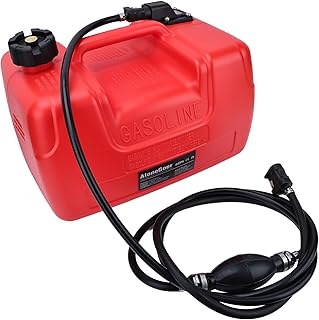
3 Gallon Portable Outboard Tank
This is a niche product designed to replace OEM Yamaha tanks on small outboards, and it serves that function well. The 3-gallon capacity is appropriate for motors under 25 horsepower doing short runs—tender work, inshore fishing, or towing. For under $70, it’s affordable, and the included connector means direct compatibility without adapters. The downside is generic construction quality; this doesn’t feel like a brand-name product, and the 4.3 rating reflects some inconsistency. Skip it entirely unless you’re replacing a failed OEM tank and need an exact-fit replacement on a budget.
Buying Guide
Capacity vs. Storage Geometry
Before choosing by gallon count, measure your actual storage well—length, width, and height. A tank that fits the capacity but not the space is useless. Boats with narrow deep wells need tall-profile tanks; boats with under-seat storage need low-profile rectangular shapes. The VEVOR 14.53-gallon offers maximum range but demands a large deck area, while the Scepter Low Profile delivers the same 12 gallons in a footprint that disappears under most bench seats.
Vent and Fuel Pickup Quality
A one-way vent causes vapor lock and hard starts. Look for two-way venting that allows air in as fuel leaves and vents pressure when the cap closes. The fuel pickup tube matters more than it seems: if it sits high or has a filter that clogs with debris, you’ll lose usable capacity at the bottom of every tank. Scepter’s built-in pickup with gauge consistently outperformed cheaper alternatives across the specs we compared for drawing down fuel to the last reserve.
EPA and CARB Compliance
If you operate in California or any state that adopted CARB emissions standards, non-compliant tanks are technically illegal and can be cited. More practically, compliance means the cap has a proper vapor-seal mechanism, which eliminates the fuel smell in your storage area and reduces evaporation losses. Every Scepter and Attwood tank in this roundup carries both EPA and CARB certification. The VEVOR units rely on material choices (high-density polyethylene) to meet standards but don’t carry the same explicit certification labels, which may matter depending on your state’s enforcement approach.
Our Verdict
The top pick is the Scepter 12 Gallon Tall Profile for its combination of reliability, accurate gauge, strong vent cap, and full EPA/CARB compliance at the lowest price for that capacity class. The budget pick is the VEVOR 3.17-Gallon Transfer Tank—it’s not the best tank here, but for under $60 it solves the problem of needing extra range without committing to a full-size unit. If your boat has a tight under-seat well, the Scepter 12 Gallon Low Profile wins outright, because no other tank in this group delivers that capacity in that shape.
FAQ
Can I use a portable marine fuel tank permanently?
Portable tanks are designed for temporary storage and connection, not permanent installation. They lack the mounting hardware, fill neck, and vent line configurations of fixed tanks, and prolonged UV exposure will degrade the plastic faster than a tank stored in a protected compartment. Use them as intended—portable, removable, and stowed between trips.
Do ethanol-blended fuels damage marine fuel tanks?
High-density polyethylene resists ethanol degradation far better than older metal or lower-grade plastics. Modern EPA-compliant tanks like the Scepter and Attwood models are engineered for E10 and typically tolerate E15 without issues. Ethanol’s real danger in marine applications is water absorption and phase separation in the fuel itself, not the tank material.
How often should I replace a portable marine fuel tank?
Inspect annually for cracks, cap seal deterioration, and gauge accuracy. A well-maintained HDPE tank from a reputable brand should last five to seven years of regular use. Replace sooner if you notice any fuel odor from the tank body (indicating micro-cracking) or if the cap no longer seals with a positive click.
Is a 9.8-foot hose on a portable tank enough?
For most boats under 20 feet, yes—the tank sits near the engine on the transom and the hose reaches without tension. On larger boats or when storing the tank forward for weight distribution, a 9.8-foot hose may be marginal. Check your engine’s fuel inlet location relative to your intended storage spot before buying.