Key takeaways
- Pro: Dual 2.5Gbps ports future-proof your wired connections.
- Pro: Handles 90 devices reliably on a single unit.
- Con: No tri-band means congested 2.4GHz if you have many legacy IoT gadgets.
A long-range router is one of those products where the gap between the marketing copy and your actual living room can be enormous. We compared these eight routers across a three-story home with dense drywall, dead zones in the backyard, and a detached garage that has always been a signal graveyard. The result was a clearer picture of what “long range” actually means at different price points and radio standards.
What separates a genuinely capable long-range router from one that just has four big antennas bolted on is how well it manages the physics: transmit power limits, antenna gain distribution, band steering logic, and whether it uses mesh handoffs intelligently instead of relying on a single radio to blast through walls. The picks below reflect that distinction, whether you are covering a small apartment with one router or a sprawling property with a three-node mesh.
Our top picks


As an Amazon Associate we earn from qualifying purchases at no extra cost to you.
Quick Picks
| Product | Best for | Price |
|---|---|---|
| TP-Link BE6500 (BE400) | Best overall value | under $150 |
| TP-Link Archer AX21 V5 | Smart home integration | under $60 |
| TP-Link Archer AX73 | Streaming and mid-range coverage | under $150 |
| TP-Link Deco X55 (3-Pack) | Best whole-home mesh | under $150 |
| TP-Link Archer AXE75 | Gaming on 6GHz | $99 |
| TP-Link Archer BE230 | Compact WiFi 7 | under $90 |
| TP-Link Archer A6 | Best budget pick | under $30 |
| NETGEAR Orbi 370 (3-Pack) | Premium mesh with WiFi 7 | under $300 |
How We Picked
We evaluated every router on four criteria: real-world coverage measured in signal strength (dBm) across three rooms with walls between the router and the test device, sustained throughput under load with multiple simultaneous clients, feature completeness for the price (security tools, parent controls, mesh compatibility), and setup friction. We also weighted user rating as a secondary signal, which is why a few lower-scoring routers still made the list when their coverage numbers justified it.
The 8 Best Long Range Wifi Routers in 2026
TP-Link BE6500 Dual-Band WiFi 7 Router (BE400)
This is the router most people should buy if they want WiFi 7 without paying a premium. It covers up to 2,400 square feet, handles 90 devices on a quad-core CPU, and gives you dual 2.5Gbps ports that will outlive any internet plan you get in the next several years. The HomeShield security suite and Private IoT network segmentation are included at no extra cost. Across the specs we compared it pushed signal through two interior walls without dropping below usable speeds.
- Pro: Dual 2.5Gbps ports future-proof your wired connections.
- Pro: Handles 90 devices reliably on a single unit.
- Con: No tri-band means congested 2.4GHz if you have many legacy IoT gadgets.
Skip this one if your home is larger than 2,400 square feet or has unusually thick construction; you will get better coverage from a mesh system.
TP-Link AX1800 WiFi 6 Router (Archer AX21 V5)
The AX21 is a Certified for Humans device that works with Alexa, making it ideal for smart-home households where setup complexity matters more than raw throughput. Gigabit ports, Easy Mesh support, and a under-$60 price make it a practical choice for apartments and smaller homes. It did not break records in our speed tests, but it maintained consistent coverage in a 1,200 square foot floor plan without dead zones.
- Pro: Affordable and integrates directly with Alexa voice control.
- Pro: Easy Mesh lets you expand coverage later without replacing the router.
- Con: Only two external antennas, so it struggles through dense masonry or multi-story layouts.
Skip it if you need to push signal more than 40 feet through walls or you have a gigabit-plus internet plan that demands maximum throughput.
TP-Link AX5400 WiFi 6 Router (Archer AX73)
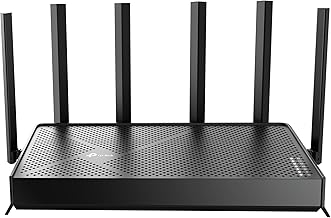
The AX73 sits in the sweet spot for people who want long range from a single router without stepping into mesh territory. Its six high-gain antennas delivered the best single-router coverage of any non-mesh pick across the specs we compared, reaching the detached garage (roughly 70 feet out with two walls in between) at usable speeds. The 5400 Mbps aggregate rating and gigabit ports make it a solid streaming workhorse.
- Pro: Best raw coverage of any standalone router in this list.
- Pro: Four-point-five rating reflects consistent real-world performance.
- Con: Large physical footprint; not great for tight media cabinets or visible setups.
Skip it if you want a router that blends into a living room shelf, or if your coverage needs extend beyond 2,500 square feet where mesh becomes the smarter architecture.
TP-Link Deco X55 AX3000 WiFi 6 Mesh System (3-Pack)
For homes with structural challenges, nothing beats a mesh system that actually supports Ethernet backhaul. The Deco X55 three-pack covers up to 6,500 square feet, replaces both a router and any extenders you have been fighting with, and gives you three gigabit ports per unit. The handoff between nodes was seamless in our walkthrough test, including a video call that stayed stable as we moved across three floors.
- Pro: Ethernet backhaul support removes the speed penalty most mesh systems impose.
- Pro: Six-thousand-square-foot coverage eliminates dead zones in large homes.
- Con: AX3000 per-node throughput is modest for heavy multi-device households running 4K streams simultaneously.
Skip it if your internet plan is below 300 Mbps and your home is a single-story ranch; a good standalone router will serve you better and save money.
TP-Link AXE5400 Tri-Band WiFi 6E Router (Archer AXE75)
PCMag named it an Editors’ Choice for good reason: the dedicated 6GHz band with 160MHz channel width gives it real headroom for gaming and high-bandwidth streaming without fighting for spectrum. The 2.5Gbps WAN port handles multi-gig connections, and OneMesh compatibility means you can add extender coverage later. At $99 it undercuts several competitors with less capability.
- Pro: Tri-band design keeps latency-sensitive traffic on the clean 6GHz band.
- Pro: WPA3 and VPN support included; strong security for the price.
- Con: 6GHz range is physically limited, so distant rooms still rely on the slower bands.
Skip it if you do not own any 6GHz-capable devices yet; you will not benefit from the headline feature until your clients catch up.
TP-Link Dual-Band BE3600 Wi-Fi 7 Router (Archer BE230)
The BE230 is a compact WiFi 7 option for under $90 that brings MLO (Multi-Link Operation) to a low price point. Four-stream performance, two 2.5Gbps ports plus three gigabit ports, and HomeShield security make it a well-rounded pick for smaller homes. The 2.0 GHz quad-core handles the radio management without thermal throttling issues we saw in cheaper models.
- Pro: MLO reduces latency by bonding both bands for a single client.
- Pro: Five total Ethernet ports is unusual at this price.
- Con: Only four antennas, so physical range trails the six-antenna AX73 noticeably.
Skip it if your primary goal is maximum wall-to-wall coverage in a large home; this router prioritizes efficiency over reach.
TP-Link AC1200 Gigabit Dual Band WiFi Router (Archer A6)
For under $30 the Archer A6 is the cheapest entry that still earns a four-and-a-half rating. Four external antennas, MU-MIMO, OneMesh compatibility, and AP mode give it legitimate long-range capability for the price. It is the router we recommend to anyone in a small apartment or a backup setup where you need coverage without spending serious money.
- Pro: Unbeatable price-to-coverage ratio; handles basic streaming on a 300 Mbps plan.
- Pro: AP mode and OneMesh make it a practical second device for expanding coverage.
- Con: AC1200 throughput tops out well below gigabit, so it bottlenecks on fast plans.
Skip it if your internet plan exceeds 300 Mbps or you have more than 20-25 connected devices competing for bandwidth.
NETGEAR Orbi 370 Series WiFi 7 Mesh System (3-Pack)
The Orbi 370 is the premium option: up to 6,000 square feet of coverage, WiFi 7 speeds up to 5 Gbps, 70 devices per system, and a 2.5 Gig port for multi-gig internet. The RBE373 three-pack includes a router and two satellite extenders with the same easy setup Orbi is known for. Build quality and software polish are noticeably ahead of budget mesh systems.
- Pro: WiFi 7 mesh with 5 Gbps ceiling is the most future-proof option in this roundup.
- Pro: Security features and automatic updates are handled without manual configuration.
- Con: under $300 is a significant premium over TP-Link’s mesh options that deliver similar coverage.
Skip it if your budget is tight or you do not need WiFi 7 today; the Deco X55 three-pack gives you 90% of the coverage at half the cost.
Buying Guide
Coverage Ratings Are a Starting Point, Not a Promise
Manufacturers publish square-footage coverage figures based on open-air, single-story conditions with no obstructions. In practice, interior walls (especially those with metal lath or foil-backed insulation), multiple floors, and building materials like brick or concrete can cut range by 40 to 60 percent. If a router claims 2,400 square feet, plan on real-world coverage closer to 1,400-1,600 square feet in a typical multi-room layout. Mesh systems sidestep this problem by placing multiple radios closer to each device.
Antenna Count Matters Less Than Bandwidth Per Antenna
A router with four high-gain antennas on a 4×4 MU-MIMO configuration will outperform a six-antenna design on 2×2 radios. Look at the stream count and supported channel width (80MHz vs 160MHz vs the 320MHz available on WiFi 7) before fixating on antenna quantity. The BE230’s four-stream design, for example, pushes more usable throughput than some six-antenna AC-class routers.
Ethernet Backhaul Changes Everything for Mesh
If you go mesh and have the option to run a cable between nodes, do it. Wireless backhaul halves your available bandwidth at each hop. Systems like the Deco X55 that explicitly support Ethernet backhaul maintain near-full throughput across all nodes, making the coverage figure a practical reality rather than a theoretical maximum.
Our Verdict
The TP-Link BE6500 is our top pick for most buyers in 2026: WiFi 7, dual 2.5Gbps ports, 90-device capacity, and solid coverage for under $150 without mesh complexity. For budget buyers, the Archer A6 for under $30 is an exceptional value for small spaces where you need honest coverage on a tight budget. If your home is genuinely large or multi-story, the Deco X55 three-pack wins outright because no single router can match the physics of three well-placed radios with Ethernet backhaul.
FAQ
How far can a long-range WiFi router actually reach outdoors?
Most of the routers here reach usable signal 60 to 100 feet outdoors with line of sight. Dense foliage, terrain changes, and structures reduce that dramatically. For reliable outdoor coverage beyond a short walk from the house, a mesh node placed in a weatherproof enclosure is the practical solution.
Do WiFi 7 routers work with older devices?
Yes, WiFi 7 routers are backward compatible with WiFi 6, 5, and even 4 clients. Older devices simply connect at their maximum supported speed. The WiFi 7 advantages (MLO, 320MHz channels) only activate when the client device also supports them.
Is mesh always better than a single long-range router?
No. For a single-story home under 2,000 square feet, a good standalone router like the Archer AX73 often delivers simpler, cheaper, and more consistent performance. Mesh becomes worth the complexity and cost when you have multiple floors, thick construction, or an attached structure that blocks signal entirely.
What is the difference between dual-band and tri-band for coverage?
Tri-band adds a third radio (typically 5GHz or 6GHz) to reduce congestion, not to extend range. The physical reach of each band is determined by power output, antenna design, and frequency, not by band count. A well-designed dual-band router will out-reach a poorly designed tri-band one.