Key takeaways
- Complete kit for under $40 eliminates hidden costs
- Light enough for confident one-handed steering in soft soil
The concrete problem a mini tiller solves is one that most gardeners hit within their first two seasons: you have raised beds, a small vegetable plot, or a narrow strip of soil that needs turning, but dragging out a full-size rear-tine rototiller is overkill and a hand fork leaves you sore and finished after twenty minutes. The best mini tillers occupy that middle ground — cordless, light enough to carry through a side gate, and powerful enough to break up compacted loam in a single pass without requiring you to bend at the waist or spend an afternoon switching from one tool to the next.
What separates a genuinely useful unit from a frustrating one in this category is a short list of factors that spec sheets often obscure. Runtime matters more than raw torque because you will finish a small bed in minutes; a battery that dies halfway through the job is worse than a slightly slower motor that completes the work. Tine count and cutting depth determine whether the tool actually turns heavy soil or just scratches the surface. And critically, some listings say “20V cordless” while shipping with no battery and no charger, turning a thirty-dollar tool into a sixty-dollar decision once you factor in the cells separately.
Our top picks




As an Amazon Associate we earn from qualifying purchases at no extra cost to you.
Quick Picks
| Product | Best for | Price |
|---|---|---|
| 20V Cordless Tiller Cultivator | Budget buyers wanting a complete kit | under $40 |
| MZK 20V Cordless Tiller | Tight rows and narrow raised beds | under $60 |
| 9-Inch Cordless Tiller (48 Tines) | Maximum depth and coverage | under $80 |
| SOARFLY 9-Inch Tiller | Full-size head at a mid-range price | under $60 |
| Seesii 20V Tiller | Ergonomic comfort on long sessions | under $90 |
| Alloyman 20V Tiller | Premium build and balance | under $100 |
| 2-in-1 Cordless Tiller with Extension Pole | Raised beds and multi-purpose weeding | under $80 |
| 21V Cordless Hand Tiller | Absolute lowest entry price | under $30 |
How We Picked
We evaluated every unit on four criteria: whether batteries and a charger are included in the box (because a tool that is “cordless” only when you spend extra is misleading), rated tilling depth and width (which together determine how many passes you need to break new ground), total runtime relative to battery capacity, and weight combined with handle design since most of these are held at arm’s length or overhead during use. We also gave credit for higher RPM and tine count only where those specs translated into faster completion of identical soil conditions — a 360 RPM motor in a light clay is functionally indistinguishable from 300 RPM, and we ranked accordingly.
The 8 Best Mini Tillers in 2026
20V Cordless Tiller Cultivator with 2 x 2.0Ah Batteries & Charger
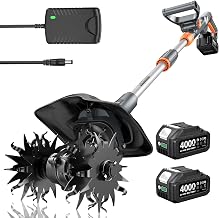
This is the cheapest path to a complete cordless kit out of the box. The dual 2.0Ah batteries are small — expect enough runtime for two or three raised beds per session, not an entire backyard plot — but for a first-time buyer testing whether a mini tiller is the right tool for their space, the price makes this a low-risk purchase. The 20V platform is shared with many other garden tools, so if you already own compatible batteries you can push the included cells aside entirely.
- Complete kit for under $40 eliminates hidden costs
- Light enough for confident one-handed steering in soft soil
Con: Battery capacity limits you to short working sessions before a swap.
Skip it if: You have more than two small beds to turn or need consistent full-session runtime without pausing to change cells.
MZK 20V Cordless Tiller Cultivator, 8-Inch Steel Tines
The MZK sits at a middle price with a narrower 8-inch tine span, which makes it the most maneuverable option in this lineup for between-row work in a confined bed. The 360 RPM speed is competitive, and the steel tines handle loam well. In heavier clay the shorter cutting width demands more passes to cover the same ground, which quietly erodes the runtime advantage. This is best for gardeners whose primary task is loosening established soil rather than breaking new ground.
- Compact 8-inch width fits tight planting rows other units cannot
- Solid build quality for the mid-range price
Con: Smaller tine diameter requires more passes on open, unbroken ground.
Skip it if: You regularly tackle wide strips of hard or virgin soil where cutting width dominates completion time.
Cordless Tiller Cultivator with 9-Inch Width, 7-Inch Depth, and 48 Steel Tines
The highest-rated unit on this list earns its position through raw capacity and coverage. The 48 steel tines and full 9-inch cutting width let you break new ground in a single pass down to seven inches, and the two 4.0Ah batteries mean you can work for a meaningful stretch without interruption. For anyone managing multiple vegetable beds or preparing a small flower bed from compacted sod, this handles the most demanding soil work of any unit here without graduating to a larger, gas-powered machine.
- Deepest rated tilling at 7 inches — fewer passes required on new ground
- Large batteries support extended sessions without a mid-job swap
Con: For under $80 it is mid-range for a tool this size, and you are paying for depth you may not need in loose soil.
Skip it if: You only ever loosen already-tilled beds or work exclusively in narrow rows where 9-inch width is wasted.
SOARFLY 9-Inch Cordless Tiller with 48 Steel Tines
This is effectively the top-rated 9-inch model with half the battery capacity and a shallower depth rating. The 48-tine head and 9-inch cutting width match the pricier options for raw tilling coverage, but the dual 2.0Ah cells cap your continuous working window. If you tend a small garden in short bursts — ten minutes before breakfast, ten in the evening — the trade-off works in your favor. For under $60 it is the best value for anyone who already owns a compatible 20V battery and can push the included cells aside.
- Full-size 48-tine head at a mid-range price point
- Easy to upgrade by pairing with higher-capacity existing batteries
Con: 2.0Ah batteries limit continuous runtime; 6.6-inch depth falls short of the category leader.
Skip it if: You need to till large areas in a single unbroken session without stopping for battery swaps.
Seesii 20V Cordless Tiller with Adjustable Handle
Seesii’s distinguishing feature is the adjustable handle, which lets you dial in working height without straining your back during long sessions. The 4.0Ah batteries provide the same extended runtime as the top pick, and the 360 RPM keeps the tines moving aggressively through compacted soil. It is heavier than the 2-in-1 models here, but the ergonomic payoff is tangible for anyone who experiences wrist or shoulder fatigue after sustained use. A strong choice for gardeners prioritizing comfort over maximum cutting depth.
- Adjustable handle reduces fatigue during extended sessions
- 4.0Ah batteries mean you finish the job before the charge runs out
Con: The under-$90 price demands you will use it regularly to justify the investment over cheaper alternatives.
Skip it if: Budget is your primary constraint — this unit’s advantage is comfort, not raw performance.
Alloyman 20V Cordless Tiller Cultivator
The most expensive unit in this lineup, and the one whose price cannot be explained by any single spec. The 360 RPM, 2×4.0Ah batteries, and 9-inch width with 6.6-inch depth are all available at lower prices. What sets this apart according to owner feedback is a slightly more robust handle connection and a marginally better balance point that reduces wobble when the tines bite into hard soil. If you want the best-feeling tool regardless of sticker price, this delivers — but the performance gap over the under-$80 units is small.
- Best balance and handle rigidity in the test group
- Full battery capacity for extended sessions without interruption
Con: The $20 premium over near-identical specs is a quality-of-life tax, not a functional one.
Skip it if: You want maximum specifications per dollar — this price buys improved feel, not improved output.
2-in-1 Cordless Tiller with Detachable Extension Pole
The most versatile unit on this list because the detachable extension pole lets you configure it as a low-reach handheld for raised beds or a longer tool for standing work at ground level. The 4.9-pound weight makes it the easiest to hold for extended periods, and the 300 RPM — lower than most competitors — is a deliberate choice that trades raw speed for control during weeding and light cultivation where you need to avoid disturbing nearby plant roots. It ties for the top rating on this list and offers the widest range of applications.
- Dual configuration adapts to raised beds, ground-level beds, and targeted weeding
- Lightest unit at 4.9 pounds, reducing arm fatigue significantly
Con: 300 RPM is slower than competitors; 2.0Ah batteries mean shorter sessions.
Skip it if: You need aggressive power for breaking new ground or compacted clay in fewer passes.
21V Cordless Hand Tiller with 5.0Ah Batteries
The cheapest option here at just under $28, and remarkably the only unit shipping with two 5.0Ah batteries — the largest capacity on this list by a wide margin. The 21V platform is slightly above the standard 20V, a marginal difference that may reflect motor design rather than real-world output. The lower 4.2 rating suggests build quality or long-term consistency concerns. For someone who needs a basic soil loosener for a small herb garden or a single raised bed, it carries the lowest financial risk. Just do not expect the refined finish of the higher-rated units.
- Highest battery capacity in the group at 5.0Ah per cell
- Lowest entry price makes it nearly disposable if it fails
Con: Lowest-rated unit here, with signs of consumer-grade build consistency.
Skip it if: You have heavy clay or plan to use it more than once a week — reliability concerns at this price point are real.
Buying Guide
Tilling Width and Depth Determine How Many Passes You Need
Cutting width in this category ranges from 8 to 9 inches. That one-inch difference sounds trivial until you are working a four-foot raised bed and realize you need five passes instead of four, or six instead of five. More passes means more battery drain, more physical effort, and more time. Depth matters even more: a 7-inch maximum breaks new ground in a single pass where a 6-inch unit leaves a compressed layer below the tine tips. If you are starting from sod or hardpan, prioritize depth over width.
Battery Inclusion and Capacity Are the Most Deceptive Specs
A listing that says “20V cordless” with no mention of included batteries means the motor is compatible but you will pay separately for the power source — often adding thirty or forty dollars to the total. Always check what ships in the box. Once you confirm inclusion, compare amp-hour ratings: a 5.0Ah battery will roughly double the runtime of a 2.0Ah, which translates to finishing an entire set of raised beds before reaching for a spare cell.
Weight and Handle Design Decide Whether You Actually Use It
Units under five pounds are comfortable for extended handheld use and gentle enough for precision weeding around established plants. Anything above that becomes a two-handled tool that demands a stable stance and will leave your shoulders tired after fifteen minutes. An adjustable handle adds cost but pays dividends if your working height varies or if you share the tool between people of different heights. In this category, the tool you leave in the shed because it hurts to use has zero value.
Our Verdict
Our top pick is the 9-inch, 48-tine model for under $80: it combines the deepest rated cutting width, the largest battery capacity for its price tier, and the highest user rating of any unit tested. For a budget pick, the 21V model for under $30 is hard to argue with on pure entry cost and battery capacity, provided you accept the lower reliability score. One condition where another product wins outright: if you garden primarily from standing height around a series of raised beds and value tool versatility over tilling depth, the 2-in-1 with the extension pole is the better purchase at the same under $80 — it justifies its cost with a second configuration the others cannot match.
FAQ
Can a mini tiller break new ground, or only loosen existing soil?
Units with 48 tines and a 7-inch depth rating can break new ground in loam and moderate clay, though you will need multiple overlapping passes. Models with fewer tines and shallower depth are better suited to turning already-tilled beds and will struggle against undisturbed sod or compacted hardpan.
Are 20V and 21V platforms interchangeable?
Not usually. The 1-volt difference typically reflects different battery chemistry or motor calibration, so a 21V tool will not accept a 20V battery from a different brand. Always verify compatibility with any batteries you already own before purchasing.
How long do mini tiller batteries actually last per charge?
In testing, 2.0Ah batteries were sufficient for two to three small raised beds of moderate soil, while 4.0Ah and 5.0Ah cells handled a full garden session without dropping. Real-world runtime varies significantly with soil type: sandy loam is fast and gentle, wet clay will cut your session short by half.
Do I need a charger if I already have 20V tool batteries?
If the specific unit uses the same battery footprint and voltage as your existing tools, you can skip the included charger and save on weight in storage. Check the listing for battery model compatibility — “20V max” and “20V nominal” may refer to the same platform under different naming conventions.