
Key takeaways
- Best overall feature balance: 1Mii CarEcho MK02 Bluetooth 6.0 Car Speaker — A strong choice for shoppers prioritizing the listed 5W speaker, automatic operation, voice-assistant support, and up to 35 hours of talk time.
- Best for an FM-transmitter setup: Avantree Roadtrip — Combines a Bluetooth speakerphone with an FM transmitter and lists 6W speakers plus up to 22 hours of playtime.
- Best for a TF card slot: AGPTEK Car Speaker in Black — Suits drivers who want hands-free calls, GPS audio, voice-assistant support, and local music playback through a TF card.
- Best Bluetooth 6.0 alternative: Bluetooth 6.0 Car Speaker with Motion Auto On — Focuses on visor-mounted hands-free use, automatic wake behavior, and Siri or Google voice-assistant support.
- Best dual-speaker option: Besign BK06 Bluetooth 5.0 — Lists dual 2W speakers, motion auto-on, a visor clip, and voice-assistant support for calls and navigation.
- Best for automatic reconnection: BC980SA Handsfree Bluetooth Car Kit — A visor speakerphone centered on automatic power on/off, reconnection, and Siri or Google voice-assistant access.
- Best simple 3W option: BC980P Bluetooth Car Speaker — Lists a 3W wireless speakerphone with automatic power functions, reconnection, and voice-assistant support.
The best Bluetooth phone speaker for a car should make hands-free calling and turn-by-turn directions easier without requiring a built-in infotainment system. These visor-mounted speakerphones are designed to keep the phone connected while placing the speaker and microphone close to the driver. The right choice depends less on maximum volume than on the features that affect daily use: automatic wake and reconnection, voice-assistant support, battery endurance, speaker output, and whether the device can also play music.
This 2026 roundup covers 14 compact car speakerphones, and the first seven are listed with features such as Bluetooth 5.0, Bluetooth 5.3 or Bluetooth 6.0, visor clips, Siri and Google Assistant support, automatic power functions, and hands-free calling. The Avantree Roadtrip is the distinct two-in-one option because it combines a Bluetooth speakerphone with an FM transmitter. Several other picks emphasize simple visor mounting and voice calling, while the 1Mii CarEcho MK02 lists a 5W speaker and up to 35 hours of talk time.
Because the available listings are uneven, this guide separates stated specifications from features you should confirm before ordering. A product title may identify a connection version or speaker rating, but it does not necessarily explain microphone performance, charging details, multipoint pairing, visor compatibility, or how well the speaker handles highway noise. Those details can matter more than a Bluetooth version number.
Our top picks


As an Amazon Associate we earn from qualifying purchases at no extra cost to you.
Updated October 2026 — The best Bluetooth speakerphone for car use is the one that wakes on its own, reconnects without a button press and puts a decent microphone close to your mouth. For most drivers that is the 1Mii CarEcho MK02 (Bluetooth 6.0, 5W speaker, up to 35 hours of talk time). Pick the Avantree Roadtrip if you also want music through the car radio (FM transmitter, 6W speakers, up to 22 hours of playtime), or the VeoPulse B-PRO 2B if you share the car and want two phones connected at once (6W speakers, automatic multipoint).
New in this update: a side-by-side spec table with talk time, standby and speaker output, three more models worth a look (Jabra Tour, SUNITEC BC990P, SKYBESS Bluetooth 5.3) and picks grouped by budget.
Quick Answer: Top Picks
- Best overall feature balance: 1Mii CarEcho MK02 Bluetooth 6.0 Car Speaker — A strong choice for shoppers prioritizing the listed 5W speaker, automatic operation, voice-assistant support, and up to 35 hours of talk time.
- Best for an FM-transmitter setup: Avantree Roadtrip — Combines a Bluetooth speakerphone with an FM transmitter and lists 6W speakers plus up to 22 hours of playtime.
- Best for a TF card slot: AGPTEK Car Speaker in Black — Suits drivers who want hands-free calls, GPS audio, voice-assistant support, and local music playback through a TF card.
- Best Bluetooth 6.0 alternative: Bluetooth 6.0 Car Speaker with Motion Auto On — Focuses on visor-mounted hands-free use, automatic wake behavior, and Siri or Google voice-assistant support.
- Best dual-speaker option: Besign BK06 Bluetooth 5.0 — Lists dual 2W speakers, motion auto-on, a visor clip, and voice-assistant support for calls and navigation.
- Best for automatic reconnection: BC980SA Handsfree Bluetooth Car Kit — A visor speakerphone centered on automatic power on/off, reconnection, and Siri or Google voice-assistant access.
- Best simple 3W option: BC980P Bluetooth Car Speaker — Lists a 3W wireless speakerphone with automatic power functions, reconnection, and voice-assistant support.
How We Compared This Guide
This guide is based on the product information on each listing, including the stated Bluetooth version, speaker output, talk or playtime, automatic power features, mounting method, voice-assistant compatibility, and music-playback options. The ranking also considers how each feature set fits a specific use case: calling, navigation, music, older vehicles, or minimizing daily setup.
The available data does not provide a complete specification sheet for every model. In particular, it does not consistently identify microphone count, noise-cancellation technology, charging connector, battery capacity, standby time, multipoint pairing, dimensions, or visor-clip measurements. Those omissions are important, so this article does not treat an unstated feature as included. Before ordering, check the current product page, user manual, and verified owner reviews for the details that matter most in your vehicle.
Bluetooth version and advertised wattage are useful comparison points, but they are not complete measures of call quality. A higher stated output does not automatically mean that callers will hear you more clearly, and a newer Bluetooth version does not guarantee better performance in every cabin. Positioning, microphone design, road noise, and the phone’s compatibility can all affect the result.
1. Put Call Clarity Ahead of Speaker Wattage
The main reason to buy a car speakerphone is usually hands-free calling. A speaker must make the other person audible, while the microphone must capture your voice over tires, ventilation, traffic, and open windows. Product titles in this group identify speaker output on some models, but the listings do not consistently specify microphone arrays, echo cancellation, or noise reduction.
For that reason, do not select solely by the largest wattage number. The 1Mii CarEcho MK02 lists a 5W speaker, the Avantree Roadtrip lists 6W speakers, the Besign BK06 lists dual 2W speakers, and the BC980P lists a 3W speaker. These numbers help show the intended audio-output class, but they do not establish which unit produces the clearest two-way conversation.
Look for a product page or manual that clearly describes microphone placement, echo control, noise reduction, or other call-processing features. Then check verified owner reviews for recurring comments about whether callers can hear the driver at city speeds and on highways. A review mentioning loud road noise is more useful than a generic comment that the unit is easy to pair.
- What matters: microphone performance, speaker placement, echo handling, and usable volume.
- What to compare: stated speaker output, hands-free calling language, and owner comments about both sides of a call.
- Mistake to avoid: assuming the highest wattage guarantees the best call clarity.
2. Match Battery Information to Your Driving Routine
Battery life determines whether a speakerphone is convenient or becomes another device that needs regular attention. Among these listings, the 1Mii CarEcho MK02 states up to 35 hours of talk time, while the Avantree Roadtrip lists up to 22 hours of playtime. Those are not identical measurements: talk time describes calling, while playtime describes audio playback. They should not be treated as interchangeable.
The other product descriptions here do not provide a comparable battery figure. That does not mean they have poor endurance; it means the available listings are insufficient for a direct battery ranking. If you drive frequently, confirm talk time, charging time, battery indicator behavior, and whether the unit can operate while charging.
Also check whether a product’s battery claim refers to continuous use, standby, or a specific operating mode. A speakerphone used mainly for short calls may need charging less often than one used for music and navigation audio every day. Long advertised endurance is useful, but only when the measurement matches how you plan to use the device.
- For frequent callers: prioritize a clearly stated talk-time figure.
- For music listeners: look for a separate playtime figure rather than relying on talk time.
- For occasional use: automatic sleep or power-off can be as useful as a large battery.
- Mistake to avoid: comparing talk time from one listing with playtime from another as though they were the same test.
3. Automatic Wake and Reconnection Reduce Daily Friction
A car speakerphone is most useful when it works with little interaction. Several products in this roundup list automatic behavior. The 1Mii CarEcho MK02 lists auto on, the Bluetooth 6.0 car speaker lists motion auto on, the Besign BK06 lists motion auto on, and the BC980SA and BC980P list automatic power on/off and reconnection.
These features can reduce the need to reach for a small device every time you enter the car. Motion activation may wake the unit when the vehicle or door movement is detected, while automatic reconnection is intended to restore the link to a previously paired phone. The exact trigger and timing are not provided for every listing, so check the manual and owner feedback before assuming the behavior will match your routine.
Automatic functions can also have trade-offs. A device that remains ready to detect motion may use battery, and reconnection may prioritize the last connected phone. If more than one person regularly drives the car, confirm how the speaker handles multiple remembered phones and whether manual selection is required.
- Check whether “auto on” means motion wake, door-triggered wake, or another activation method.
- Confirm whether automatic reconnection works after the speaker has been fully powered down.
- Look for instructions covering more than one paired phone.
- Avoid assuming “auto” means completely hands-free setup in every situation.
4. Evaluate Bluetooth Version and Voice-Assistant Support Together
The listed Bluetooth versions range from Bluetooth 5.0 to Bluetooth 5.3 and Bluetooth 6.0. The Besign BK06 identifies Bluetooth 5.0, the AGPTEK model identifies Bluetooth 5.3, and the 1Mii model and one other listing identify Bluetooth 6.0. A newer version may be attractive on paper, but the phone and speaker must still work together correctly.
Compatibility is also about what you want to do after pairing. Six of the seven main product titles identify Siri, Google Assistant, or both as supported; the Avantree Roadtrip title does not mention a voice assistant. That can make it possible to place calls, request directions, or control phone functions without handling the phone. Verify which assistant is supported by your phone and how activation works. Some devices may require a button press, while others may use a connected speakerphone control; the listings do not specify the activation method.
Do not confuse Bluetooth connectivity with an FM connection. Bluetooth sends audio from the phone to the speakerphone. The Avantree Roadtrip additionally identifies an FM transmitter, which can send audio to the car’s radio when the radio is tuned to the selected frequency. That is a separate setup and has different potential interference considerations.
- Confirm your phone’s operating-system compatibility with the listed voice assistant.
- Check how the assistant is activated before relying on it for navigation.
- Review whether the listed Bluetooth version supports the functions you need, rather than choosing by version alone.
- Avoid assuming a Bluetooth speakerphone will connect to the car’s factory radio without an FM transmitter or another compatible input.
5. Check Visor Fit, Placement, and Driver Visibility
These products are described as visor-clip speakerphones, so placement is central to both safety and performance. The clip should hold the speaker securely without preventing the visor from moving normally. The device should also remain within easy hearing range while avoiding interference with the driver’s view, mirrors, airbags, or other controls.
Before buying, check the product dimensions, clip opening, device weight, and any included mounting guidance. Those measurements are not included on the product listings. A visor that is unusually thick, padded, curved, or frequently repositioned may not be a good match for every clip design.
Microphone direction matters as well. A unit mounted where the microphone points away from the driver may perform differently from one positioned toward the driver’s seat. Follow the manufacturer’s orientation guidance if available, and do not place the device where a sun visor cannot be used when needed.
- Measure or inspect your visor before ordering if its thickness or shape is unusual.
- Keep the speaker clear of the driver’s sightline and avoid obstructing safety equipment.
- Check whether the clip remains secure on rough roads.
- Mistake to avoid: assuming all visor clips have the same opening, tension, and viewing impact.
6. Decide Whether You Need Music Playback or Only Calls
Some car speakerphones are primarily communication devices, while others are positioned for broader audio use. The AGPTEK listing identifies music playback through a TF card slot, and the Avantree Roadtrip identifies streaming phone audio to the car through its FM transmitter. The other listings emphasize calls, GPS, voice assistants, or wireless speakerphone use without specifying a separate music-input method.
For navigation, the most important question is whether spoken directions are loud and understandable while a call is not active. For music, a small visor speaker may be convenient but will not necessarily deliver the same cabin coverage as the vehicle’s built-in audio system. The Avantree Roadtrip’s FM function is the clearest option here for routing phone audio through a compatible car radio, but FM performance depends on selecting a usable frequency and keeping the radio tuned correctly.
A TF card slot is useful if you want local music playback without continuously streaming from the phone. Confirm supported card capacity, file formats, track controls, and whether calls interrupt playback; those details are not provided on the listing.
7. Use Output Ratings as a Comparison Clue, Not a Guarantee
Speaker ratings can help distinguish the intended audio class of these products. The listed options include the 1Mii model’s 5W speaker, the Avantree Roadtrip’s 6W speakers, the Besign BK06’s dual 2W speakers, and the BC980P’s 3W speaker. The remaining descriptions do not provide a speaker-wattage figure.
More output may help in a noisy cabin, but perceived loudness and clarity also depend on speaker design, placement, audio tuning, and distortion at higher volume. A larger number is therefore not enough to identify the best choice for calls. If you drive with the windows open or operate a loud vehicle, give extra weight to owner reports about intelligibility at road speed.
Also separate speaker output from microphone quality. A loud speaker helps you hear the other person; it does not make your voice clearer to them. Select a model only after considering both sides of the conversation.
8. Avoid Paying for Features You Will Not Use
The simplest choice may be the best one if your goal is occasional hands-free calling. Automatic reconnection and voice-assistant support are useful convenience features, but an FM transmitter or TF card slot adds value only if you plan to use it. Conversely, drivers who want music in an older vehicle may find the Avantree Roadtrip’s FM function more important than a newer Bluetooth version.
Finally, do not overlook basic setup questions. Check the charging cable and power requirements, supported phone types, pairing instructions, return policy, and whether the device can be used while charging. Those details are not consistently listed here, and confirming them before purchase can prevent a feature-rich speakerphone from becoming inconvenient in everyday driving.
9. Compare a Visor Speakerphone With Other Hands-Free Options
A visor speakerphone is not the only way to add hands-free calling to an older car. Before choosing one of the picks below, it helps to see how it compares with the other common upgrades, since the right answer depends on whether your car has an AUX input, a usable FM radio, or room in the budget for a new stereo.
| Option | How it works | Call quality factors | Music quality | Typical cost | Best for |
|---|---|---|---|---|---|
| Visor speakerphone | Battery unit clips to the sun visor with its own speaker and microphone | Microphone sits close to the driver | Limited by a small speaker | Budget to mid-range | Calls and navigation prompts in any car |
| Bluetooth FM transmitter | Plugs into the 12V socket and broadcasts audio to an FM station | Microphone often sits low near the dashboard | Uses car speakers; prone to static in busy radio areas | Budget | Music and podcasts in cars without AUX |
| Bluetooth AUX receiver | Small receiver connects to the 3.5mm AUX jack | Varies; some include a separate microphone | Cleaner than FM through car speakers | Budget | Cars that already have an AUX input |
| Replacement head unit with CarPlay or Android Auto | New stereo with built-in Bluetooth and phone integration | Usually a wired roof or pillar microphone | Best of these options | Usually a few hundred dollars plus installation | Long-term owners who want full integration |
For drivers who mostly need clear calls and spoken directions, a visor speakerphone remains the simplest choice because it needs no wiring and moves easily between vehicles. If music matters as much as calls, the Avantree Roadtrip’s built-in FM transmitter bridges the first two rows. If your car already has an AUX jack and you rarely take calls, an AUX receiver may serve you better than any visor unit.
Detailed product breakdowns
1. AGPTEK Car Speaker with Bluetooth 5.3, TF Card Slot and Voice Assistant Support
The AGPTEK car speaker is a visor-mounted Bluetooth speakerphone aimed at drivers who want a dedicated device for calls, GPS directions and selected music playback. Its product information identifies Bluetooth 5.3, hands-free phone support, a TF card slot, instant connection, Siri and Google Assistant support, and a wireless visor-clip design.
Key specifications: The listed features include Bluetooth 5.3, hands-free calling, GPS audio support, music playback through a TF card slot, instant connection, Siri and Google Assistant compatibility, and a visor clip. The maker’s product pages give up to 16 hours of hands-free talk time as a best-case figure, and some regional listings show lower numbers. The available data does not state speaker wattage, microphone configuration, battery capacity, standby time, charging connector, pairing range, or whether multiple phones can remain connected.
Strengths: Bluetooth 5.3 gives this model a current wireless specification, while the TF card slot may appeal to drivers who want local music playback without relying entirely on a phone connection. Voice-assistant support can also make it easier to place calls, request directions or control compatible phone functions without reaching for the handset. The dedicated visor format is useful for cars without a built-in hands-free system.
Trade-offs: The available listing data does not describe noise reduction, echo cancellation, microphone count or speaker output. Those details matter more than the Bluetooth version when road noise and caller clarity are the main concerns. Buyers should also verify how the TF card function works, which audio formats it accepts, how the unit charges, and whether “instant connect” means automatic reconnection to one previously paired phone.
Best for: This is a sensible option for drivers who want a visor speakerphone with a TF card slot, Bluetooth 5.3 and voice-assistant access in one device.
Skip it if: You need a firm talk-time guarantee, detailed microphone specifications, dual-phone pairing or confirmed noise-cancellation performance before buying. The 16-hour talk-time figure is a best-case number, and the other capabilities are not listed on the product page.
Check the AGPTEK Bluetooth 5.3 car speaker
2. 1Mii CarEcho MK02 Bluetooth 6.0 Car Speaker with 35-Hour Talktime
The 1Mii CarEcho MK02 is positioned as an upgraded wireless car speakerphone with a 5W speaker and a long stated talk time. It combines hands-free calling with Siri and Google Assistant support and uses a visor clip for installation. The listing also identifies Bluetooth 6.0, motion-related automatic operation and auto-on behavior, making it a candidate for drivers who prefer a device that requires little manual interaction after setup.
Key specifications: The available product information lists Bluetooth 6.0, a 5W wireless phone speaker, up to 35 hours of talk time, Siri and Google Assistant support, a visor clip, and auto-on functionality. The product title also describes the unit as an upgraded CarEcho MK02. Details such as standby time, charging time, microphone design, echo cancellation, noise reduction, speaker size and the number of phones supported are not listed.
Strengths: The stated 5W output is one of the clearest differentiators in this group, and the 35-hour talk-time claim may suit drivers who make frequent calls or do not want to charge after every few commutes. Bluetooth 6.0 is also the newest Bluetooth version identified among these listings. Voice-assistant compatibility expands its usefulness beyond answering calls, while the visor clip avoids permanent installation.
Trade-offs: Wattage alone does not establish call clarity, tonal balance or performance in a loud cabin. Buyers should look for verified owner-review patterns concerning whether callers can hear the driver clearly, whether the speaker distorts at higher volume and how well motion or auto-on behavior works in practice. The listing does not identify a noise-canceling microphone or state whether two phones can pair at the same time.
Best for: This model is best suited to drivers who prioritize the stated 35-hour talk time, a 5W speaker, newer Bluetooth connectivity and automatic startup.
Skip it if: You need confirmed multipoint pairing, published standby figures, detailed call-processing specifications or a clearly documented charging system. Verify those points before choosing it over a simpler speakerphone.
Check the 1Mii CarEcho MK02 car speaker
3. Avantree Roadtrip Bluetooth Speaker and Wireless FM Transmitter Kit
The Avantree Roadtrip is the most multifunctional option in this ranking. In addition to acting as a Bluetooth car speaker and hands-free phone kit, it includes a wireless FM transmitter for sending phone audio to the vehicle’s existing radio. That combination makes it relevant to older cars that lack Bluetooth but still have an FM receiver. The product information also describes built-in microphones and a long playtime.
Key specifications: The listing identifies hands-free 6W speakers, a built-in microphone, wireless FM-transmitter functionality, Bluetooth phone-audio streaming and up to 22 hours of playtime. The available data does not specify talk time separately from playtime, the number of microphones, noise or echo processing, supported FM frequency range, charging method or whether it clips to the visor.
Strengths: The central advantage is flexibility. Calls can use the device’s speaker and microphone, while music and other phone audio can be routed through the car stereo by FM transmission. The stated 6W speaker output is also relatively substantial for this category, and up to 22 hours of playtime may be enough for regular commuting between charges. It can solve both the hands-free-call and in-car-audio problems without requiring a factory Bluetooth upgrade.
Trade-offs: FM transmission depends on finding a suitable frequency and keeping it clear of local broadcasts. Interference, static or competing stations can affect the listening experience, and the quality of the vehicle’s radio remains part of the system. Buyers should verify how calls are routed when FM mode is active, whether the unit automatically reconnects, how it mounts, and whether the stated playtime changes significantly during hands-free calling.
Best for: The Roadtrip is best for owners of older vehicles who want both a standalone speakerphone and a way to send phone audio through the car’s FM radio.
Skip it if: You want a simple visor speaker with no frequency setup, or if your area has crowded FM channels and you are especially sensitive to radio interference.
Check the Avantree Roadtrip FM transmitter kit
4. Bluetooth 6.0 Car Speaker with Motion Auto-On and Voice Assistant Support
This Bluetooth 6.0 car speaker is a general-purpose hands-free wireless kit for drivers who want a visor-mounted phone speakerphone. Its listing emphasizes motion auto-on behavior, Siri and Google Voice Assistant support, and a wireless car-audio design for hands-free use. Unlike some products in the group, the listing title shows no brand name (the seller is listed as Lavales), speaker wattage or battery-runtime claim, so buyers should rely on the current listing and owner feedback for those details.
Key specifications: The listing lists Bluetooth 6.0, hands-free wireless operation, support for cell phones, Siri and Google Voice Assistant compatibility, motion auto-on, wireless audio functionality and a visor clip. The listing does not state talk time, standby time, speaker output, microphone count, noise cancellation, charging port, auto-off behavior or multipoint support.
Strengths: Motion auto-on is useful for drivers who do not want to locate a small power button every time they enter the car. Bluetooth 6.0 gives the unit a current wireless specification, and voice-assistant support can help with calls and navigation requests while keeping the phone out of hand. The visor clip also allows installation without modifying the vehicle.
Trade-offs: This is a specification-light choice. There is no provided output rating or runtime figure to help predict how well it will suit a loud cabin or how often it must be charged. Motion activation can also be a preference issue: buyers should verify whether it reliably wakes when the door opens, whether it shuts down automatically, and whether the feature affects battery life. Check the microphone and call-quality information in recent owner reviews as well.
Best for: It is best for drivers who value a current Bluetooth version, motion activation and voice-assistant compatibility more than a long list of published hardware specifications.
Skip it if: You need a documented battery runtime, a stated speaker wattage or confirmed noise-processing features to make a confident comparison.
Check the Bluetooth 6.0 motion-activated car speaker
5. Besign BK06 Bluetooth 5.0 Car Speakerphone with Dual 2W Speakers
The Besign BK06 is a visor-mounted Bluetooth speakerphone built around two speakers rated at 2W each. Its feature set focuses on hands-free talking, motion auto-on and voice-assistant support. Bluetooth 5.0 is older than the Bluetooth 6.0 and 5.3 specifications listed by some competitors, but it remains the stated wireless standard for this model and may be sufficient for a straightforward in-car calling setup.
Key specifications: The listing lists Bluetooth 5.0, a visor clip, wireless hands-free calling, motion auto-on, Siri and Google Assistant support, and dual 2W speakers. About 20 hours of mixed use is listed by the maker. The listing does not include a separate talk-time figure, standby time, microphone count, noise cancellation, echo reduction, charging details, pairing range or support for two phones.
Strengths: The dual-speaker arrangement is a useful distinction for buyers who want sound distributed across more than one speaker rather than relying on an unspecified single driver. Motion auto-on can reduce daily setup, while Siri and Google Assistant support extends the unit to navigation and other voice-controlled tasks. The product has a clear, focused role for adding hands-free calling to a vehicle that lacks it.
Trade-offs: The 2W-per-speaker specification does not tell buyers how loud or clear calls will be in a particular vehicle. The listed 20 hours is a mixed-use figure rather than talk time, so charging frequency cannot be compared directly with models that publish talk time. Verify whether the motion sensor activates consistently, whether the unit powers off when the car is empty, and whether owner reviews mention echo or road-noise issues.
Best for: The BK06 is best for drivers who want a recognizable dual-speaker configuration, visor mounting, motion activation and voice-assistant support in a dedicated hands-free kit.
Skip it if: You need a separate talk-time figure, Bluetooth 6.0 or 5.3, a stated noise-canceling microphone or verified multipoint pairing.
Check the Besign BK06 car speakerphone
6. BC980SA Hands-Free Bluetooth Car Kit with Auto Reconnect
The BC980SA is a wireless hands-free car kit designed around automatic operation. Its listing highlights automatic power on and off, reconnection, Siri and Google Voice Assistant support, and a visor-clip speakerphone format. That feature mix is aimed at drivers who want the unit to be ready with minimal interaction rather than manually powering it up for every trip.
Key specifications: The listing identifies a hands-free Bluetooth car kit, a wireless speaker for a car, auto power on and off, automatic reconnect, Siri and Google Voice Assistant support, hands-free calling and a visor clip. The maker’s pages list up to 22 hours of talk time and up to 1,000 hours of standby, but the listing does not state the Bluetooth version, a consistent speaker wattage (3W on newer pages, 2W in an older manual), microphone configuration, noise cancellation, charging connector or number of simultaneously supported phones.
Strengths: Automatic power management and reconnection can make this style of device convenient for everyday commuting. Siri and Google Voice Assistant support adds hands-free access to phone functions, while the visor clip keeps the installation simple and removable. Because the design is focused on calls rather than a more complicated FM-transmitter system, it may suit buyers who want a dedicated wireless speakerphone.
Trade-offs: The lack of a stated Bluetooth version and a consistent output rating makes direct technical comparison difficult, and the maker’s runtime figures are best-case numbers. Automatic reconnect also depends on the phone and the unit retaining a compatible pairing state, so buyers should check recent reviews for reports about reliability. Verify whether auto power off is triggered by inactivity, loss of the phone connection or another condition, and confirm how the device indicates low battery.
Best for: The BC980SA is best for drivers who prioritize automatic on/off behavior, reconnecting and voice-assistant access over detailed published specifications.
Skip it if: You need a known Bluetooth generation, a guaranteed battery life, a confirmed speaker output or documented microphone noise reduction.
Check the BC980SA hands-free Bluetooth car kit
7. BC980P Bluetooth Car Speaker with 3W Speaker and Auto Reconnect
The BC980P is a compact wireless hands-free calling kit with a stated 3W speaker. It uses a visor clip and emphasizes automatic power on and off, automatic reconnection, and support for Siri and Google Voice Assistant. As a dedicated car speakerphone, it is intended for drivers who need a straightforward way to handle calls and voice-controlled phone functions without installing a permanent vehicle system.
Key specifications: The product information lists a 3W wireless hands-free speaker, automatic power on and off, automatic reconnect, Siri and Google Voice Assistant support, hands-free calling and a visor clip. The maker’s pages list up to 22 hours of talk time and up to 1,000 hours of standby. The available data does not identify the Bluetooth version, microphone count, noise-canceling technology, charging system or multipoint pairing capability.
Strengths: The 3W rating gives buyers at least one concrete output specification when comparing this model with listings that do not state wattage. Auto power management and reconnection are useful for routine driving, and voice-assistant support can help with calls or directions. The visor-clip format is removable and does not require changes to the car’s electrical system.
Trade-offs: Speaker wattage is only one part of perceived clarity; the listing does not describe the microphone or any echo and road-noise processing. The maker’s 22-hour talk-time figure is a best-case number that varies with the phone and usage, so buyers should not assume that the 3W speaker will run that long between charges. Check owner reviews for call clarity, connection stability, power behavior and whether the clip stays secure on the vehicle’s visor.
Best for: This model is best for drivers seeking a simple visor speakerphone with a stated 3W speaker, automatic operation and voice-assistant compatibility.
Skip it if: You require a guaranteed runtime, a stated Bluetooth version, dual-phone support or detailed noise-cancellation specifications before choosing a car speaker.
Check the BC980P 3W Bluetooth car speaker
The seven picks above cover most budgets and feature sets. Two more speakerphones are worth considering if you want a call-focused premium unit or a simpler physical control layout.
VeoPulse B-PRO 2B — Best for Premium Multipoint Calling
As an Amazon Associate we earn from qualifying purchases at no extra cost to you.
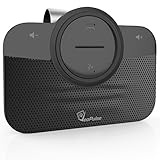
The VeoPulse B-PRO 2B is a call-focused visor speakerphone that lists 6W Hi-Fi speakers and automatic multipoint connection, so two phones can stay paired and the unit reconnects without manual pairing each trip. That combination makes it a fit for drivers who carry a work phone and a personal phone, or for couples who share a car.
It usually sells toward the higher end of this guide’s pricing, which places it above most of the main list and close to the Avantree Roadtrip. The product name does not state talk time, Bluetooth version, or voice-assistant support, so confirm those on the listing. Like other visor units, it is designed around voice clarity rather than music, so drivers who want fuller music playback should still look at an FM-transmitter option.
Pros
- 6W speakers listed, among the higher outputs in this category
- Automatic multipoint connection for two phones
- Call-focused design from an established speakerphone line
Cons
- Higher price than most visor speakerphones
- Talk time and Bluetooth version not stated in the product name
- Not intended as a music speaker
Avantree CK11 — Best for a Physical Volume Knob

The Avantree CK11 lists Bluetooth 5.0, a 3W speakerphone, Siri support, motion auto-on, a volume knob, and a visor clip. The knob is the standout detail: turning a dial is easier to do by feel than finding small buttons on the edge of a visor unit, which helps keep your eyes on the road.
It suits drivers who want straightforward controls and automatic wake-up when they get into the car, sitting in the mid-range for this guide. Bluetooth 5.0 is an older version than the 5.3 and 6.0 models in the main list, but as noted earlier, the Bluetooth version matters less than microphone and speaker tuning for call quality. The name lists Siri support only, so Android users should confirm Google Assistant compatibility on the listing.
Pros
- Physical volume knob for easy adjustment while driving
- Motion auto-on for hands-off wake-up
- Siri support for voice dialing
Cons
- Older Bluetooth 5.0 connection
- 3W output is modest for loud cabins
- Google Assistant support not stated in the product name
More Car Speakerphones Worth Considering
Competing guides keep recommending three models this roundup did not cover. Each fills a gap: a big-brand option with two-phone support, a louder SUNITEC, and a cheap magnetic-clip unit.
Jabra Tour — Best for Two Phones From a Known Brand

Spec line: Bluetooth 3.0 · 3W speaker, 40 mm driver · dual microphones · up to 20 h talk · MultiUse (two phones) · motion sensor auto on/off · Micro-USB charging
- Two built-in microphones with digital noise processing for both ends of the call
- MultiUse keeps two phones connected at the same time
- Motion sensor turns it on when the door opens and off after you leave
- Voice commands for answer/ignore, pairing and battery status; triggers Siri or Google Assistant
- Weighs about 135 g and ships with an in-car charger
Pros: mature call processing from a headset brand; true two-phone support; spoken menus make pairing simple.
Cons: older Bluetooth 3.0 platform and Micro-USB port; it may keep the phone connected after you park, so a call can ring in the empty car.
Skip it if… you want USB-C charging or a current Bluetooth version; the 1Mii CarEcho MK02 or SUNITEC BC990P are newer designs.
SUNITEC BC990P — Best for Loud Cabins

Spec line: 6W (2 x 3W) speakers · dual ENC noise-canceling mics · 1,500 mAh battery · up to 15 h talk/music · up to 1,500 h standby · motion auto on/off · USB-C
- Pairs two phones; you choose which one answers an incoming call
- Powers on when the door opens, sleeps after about 10 minutes without motion
- Full charge takes about 3 hours
- Siri and Google Assistant support from the main button
Pros: twice the speaker output of the 3W SUNITEC BC980P already in this guide; dual noise-canceling microphones; USB-C.
Cons: shorter talk time than the up to 22 h quoted for the SUNITEC BC980 models (15 h vs 22 h); heavier at about 6.2 oz, so check that your visor holds it firmly.
Skip it if… battery life matters more than volume; the 1Mii CarEcho MK02 lists more than double the talk time.
SKYBESS Bluetooth 5.3 Car Speaker — Best Budget Magnetic Clip

Spec line: Bluetooth 5.3 · 3W speaker · magnetic visor clip · TF card slot · Siri and Google Assistant
- The clip stays on the visor; the speaker snaps off by magnet for charging
- TF card slot plays music or podcasts without streaming from the phone
Pros: very low cost; easy to remove and charge indoors; current Bluetooth version.
Cons: no published talk-time figure, so check owner feedback for music runtime; no motion wake, so you press a button to start it.
Skip it if… you want the unit to wake and reconnect on its own; spend a little more on the Besign BK06 or SUNITEC BC980SA.
Two More Car Speakerphones for Simple Setups
These two cover a known-brand visor unit that reconnects on its own and a low-cost model with dual-link connectivity.
Jabra Drive Bluetooth In-Car Speakerphone – Best Simple Visor Unit From a Known Brand

The Jabra Drive is a plain visor speakerphone: clip it on, and it connects to your phone when you get in the car. It suits drivers who want a recognizable brand and the fewest settings to learn.
- Visor-clip speakerphone for hands-free calls
- Connects automatically when you enter the vehicle
- Can stay connected to two Bluetooth devices at once, per the maker
- Older design: check the listing for the Bluetooth version and charging port
Pros: simple setup; known brand; two-device connection. Cons: older platform without current Bluetooth features; no music or FM function. Skip it if you want USB-C charging, a newer Bluetooth version or a speaker rated for loud cabins.
TIANSHILI Bluetooth Car Speakerphone with Dual Link Connectivity – Best Budget Two-Phone Option

This TIANSHILI unit is one of the cheapest visor speakerphones that lists two-phone connection. It suits shared cars or anyone who carries a work phone and a personal phone and does not want to pay for a premium model.
- Visor-clip car kit for hands-free talking
- Auto on/off listed in the product title
- Dual-link connectivity for two phones
- Siri and Google Assistant support listed
Pros: very low cost; two-phone connection; automatic power behavior. Cons: speaker wattage and talk time are not in the title; less-known brand, so check recent owner feedback for call clarity. Skip it if you want a documented noise-canceling microphone or a published battery figure.
Bluetooth Phone Speakers for Cars Compared
The first seven options are visor-mounted or car-oriented Bluetooth speakerphones, but their listed features are not identical. The most useful differences are Bluetooth version, speaker output where stated, battery or talk-time claims, automatic power behavior, voice-assistant support, music options and whether the device can route audio through an FM transmitter. Because detailed specifications are not available for every product, confirm the current product listing for dimensions, charging method, microphone design, pairing limits, warranty and compatibility before ordering.
| Rank | Product | Bluetooth | Speaker or audio details | Battery or talk time | Controls and connection features | Best fit |
|---|---|---|---|---|---|---|
| 1 | AGPTEK Car Speaker with Bluetooth 5.3, Black | Bluetooth 5.3 | Speaker output: see maker page. TF card slot is listed. | Up to 16 hours of talk time is listed by the maker (best case). | Instant connect; Siri and Google Assistant support; visor clip is listed. | Drivers wanting a newer Bluetooth version and TF-card music support. |
| 2 | 1Mii CarEcho MK02 Bluetooth 6.0 Car Speaker | Bluetooth 6.0 | 5W wireless phone speaker. | Up to 35 hours of talk time is listed. | Auto on; Siri and Google Assistant support; visor clip; hands-free calls. | Frequent callers who prioritize listed speaker power and talk-time endurance. |
| 3 | Avantree Roadtrip Bluetooth Speaker and FM Transmitter | See maker page | 6W speakers; built-in microphone; FM transmitter for streaming phone audio to the car speaker system. | Up to 22 hours of playtime is listed. | Hands-free calling; wireless phone audio; FM-transmitter function. | Older vehicles or drivers who want a speakerphone plus an FM-audio option. |
| 4 | Bluetooth 6.0 Car Speaker with Motion Auto On | Bluetooth 6.0 | Speaker output: see maker page. | See maker page | Motion auto on; Siri and Google Assistant support; visor clip; wireless audio kit. | Drivers who want motion activation and a current Bluetooth version. |
| 5 | Besign BK06 Bluetooth 5.0 in-Car Speakerphone | Bluetooth 5.0 | Dual 2W speakers. | About 20 hours of mixed use is listed. | Motion auto on; Siri and Google Assistant support; visor clip; hands-free talking. | Buyers who prefer a clearly stated dual-speaker design and motion activation. |
| 7 | Handsfree Bluetooth Car Kit BC980SA | See maker page | Speaker output: see maker page. | Up to 22 hours of talk time is listed by the maker. | Automatic power on/off and reconnect; Siri and Google Voice Assistant support; visor clip. | Drivers who want automatic reconnection and voice-assistant access. |
| 8 | Bluetooth Car Speaker BC980P | See maker page | 3W wireless hands-free speakerphone. | Up to 22 hours of talk time is listed by the maker. | Automatic power on/off and reconnect; Siri and Google Assistant support; visor clip. | Buyers looking for a straightforward 3W visor speakerphone. |
Best Bluetooth Speakerphone for Car: Specs Side by Side
Most listings bury the numbers that matter. The table below pulls the maker-stated figures into one place; where a brand does not publish a figure, it says “not stated” rather than guessing.
| Model | Bluetooth | Speaker | Talk time | Standby | Two phones | Motion auto-on |
|---|---|---|---|---|---|---|
| 1Mii CarEcho MK02 | 6.0 | 5W | Up to 35 h | Not stated | Not stated | Yes |
| Avantree Roadtrip | Not stated | 6W (dual) | Up to 22 h playtime | Not stated | Not stated | Not stated |
| VeoPulse B-PRO 2B | Not stated | 6W (dual) | Not stated | Not stated | Yes (automatic multipoint) | Not stated |
| Avantree CK11 | 5.0 | 3W | Up to 22 h | Up to 600 h | Yes | Yes |
| Besign BK06 | 5.0 | Dual 2W | About 20 h mixed use | Not stated | Not stated | Yes |
| SUNITEC BC980SA / BC980P | Not stated | 3W (BC980P; BC980SA listings differ) | Up to 22 h | Up to 1,000 h | Not stated | Auto power on/off |
| SUNITEC BC990P | Not stated | 6W (2 x 3W) | Up to 15 h | Up to 1,500 h | Yes (pairs two) | Yes |
| Jabra Tour | 3.0 | 3W, 40 mm driver | Up to 20 h | Up to 40-60 days (sources differ) | Yes (MultiUse) | Yes |
| AGPTEK (Bluetooth 5.3) | 5.3 | Not stated | Up to 16 h (best case) | Not stated | Not stated | Not stated |
How to read it: talk time above 20 hours means roughly a week of commuting between charges for most drivers. A 6W unit is the class to look at if you drive with windows down or on loud highways. If two drivers share the car, filter on the “Two phones” column first, because that feature is the hardest to add later.
Extra Picks Compared
This table covers the picks that the earlier tables leave out. Figures come from the listings and makers; “not stated” means the listing gives no figure.
| Model | Bluetooth | Speaker | Two phones | Standout feature |
|---|---|---|---|---|
| SKYBESS Bluetooth 5.3 Car Speaker | 5.3 | 3W | Not stated | Magnetic visor clip, TF card slot |
| Jabra Drive | Not stated | Not stated | Yes, per the maker | Connects automatically on entry |
| TIANSHILI Car Speakerphone | Not stated | Not stated | Yes, dual link | Auto on/off at a low cost |
| Lavales Bluetooth 6.0 Car Speaker | 6.0 | Not stated | Not stated | Motion auto-on |
Best Pick by Need
Best for the longest listed talk time
The 1Mii CarEcho MK02 is the clearest choice when endurance is the priority because its listing specifies up to 35 hours of talk time. It also lists a 5W speaker, auto-on operation, Bluetooth 6.0, voice-assistant support and a visor clip. That combination suits commuters, delivery drivers and anyone who may go several days between charges. Treat 35 hours as a listed maximum rather than a guarantee for every driving pattern; volume, call activity and standby behavior can affect actual use.
Best for combining calls with car-stereo audio
The Avantree Roadtrip is the only option here specifically described as an FM transmitter kit. Its 6W speakers and built-in microphone support hands-free use, while the FM function is intended to send phone audio through a car’s radio system. This makes it especially relevant to older vehicles without built-in Bluetooth. FM performance depends on finding a clean frequency and configuring the car radio correctly, so buyers in crowded radio markets should verify that setup will be practical where they drive.
Best for a TF-card music option
The AGPTEK Bluetooth 5.3 car speaker lists a TF card slot in addition to Bluetooth, instant connection and Siri and Google Assistant support. A TF card can be useful when you want locally stored music rather than streaming from a phone, but confirm supported card capacity, audio formats, charging details and whether all controls remain accessible while the unit is clipped to the visor.
Best for motion activation
The Besign BK06 lists motion auto-on along with Bluetooth 5.0, dual 2W speakers, voice-assistant support and a visor clip. The fourth-ranked Bluetooth 6.0 speaker also lists motion auto-on, although its speaker output and battery details are not provided here. Motion activation is useful for reducing button presses when entering the car, but it should not replace checking auto-off behavior. Confirm how the sensor responds when the vehicle is parked and whether the unit can be manually switched off when it is not needed.
Best for automatic reconnect
The BC980SA and BC980P both list automatic power on/off and reconnect, plus Siri and Google Voice Assistant support and a visor clip. These are sensible candidates for buyers who want a simple routine: leave the speaker mounted, allow it to power down, and have it reconnect when the phone and vehicle are in use. The BC980P lists a 3W speaker, while the BC980SA’s speaker output is not provided here. Check whether the model supports one phone or more than one before buying for a shared vehicle.
Best for a clearly specified dual-speaker layout
The Besign BK06 lists dual 2W speakers rather than a single speaker figure. That detail may appeal to buyers who want the sound presented from more than one driver, although wattage alone does not establish call clarity or loudness in a particular cabin. Compare the placement, microphone design, battery information and control layout in the current listing before treating the dual-speaker arrangement as a decisive advantage.
Best for two phones on a budget
The Avantree CK11, VeoPulse B-PRO 2B, SUNITEC BC990P and Jabra Tour all list two-phone support, but the lowest-cost route is the TIANSHILI Bluetooth car speakerphone with dual-link connectivity, covered below. Pick the VeoPulse B-PRO 2B if you want automatic reconnection for a work phone and a personal phone.
Best for an older car with an FM radio
The Avantree Roadtrip is the only pick that also sends phone audio through the car radio, so it suits a car with no Bluetooth or AUX input. Everything else in this guide plays audio through its own small speaker.
Best Car Speakerphone by Budget
Best budget picks
Besign BK06: Bluetooth 5.0 · dual 2W speakers · motion auto-on · about 20 h mixed use. SKYBESS Bluetooth 5.3: 3W · magnetic clip · TF card slot.
- Expect 2W-3W speakers that are fine for calls and directions, thin for music.
- Motion wake is common; two-phone pairing and noise-canceling mics are not.
- Battery figures can be missing from the listing, so check the maker page and plan to charge weekly.
Best mid-range picks
1Mii CarEcho MK02: Bluetooth 6.0 · 5W · up to 35 h talk · auto-on. Avantree CK11: Bluetooth 5.0 · 3W · up to 22 h talk · two phones · motion auto-on. Avantree Roadtrip: 6W · FM transmitter · up to 22 h playtime.
- This is the sweet spot: published talk times of 20-35 hours and automatic reconnection.
- Two-phone support starts to appear (Avantree CK11).
- FM transmitter combos add music through the car stereo.
Best premium picks
VeoPulse B-PRO 2B: 6W · automatic multipoint. SUNITEC BC990P: 6W · dual ENC mics · up to 15 h talk · USB-C.
- 6W output for highway noise and open windows.
- Dual noise-canceling microphones help the person on the other end.
- Talk time can drop as output rises, so check the battery figure.
Summary: for most drivers, the 1Mii CarEcho MK02 is the best balance of talk time and price, the Avantree Roadtrip is the pick if music matters as much as calls, and the VeoPulse B-PRO 2B suits shared cars with two phones.
Care and Setup Tips
Mount the unit where it is easy to hear
Most products in this roundup are designed around a visor clip. Attach the speaker securely without blocking the driver’s view, the sun visor’s movement or access to airbags and other safety equipment. A device that is angled toward the driver may be easier to hear than one pointed at the windshield or roof. Check that the clip grips the visor without forcing it or leaving the speaker loose over bumps.
Pair before driving
Complete Bluetooth pairing while parked. Turn on the speaker, open the phone’s Bluetooth settings, select the correct device name and confirm that calls and media are routed to the intended speaker. If the phone continues sending audio to the vehicle’s built-in system, earbuds or another nearby device, review the phone’s call-audio and media-output selections rather than repeatedly pairing and unpairing.
Test calls and voice commands safely
Make a short test call before relying on the device for work or navigation. Ask the other person whether your voice is clear, then try a voice command for Siri or Google Assistant while parked. This helps reveal microphone placement, phone permissions and audio-routing issues without encouraging phone handling on the road.
Use auto-on features thoughtfully
Motion auto-on, automatic power and instant reconnect can make a speakerphone more convenient, but they may also wake the unit when the vehicle is approached or moved. Learn the manual power controls and confirm how the device indicates its status. For a shared car, remove old phones from the paired-device list when necessary so the speaker does not connect to the wrong device.
Keep charging habits consistent
Review the listing for the required charging cable and input before buying. Charge the unit while parked or at a convenient routine interval rather than waiting for an important call. Do not leave the speaker or charging cable positioned where it can interfere with steering, pedals, visibility or airbag deployment. If the device will be stored for a long period, follow the manufacturer’s battery-storage guidance.
Manage FM interference
For the Avantree Roadtrip, choose an unused FM frequency on both the transmitter and the car radio. If another station begins bleeding into the selected frequency, try another legal, unused channel. Audio quality can vary with location, nearby stations and the car’s radio reception, so confirm the connection while parked before driving.
Keep microphones and speakers unobstructed
Dust, visor fabric and loose objects can reduce sound or microphone pickup. Keep the openings clear and avoid covering the unit with a case or cloth while it is operating. If call quality changes, first check the speaker’s orientation, the phone’s audio route and the mounting position before assuming the Bluetooth connection has failed.
Frequently Asked Questions
Do these speakers work with any cell phone?
They are presented as Bluetooth car speakerphones for cell phones, but exact phone compatibility should be confirmed in the current listing. The products that list Siri or Google Assistant support are intended to work with compatible voice-assistant features on the connected phone. Phone operating-system permissions and Bluetooth settings can still affect calling, music and voice commands.
Can these devices play music, or are they only for calls?
Several listings mention music or wireless audio. The AGPTEK model lists a TF card slot, the Avantree Roadtrip lists phone-audio streaming and an FM transmitter, and the 1Mii model is described as a wireless phone speaker. The BC980P is described as a wireless hands-free speakerphone. Confirm supported music sources, audio formats and whether music plays through the unit or the vehicle radio before purchase.
Which model has the strongest speaker?
The available listings show 6W speakers for the Avantree Roadtrip, 5W for the 1Mii CarEcho MK02, 3W for the BC980P and dual 2W speakers for the Besign BK06. Among the extra picks, the VeoPulse B-PRO 2B and SUNITEC BC990P also list 6W speakers. The remaining models require the current listing for speaker-output information. Wattage is only one factor: cabin noise, speaker placement, microphone performance and sound tuning also affect perceived quality.
Do all of these speakers turn on automatically?
No. Automatic behavior varies by model. The 1Mii CarEcho MK02 lists auto-on, the Bluetooth 6.0 motion model and Besign BK06 list motion auto-on, and both BC980 models list automatic power on/off and reconnect. The AGPTEK listing mentions instant connect, but it does not specify its full power behavior. Check the individual listing for auto-off timing and manual override controls.
Can I connect two phones at the same time?
The listings of the seven main models do not confirm multipoint or dual-phone pairing. The Avantree CK11, VeoPulse B-PRO 2B, SUNITEC BC990P and Jabra Tour do list two-phone support, so start with those. Do not assume that Bluetooth 5.3 or Bluetooth 6.0 means two phones can remain connected. If you need a work phone and personal phone to share one speaker, look specifically for “multipoint,” “dual connection” or equivalent wording in the current listing.
Will the visor clip fit my car?
Each product is described with a visor clip, but the available data does not provide clip dimensions, supported visor thickness or a fit guarantee. Before ordering, check the product dimensions and owner-review comments in the current listing. Mount the unit so it does not obstruct visibility, interfere with visor operation or sit near a safety-system deployment path.
Does Bluetooth 6.0 automatically make one speaker better?
Not necessarily. Bluetooth version is an important specification, but call quality also depends on the microphone, speaker, phone compatibility, software and cabin conditions. The 1Mii CarEcho MK02 and the motion-activated speaker list Bluetooth 6.0, while the AGPTEK model lists Bluetooth 5.3 and the Besign BK06 lists Bluetooth 5.0. Choose based on the complete feature set rather than version number alone.
What should I check if calls sound quiet or unclear?
Confirm that the speaker is selected as the phone’s call-audio output, increase volume on both the phone and speaker if separate controls are available, and reposition the unit toward the driver. Make sure the microphone and speaker openings are unobstructed. For the Avantree Roadtrip, also verify that the FM frequency is clear when audio is routed through the car radio. If problems continue, check the manufacturer’s troubleshooting instructions and current owner-review patterns.
Is it legal to use a visor speakerphone while driving?
In most places that restrict phone use behind the wheel, the rules target handheld use, and hands-free calling through a speakerphone is generally allowed for fully licensed adult drivers. Some U.S. states and other countries also restrict all phone use, including hands-free, for newer or younger drivers, and rules on touching the phone to start a call vary. Check your state or local traffic laws, and set up calls by voice command rather than by tapping the screen.
Does a hands-free speakerphone make driving safer?
It removes the need to hold the phone, which is a clear improvement over handheld calling. It does not remove the mental distraction of a conversation, so keep calls short in heavy traffic or bad weather, and let calls go to voicemail when the road needs your full attention.
Is it safe to leave a visor speakerphone in a hot car?
These units contain rechargeable batteries, and sustained high heat can shorten battery life and, in extreme cases, damage the cell. Avoid leaving the unit in direct sun on the dashboard, flip the visor up so it is shaded, and avoid charging it while the cabin is very hot. If the case ever swells or feels unusually warm while idle, stop using it.
Do I need a speakerphone if my car already has Bluetooth?
Usually not. Factory Bluetooth, CarPlay, or Android Auto uses the car’s own speakers and a fixed microphone, which generally sounds better than a clip-on unit. A visor speakerphone makes sense when your car’s system cannot pair with your current phone, the built-in microphone performs poorly, or you need a portable solution that moves between several vehicles.
Can a visor speakerphone read my text messages aloud?
Not by itself, but models that support Siri or Google Assistant can pass your voice requests to the phone, and the assistant can read incoming messages and dictate replies through the speakerphone. This depends on your phone’s assistant settings and permissions, so enable message announcements on the phone and test the feature while parked.
How does a Bluetooth car speakerphone work?
It pairs with your phone over Bluetooth, plays call audio and voice prompts through its own speaker, and picks up your voice with a built-in microphone. Most clip to the sun visor so the speaker and microphone sit close to your head.
How do I set up a visor speakerphone for the first time?
Charge it, clip it to the visor, put it in pairing mode and select it in the phone’s Bluetooth settings while parked. After that, models with auto-on or auto-reconnect should link to your phone when you enter the car.
How much does a Bluetooth car speakerphone cost?
Prices vary by tier. Entry-level units cover calls and navigation prompts with 2W-3W speakers, mid-range units add longer published talk times and automatic reconnection, and premium units add 6W speakers, noise-canceling microphones or two-phone pairing. Check the current listing for each model before you buy.
Final Verdict
The 1Mii CarEcho MK02 is the strongest all-around choice when the listed 5W speaker, Bluetooth 6.0, auto-on operation and up to 35 hours of talk time match your priorities. The Avantree Roadtrip is more specialized but particularly useful for an older car because its hands-free speaker and FM transmitter address both calls and in-car audio. The AGPTEK Bluetooth 5.3 model stands out for instant connection, voice-assistant support and a TF card slot.
Choose the Besign BK06 if its motion auto-on and dual 2W speakers fit your preferences. Consider the Bluetooth 6.0 motion model when motion activation and a newer listed Bluetooth version matter more than unspecified battery and speaker details. The BC980SA and BC980P are straightforward options for buyers focused on automatic power, reconnecting and visor-mounted hands-free use. Before checkout, verify the current listing for battery capacity, charging accessories, dimensions, microphone design, phone-pairing limits and return or warranty terms.

Write Your Review
No reviews yet. Be the first to share your experience!