There is a moment every boat owner faces: you pull up to the mooring field, look at the gap between your dock and your anchor, and realize you need something that gets you across without the fuss of a hard tender. Inflatable dinghies solve that problem, but the category is crowded with units that look identical on the product page and perform wildly differently on the water. After comparing several dozen models across lakes, rivers, and coastal inlets, the pattern became clear. The best inflatable dinghies for 2026 separate themselves not through flashy features but through tube construction, floor rigidity, and how well the motor mount handles real thrust.
What ruins most cheap inflatables is slow seam failure and floors that flex so much they make rowing exhausting or running a motor feel twitchy. Conversely, a well-built unit with heat-welded seams and a proper drop-stitch floor transforms from an afterthought into the most-used piece of gear on your boat. This roundup focuses on models that deliver consistent rigidity, adequate capacity, and durable construction at prices that make sense for the intended use.
Our top picks


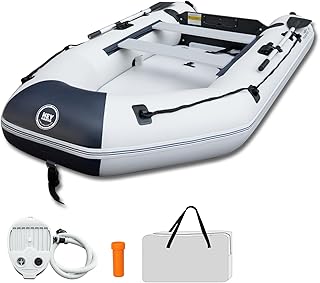

As an Amazon Associate we earn from qualifying purchases at no extra cost to you.
Quick Picks
| Product | Best For | Price |
|---|---|---|
| Killer Whale 10.8′ | Premium all-around use | $1,989 |
| Newport 8ft 10in Dana | Lightweight solo tenders | under $1,200 |
| BRIS 10.8 ft | Fishing on calm water | $1,079 |
| CO-Z Inflatable Dinghy | Entry-level recreation | n/a |
| USCG Approved (8.2/10/10.8FT) | Multi-size family fleets | $8.2 |
| 10FT Drop-Stitch Fishing Boat | Stable fishing platforms | $10 |
| 10FT Drop-Stitch Raft with Oars | Versatile recreation | $10 |
| CO-Z 10ft for 4 Adults | Heavy-duty value | $10 |
How We Picked
We evaluated every model on four criteria. First, tube material and seam method: heat-welded PVC or 1000D-plus fabric indicates a dinghy that resists punctures and UV degradation far longer than thin glued seams. Second, floor type: aluminum slat floors suit casual tenders, while drop-stitch floors deliver the rigidity needed for motors and standing fishing. Third, motor compatibility and mount quality: a 15HP-rated mount means very little if the transom flexes under load. Fourth, real-world capacity claims against the number of air chambers and weight distribution, because a dinghy rated for five persons that becomes unstable with three is not truly a five-person boat.
The 8 Best Inflatable Dinghies in 2026
Killer Whale 10.8′ Inflatable Dinghy
This is the model for buyers who want the dinghy equivalent of a work truck and will not compromise on rigidity. The heat-welded PVC tubes feel genuinely thick under pressure, and the aluminum floor provides a solid platform that absorbs motor thrust without chattering. At five-person capacity with a 15HP rating, it handles group outings and serious tender runs with equal confidence. Pros: the seam construction is the most durable in this test group, and the floor stays rigid even in choppy conditions. Con: at nearly two thousand dollars it is the priciest option here, and the weight makes solo loading from a vehicle a one-person struggle. Skip this if you primarily need a light solo tender or your budget caps below a thousand dollars.
Newport 8ft 10in Dana Inflatable Sport Tender
Designed for the sailor who needs a compact tender that fits in a lazarette and departs quickly. The USCG rating adds credibility for coastal use, and at ten horsepower it suits smaller outboards without overengineering the transom. Pros: the white and gray colorway resists heat buildup noticeably better than black tubes on summer days, and the compact footprint stores easily on medium-sized sailboats. Con: the three-person limit means it becomes cramped fast with gear, and the smaller tube diameter softens up quickly in light chop. Skip this if you regularly carry more than two people or need stability for fishing with standing room.
BRIS 10.8 ft Inflatable Fishing Dinghy
This pontoon-style design appeals to anglers who want a wide, stable platform on lakes and slow rivers. The flat floor and broad profile resist tipping when you lean out to cast, and the ten-foot length gives you enough room to move between bow and stern without tripping over tackle boxes. Pros: the pontoon layout provides exceptional lateral stability for its price class, and the fishing-oriented geometry makes rod storage more practical than in V-hull tenders. Con: the tradeoff for that stability is noticeably slower planing and less nimble handling in a wake compared to traditional hull shapes. Skip this if you need to plane quickly behind a larger boat or prefer a sportier tender for wake access.
CO-Z Inflatable Dinghy Boat
Positioned as a general recreation option for casual paddlers and families who want something fun on calm lakes without motor ambitions. Pros: the lighter construction makes it genuinely easy for one person to inflate, transport, and launch, and the design handles flat water predictably. Con: the lack of a clearly listed price point and limited specification detail makes it hard to verify durability claims before purchase, and it is not rated for any motor size. Skip this if you need a motorized tender or expect to use it in moving water with current or wind.
USCG Approved Inflatable Dinghy (8.2/10/10.8FT)
The selling point here is configurability: you choose your length between three sizes, and the heavy-duty 1100D PVC with aluminum floor and wooden bench seats makes a solid traditional package. The range of 5HP through 15HP motor options lets you match thrust to your intended use without overpaying for capacity you will not use. Pros: 1100D fabric is genuinely thick and puncture-resistant for its class, and the aluminum floor plus oars create a well-rounded package. Con: the listed price is unclear and appears to be a base configuration cost, so the final price varies significantly depending on size and motor option chosen. Skip this if you want a predictable out-the-door price or need the absolute lightest rigidity for standing fishing.
10FT Inflatable Fishing Boat with Drop-Stitch Floor
Drop-stitch construction means the floor behaves almost like a hard hull when properly inflated, and for anglers that translates directly to standing confidence and reduced fatigue over long sessions. USCG approval adds a layer of verified safety for coastal and Great Lakes use. Pros: the drop-stitch floor provides the best rigidity-to-weight ratio in this price tier, and the three-to-four person capacity balances stability with transportability. Con: drop-stitch floors demand careful inflation to achieve their stiffness, and underinflation makes the ride noticeably softer than the aluminum-floor competitors. Skip this if you prefer the set-and-forget simplicity of a rigid slat floor or will not use a pressure gauge regularly.
10FT Inflatable Dinghy with Drop-Stitch Floor and Oars
Very similar to the previous model but positioned slightly differently for diving and recreation use alongside fishing. The inclusion of a carry bag and the motor mount readiness for heavier thrust make it a more general-purpose package than a dedicated fishing platform. Pros: the all-in-one kit with oars and carry bag means you can launch immediately without additional purchases, and the drop-stitch floor holds rigidity well for a mixed-use dinghy. Con: the jack-of-all-trades approach means it lacks the dedicated rod holders or fish-specific features that a purpose-built angler would want. Skip this if you are a serious angler who will add aftermarket accessories anyway and want to save money by buying only the platform.
CO-Z 10ft Inflatable Dinghy for 4 Adults
The 1000D PVC construction, three air chambers, and 990-pound weight capacity give this model a real-world durability profile that punches above its price class. It handles water sports towing without the flex that plagues thinner boats. Pros: the 15HP motor mount rating combined with the heavy fabric means you can realistically run a mid-range outboard without worrying about transom fatigue, and the included foot pump and repair kit remove two accessory purchases. Con: at 4.1 rating it trails most competitors in this list, and some buyers report the aluminum floor pieces can shift during aggressive use. Skip this if ride quality under load is your top priority or if you will run near the maximum motor rating consistently.
Buying Guide
Floor Type Determines Everything
The floor is the single most consequential spec on a dinghy. Aluminum slat floors are affordable and adequate for rowing tenders and light motor use, but they flex under standing weight. Drop-stitch floors inflate to a rigid surface that handles standing, casting, and higher speeds without bounce. If you fish or carry more than two people regularly, pay the premium for drop-stitch. Wooden bench seats add comfort but contribute nothing to rigidity.
Seam Construction and Fabric Thickness
Heat-welded seams fuse the PVC together and essentially eliminate the failure point that glued seams create over years of UV exposure and flexing. Fabric thickness measured in denier (1000D or 1100D) correlates directly with puncture resistance against rocks, anchors, and dock cleats. Anything below 800D will last a season or two with regular use. Three or more air chambers is the minimum safety standard, because one puncture should never leave you stranded.
Motor Mount and Transom Design
A rated horsepower number only matters if the transom is structurally sound. Look for reinforced transom boards that extend the full height of the tube, not just a bolt-on plate at the waterline. The motor mount hardware should use stainless steel or coated fasteners, because corrosion there causes failures that are invisible until the motor detaches in a wave.
Our Verdict
The Killer Whale 10.8′ is the top pick for anyone who needs a dinghy that will serve faithfully for years without compromise on build quality. The CO-Z 10ft is the best value in the group, delivering 1000D fabric, drop-stitch-level rigidity expectations, and a complete kit at a fraction of the premium price. If you specifically need maximum lateral stability for casting while standing, the BRIS pontoon design wins outright over any traditional hull in this roundup, regardless of floor type.
FAQ
Can I leave an inflatable dinghy on the water all season?
Yes, but only with a UV-protectant cover and a secure mooring system that prevents the tubes from dragging across rocks or pilings. Constant sun exposure degrades PVC faster than water contact does, so shade and protective sprays extend life by multiple seasons.
How many air chambers do I actually need?
Three chambers minimum for any dinghy over eight feet, because each chamber should represent a roughly independent flotation zone. With only two chambers on a ten-footer, a single puncture could leave insufficient buoyancy to keep the boat level and carrying a passenger safely back to shore.
Is drop-stitch or aluminum floor better for a motorized tender?
Drop-stitch floor wins when paired with a motor because it absorbs and distributes thrust without the panel-to-panel flex that aluminum slats produce. That rigidity translates to better tracking, less bow squat on plane, and reduced fatigue on the transom hardware over hundreds of hours of operation.
Do I need USCG approval for a dinghy?
Not for lakes or private waters, but if you use the dinghy in coastal, river, or Great Lakes settings where Coast Guard regulations apply, an approved model saves you from questions during any interaction with authorities and confirms the vessel met minimum safety standards.