When you have never played piano, every listing looks equally plausible. Six hundred voices sounds better than ten. Bluetooth sounds better than no Bluetooth. A thousand accompaniment rhythms sounds like extraordinary value. None of those things will affect whether you can play a scale evenly in six months, and one of them — the key action — will affect it enormously. That is the single most useful thing a first-time buyer can know.
The second is that the instrument has to be usable when you feel like practising, which usually means late at night in a shared home. Headphone output is not a luxury for a beginner; it is the difference between practising and postponing. Add a sustain pedal, because sheet music will ask for one within a few months, and a stand that puts the keys at the right height so your wrists stay level. This guide compares boards that all claim to be beginner-friendly and separates the ones that will still serve you at grade four from the ones you will replace.
Our top picks





As an Amazon Associate we earn from qualifying purchases at no extra cost to you.
Quick Comparison
| Product | Best For | Standout Feature | Watch Out For |
|---|---|---|---|
| Yamaha P71 | Buying once and not upgrading | Graded hammer action that grows with you | Deliberately plain; almost no extra features |
| STRICH SDP-P7 | First-time buyers wanting extras | Piano stickers and music rest included | Stickers should come off after a few weeks |
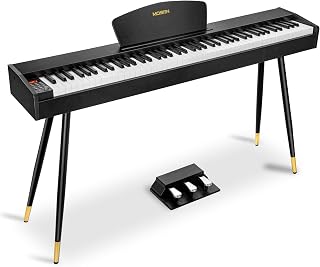
| MOSEN MDP-88BK | Recording your own practice | Recording mode with triple pedals fitted | Large voice list is mostly unused by beginners |
| Portable Hammer Action Piano | Small apartments and travel | Compact chassis with headphone practice | Speakers are quiet in a large room |
| Donner DEP-20 | Lessons away from home | Full weighted bed that one person can carry | Action is lighter than an acoustic upright |
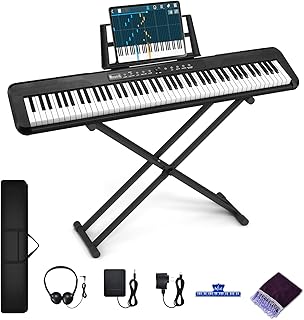
| Progressive Hammer Desk Piano | Buyers who want nothing left to order | Stand, pedal, music rest and adapter supplied | Fewer voices than feature-led rivals |
How to Choose
- Action beats every other feature: Hammer action trains the finger strength and control that acoustic pianos demand. Voice count, rhythms and app connectivity change nothing about your technique.
- Insist on 88 keys: Graded sheet music assumes the full range. Buying 61 keys now means buying again the moment your left hand goes below the bottom of the board.
- Headphones make practice possible: Silent practice removes the biggest social obstacle to learning at home, and headphones usually reveal more detail in the sample than the speakers do.
- Get the pedal early: Sustain appears in beginner repertoire faster than most people expect. A board that includes one saves a second order and a lost week.
- Set the height properly: Keys should sit around elbow height with forearms roughly level. A stand that is too low causes wrist strain that gets blamed on practice volume.
Top Picks Reviewed
Best Long-Term Choice: Yamaha P71
If the goal is to buy once, this is the answer. The graded hammer bed is heavier in the bass and lighter at the top, exactly as an acoustic behaves, so nothing you learn on it has to be relearned later. The core grand piano voice responds properly to light touch, which is what lets you practise dynamics from week one.
It is austere by design. There is no lesson mode, no rhythm section, and the included footswitch is basic. That plainness is why the money went into the keys.
Best Beginner Bundle: STRICH SDP-P7
A full-size hammer-action bed shipped with a sustain pedal, music rest and key stickers. For a nervous first-timer the stickers genuinely reduce the intimidation of a wall of identical white keys during the first fortnight.
Take them off after a few weeks. Reading stickers instead of the keyboard’s own black-key landmarks slows down sight-reading and builds a habit you will have to break.
Best for Self-Assessment: MOSEN MDP-88BK
The recording mode is the underrated feature here. Beginners cannot hear their own timing accurately while concentrating on notes, and playing a recording back reveals uneven rhythm immediately. Triple pedals mean proper technique is available when the repertoire asks for it.
The extensive voice library is largely decorative for a learner. You will use the acoustic piano voice for the vast majority of your practice time.
Best for Small Spaces: Portable Hammer Action Piano
A full 88-key hammer bed in a chassis designed to be moved and stored, with a sustain pedal and headphone output included. In a studio flat where the piano lives against a wall and comes out for practice, that portability is the deciding factor.
The built-in speakers are modest. In a large or hard-floored room the sound gets thin, which headphones or a small pair of powered speakers solve entirely.
Best for Lessons: Donner DEP-20
Light enough for one adult to carry to a teacher’s studio and back while still offering a full weighted bed and a sustain pedal. Practising on the same instrument you have a lesson on removes a surprising amount of friction.
The action is on the lighter side. A student who also plays an acoustic upright will notice the keys return faster and resist less.
Most Complete Package: Progressive Hammer Desk Piano
Everything arrives at once: sheet music stand, pedal, power adapter, headphone mode and USB-MIDI. For a beginner who does not yet know which accessories exist, that completeness prevents the classic mistake of ordering a piano and discovering it has no stand.
The voice selection is small. If you want to explore organs, strings and synth sounds, look elsewhere; if you want to learn piano, it is sufficient.
Frequently Asked Questions
Do I need 88 keys as a complete beginner?
Yes, if you plan to follow graded sheet music. Shorter keyboards run out of range in the left hand quickly, and the cost difference is small compared with buying twice.
Are key stickers helpful or harmful?
Helpful for a couple of weeks, harmful after that. Use them to get oriented, then remove them so you learn to navigate by the black-key groupings the way pianists actually do.
Can I learn without a teacher?
Many people do, using apps and method books. The risk is unnoticed technique problems — collapsed wrists, tense shoulders, curled thumbs. A handful of lessons early on catches those cheaply.
How long until I can play a simple piece?
With twenty minutes of daily practice, a simple two-hand arrangement is realistic within a couple of months. Consistency matters far more than session length at this stage.
Final Thoughts
Ignore the feature lists and buy the best hammer action you can afford with 88 keys, a headphone jack and a sustain pedal. Set it at the right height, practise a little every day, and let the extra voices go unused. That combination will carry a beginner further than any board chosen for its spec sheet.