Most people buying an acoustic guitar make the same mistake twice: they spend everything on the instrument, then discover that a guitar alone is not a playable setup. You need a way to tune it accurately, a capo to match the recorded key of songs you want to play along with, spare strings for the night one snaps, and something to actually play from. Without those, a good guitar sits in a corner sounding progressively worse as the strings oxidise.
This roundup takes the whole-setup view. There are dreadnoughts for players who want volume and a strummy low end, a smaller-bodied starter for younger hands, a comprehensive accessory kit, and songbooks and chord references that give you material for the first year. The honest tradeoff is budget allocation: money spent on a chord book is money not spent on tonewoods, but a slightly cheaper guitar you play every evening beats a nicer one you never learned to use.
Our top picks




As an Amazon Associate we earn from qualifying purchases at no extra cost to you.
Quick Comparison
| Product | Best For | Standout Feature | Watch Out For |
|---|---|---|---|
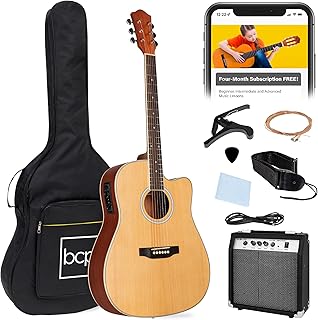
| Fender FA-25 Dreadnought | The main instrument purchase | Reliable factory setup and dreadnought projection | Deep body is a stretch for smaller players |
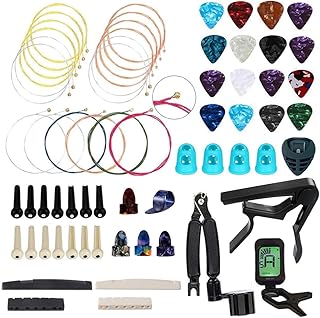
| NERECNDENS 66-Piece Kit | Restringing and basic maintenance | Winder, cutter, tuner and bone parts in one box | Individual tools are basic rather than premium |
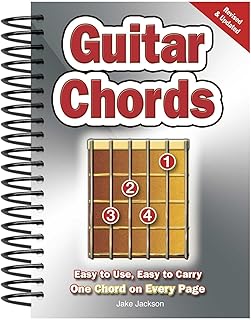
| Guitar Chords Reference | Quick lookup at the music stand | One chord per page keeps it readable while playing | Reference only; no lessons or progression |
| Guitar Player Acoustic Songbook | Players who already know open chords | Strumming and picking patterns alongside lyrics | Assumes you can already change chords in time |
| Simple Acoustic Songs | First songs after week one | Simplified tab and chords for popular material | Arrangements are stripped down from originals |
| Ashthorpe 38-inch (Blue) | Younger or smaller players | Compact body with a full starter bundle | Less volume and sustain than a full-size body |
How to Choose
- Match body size to the player: A dreadnought pushes air and suits strumming, but a 38-inch body keeps the fretting arm at a sane angle for teenagers and smaller adults.
- Insist on accurate tuning: A clip-on chromatic tuner is non-negotiable. Practising on an out-of-tune guitar trains your ear to accept wrong intervals.
- Buy a capo early: Most recorded songs are not in guitar-friendly keys. A capo lets a beginner play along using shapes they already know instead of quitting in frustration.
- Choose material at your level: A chord dictionary answers questions; a graded songbook gives you a path. Buy the one that matches whether you need reference or structure.
- Keep restringing tools handy: A winder and cutter turn a twenty-minute chore into a five-minute one, which is the difference between fresh strings and dead ones.
Top Picks Reviewed
Best Main Instrument: Fender FA-25 Dreadnought
The natural-finish FA-25 is the anchor of a sensible acoustic setup. The dreadnought body gives you the low-end thump that makes open-chord strumming sound full, and the neck arrives straighter and better fretted than most instruments at this price, which means less buzzing and less hand fatigue.
Its size is the honest caveat. A dreadnought’s deep waist forces a wide reach around the body, and players under about five foot four often find themselves leaning over the top instead of sitting upright.
Best Maintenance Kit: NERECNDENS 66-Piece Accessory Kit
This covers the unglamorous parts of guitar ownership: a full set of acoustic strings, a winder and cutter combo, capo, tuner, picks and spare bone nut and saddle blanks. Having replacements on hand means a broken string costs you ten minutes instead of a week.
None of the individual tools would be a luthier’s first choice, and the string winder is plastic rather than geared metal. For home use that is entirely adequate.
Best Quick Reference: Guitar Chords
The single-chord-per-page format is the whole point. Propped on a music stand, it is legible at arm’s length, so you can find a Bm7 mid-song without squinting at a cramped grid of forty diagrams.
It teaches you nothing about rhythm, technique or how chords function together. Treat it as a dictionary, not a course.
Best Repertoire Builder: Guitar Player Acoustic Songbook
This one earns its place because it includes strumming and picking patterns rather than just chord grids over lyrics. Knowing which rhythm belongs to a song is usually the missing piece that makes a beginner’s version sound wrong.
It assumes competence you may not have yet. If your chord changes still stall, work through simpler material first and come back to this.
Best First Songbook: Simple Acoustic Songs
Simplified tab, chords and lyrics for recognisable acoustic material means you can play something people recognise within your first month. That early win does more for practice consistency than any gear upgrade.
The arrangements are deliberately reduced. Fingerpicking figures and intros are often flattened into strummed chords, so they will not match the record exactly.
Best Small-Body Option: Ashthorpe 38-inch
The shorter body and reduced reach make this the sensible choice for a younger player, and the bundled gig bag, spare strings, strap and picks mean nothing else needs ordering.
You give up projection and sustain. Strummed hard, it thins out where a dreadnought would still be blooming, which is a fair trade for an instrument that gets held correctly.
Frequently Asked Questions
Do I need a capo straight away?
Sooner than most people expect. Countless popular songs sit in keys that are awkward on open strings, and a capo transposes them into shapes a beginner already knows. It is the cheapest accessory that immediately expands your repertoire.
How do I know when my guitar needs a setup?
If chords sound in tune at the first fret but sharp around the twelfth, or if pressing down above the fifth fret is tiring, the action or intonation needs attention. Both are quick adjustments for a technician.
Is tab or standard notation better for guitar?
Tab tells you where to put your fingers and is far faster to read for guitar-specific material. Standard notation tells you rhythm and pitch precisely and travels to other instruments. Most players start with tab and add notation later.
How long before I can play a full song?
With three or four open chords and a steady strum, a simplified song is realistic within a few weeks of consistent short practice. Clean chord changes, not chord knowledge, are what take the time.
Final Thoughts
Buy one guitar that fits you properly, then spend the remainder on the things that keep you playing: a tuner, a capo, spare strings and material you actually want to learn. An acoustic setup is a system, and the weakest part of that system decides how often the guitar comes off its stand.