
Best humidifier for plants answers change completely depending on whether you are humidifying a sealed cabinet, an open shelf or an entire room. This guide sorts seven machines by grow space type, covering output requirements, placement, runtime and the hard water problems that leave residue on leaves.
As an Amazon Associate we earn from qualifying purchases.
Our top picks


As an Amazon Associate we earn from qualifying purchases at no extra cost to you.
By Daniel Foster
Sizing the Machine to the Enclosure
The best humidifier for plants in a sealed cabinet is nothing like the right machine for an open room, because a cabinet holds humidity almost effortlessly while a room fights every point of increase against escaping air. The volume you are treating, and how well it retains moisture, sets the output you need before any model enters the discussion.
Output, Enclosure Volume and Runtime: The Numbers That Decide It
In a sealed cabinet of a few cubic feet, the best plant humidifier is a small one: an ultrasonic unit producing 200 millilitres per hour will overshoot 80 percent quickly and must be controlled with a humidistat or an external controller. The risk here is too much humidity, not too little.
In an open room, the calculation inverts. A 250 square foot space with an interior door and typical winter heating needs 300 to 500 millilitres per hour to hold 55 percent, and tank capacity must support that for at least one overnight cycle.
Greenhouses and conservatories are harder still, with large glazed surfaces losing both heat and moisture. Console machines with multi-gallon daily output exist for exactly this, and smaller units simply cannot keep pace regardless of how many you run.
Space and Fit: Where It Goes Among the Plants
In a cabinet, the machine usually sits inside or feeds through a port, which means measuring internal clearance and planning the cable route through a gap or drilled hole. Water spillage during refills is a genuine concern with electronics and lights nearby.
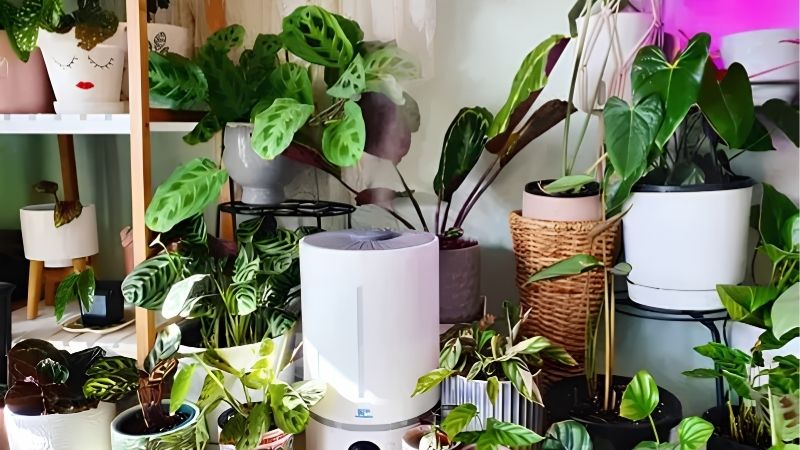
In an open room, keep the unit several feet from foliage with the outlet angled into open air. Mist landing directly on leaves leaves mineral spots, and water pooling in leaf axils or crowns is where rot commonly starts on aroids.
Height helps as well. Placing the machine on a low stool or table rather than the floor lets mist disperse through the room instead of settling into carpet or pooling against skirting boards, where it does nothing for the plants and encourages damp.
Hard Water, Residue and Sensitive Foliage
Ultrasonic machines disperse dissolved minerals with the mist, coating leaves in a fine white film that blocks light and looks unpleasant on glossy foliage. Distilled, reverse osmosis or demineralised water solves it completely.
Evaporative and steam designs leave minerals behind in the wick or on the element, so tap water is appropriate and no residue reaches the plants. That advantage is why many collectors in hard water areas end up avoiding ultrasonic machines entirely.
Test the water before deciding. Inexpensive hardness strips report in grains per gallon or parts per million, and a high reading turns the ultrasonic option into a weekly errand buying distilled water rather than a convenience.
Seven Machines Sorted by Setup
The best humidifier for plants depends on the enclosure, so the picks below are grouped by the kind of growing space each one suits. Every entry names a real drawback. Figures reflect manufacturer specifications and pooled long-term owner reports rather than measurement conducted here.
1. Sealed Cabinet: Compact Ultrasonic With External Controller
A small ultrasonic unit paired with an inline humidity controller is the standard cabinet approach, switching the machine on and off around a set point rather than running continuously and drowning the enclosure.
Without a controller these units will overshoot badly. Small tanks also mean daily refills, and reaching inside a planted cabinet to refill is awkward.
2. Shelf or Corner: Levoit OasisMist 4.5L
A large tank with adjustable output and a built-in humidistat, sized for a plant shelf or a corner of a bedroom. Runtime comfortably covers a night without attention.
It is ultrasonic, so hard water leaves residue on nearby foliage. Coverage suits one room rather than an open-plan area.
3. Single Room, Tap Water: Honeywell HCM-350
Evaporative operation means minerals stay in the wick and never reach the leaves, and the dishwasher-safe parts make maintenance realistic through a whole season.
The fan is audible, output is self-limiting so it maintains rather than drives humidity upward, and wicks need replacing every one to three months.
4. Large Plant Room: Vornado Evap40
Multiple wicks and strong airflow cover a genuinely large space with no residue risk, which suits a spare room converted to a collection.
Noise at higher speeds is significant, the unit is bulky, and the wick set is a meaningful recurring cost.
5. High Output Single Room: Levoit LV600S
Six litre tank, cool and warm mist and output at the top of the consumer range, with a humidistat holding a set point. It drives humidity upward faster than evaporative machines can.
Cool mode disperses minerals with tap water, warm mode raises power draw, and the body has several areas that need careful cleaning.
6. Hard Water Areas: Boneco S450
Boiling steam leaves scale on the element rather than on foliage, which is the cleanest answer where water is hard and distilled water is impractical to buy weekly.
Regular descaling is unavoidable, power consumption is the highest here, and the hot output needs placing safely away from pets and children.
7. Greenhouse or Conservatory: AIRCARE Console
A console evaporative machine with a very large tank and multi-gallon daily capacity, built for spaces where smaller units simply cannot maintain a level.
It occupies floor space like a piece of furniture, runs loudly, and the belt wick is expensive to replace. Unnecessary for anything smaller.
| Setup | Recommended type | Output need | Water requirement |
|---|---|---|---|
| Sealed cabinet | Compact ultrasonic plus controller | Low, controlled | Distilled preferred |
| Plant shelf or corner | Levoit OasisMist 4.5L | Moderate | Distilled preferred |
| Single room, tap water | Honeywell HCM-350 | Moderate | Tap fine |
| Large plant room | Vornado Evap40 | High | Tap fine |
| Fast humidity increase | Levoit LV600S | High | Distilled in cool mode |
| Hard water household | Boneco S450 | High | Tap with descaling |
| Greenhouse | AIRCARE console | Very high | Tap fine |
Model availability and pricing change frequently, so confirm both at the time of purchase.
Airflow, Rot Risk and Long-Term Upkeep
The best humidifier for plants still causes more problems than it solves without air movement, particularly in enclosed setups. The maintenance side also differs from ordinary household use because the machine runs harder and longer.
Why Air Movement Matters as Much as Moisture
Still humid air sitting on leaf surfaces encourages fungal leaf spot and, in cabinets, bacterial rot in crowns and new growth. A small clip fan on low keeps the boundary layer moving without drying the enclosure meaningfully.
In closed cabinets, run the fan continuously and vent briefly each day if condensation pools on the glass. Persistent standing water on shelves and inside pots is a reliable predictor of root and crown problems.
Cleaning, Scale and Component Life
Empty and rinse the tank daily, descale weekly, and let every part dry before reassembly. Machines running many hours a day in a humid room accumulate scale faster than a bedroom unit used occasionally, and output falls long before anything appears broken.
Wicks stiffen with mineral content and lose output before they look worn, so replace them on schedule. Warranty terms typically cover the body for a year or more while wicks, filters and cartridges are excluded as consumables, and any water-handling appliance should carry a recognised electrical safety listing.
Seasonal Demand and Buying Windows
Heating season is when indoor humidity collapses and tropical foliage starts crisping at the tips, which is also when demand rises and popular models sell through. Buying in early autumn avoids the scramble entirely.
Promotion clusters around Prime Big Deal Days in early October and Black Friday through Cyber Monday at the end of November, both of which arrive before the driest weeks of winter in most regions.
Frequently Asked Questions
These questions come up most often from growers choosing the best humidifier for plants in a specific setup.
How high should humidity go?
Any best humidifier for plants should target 50 to 60 percent for most tropical foliage, with calathea, ferns and many orchids preferring higher. Above roughly 60 percent in an ordinary room, condensation and mould on cold surfaces become the limiting factor.
Do I need a controller for a cabinet?
Almost always, whatever the best humidifier for plants in your cabinet turns out to be. A small machine in a sealed enclosure overshoots quickly, and an inline humidity controller switching it around a set point is the difference between a stable environment and a dripping one.
Will hard water hurt my plants?
The residue is cosmetic on leaves rather than harmful, though a thick film blocks light over time. The bigger issue is mineral accumulation in soil from watering, which is a separate matter from what the humidifier disperses.
Can I run it only at night?
Yes, and many growers do, since transpiration and stomatal activity vary through the day. A timer or humidistat achieves the same result more reliably than switching it manually.
See More:
- Best low price dash cam
- Projector screens at Best Buy
- Best buy projector screens
- Best projector for games
- Best projector for gaming
Final Thoughts on Matching Machine to Setup
The best humidifier for plants follows from the enclosure rather than the collection. Cabinets need small output and tight control, single rooms need enough hourly output to overcome escaping air, and greenhouses need console capacity that smaller machines cannot approach.
Measure the space, test your water hardness, and place a hygrometer among the plants rather than trusting the machine. Add a small fan for air movement, and stop raising humidity when condensation appears on the windows.





Write Your Review
No reviews yet. Be the first to share your experience!