Key takeaways
- CADR: 393 smoke / 387 dust / 441 pollen cfm (Blueair US rating)
- Room size: 609 sq ft at 4.8 ACH
- Noise and power: 24–55 dB, 2.6–58W
- Sensors and app: laser PM1, PM2.5 and PM10 sensing, Wi-Fi, Blueair app, Alexa
- Size: 23.6 x 19.7 x 9.9 in, about 32 lb; RealTrack filter-life tracking
Blueair review evaluations demand a strict look at verifiable CADR ratings, daily energy consumption, and recurring filter replacements across varied floor plans. We compare six leading Swedish-designed air cleaners using published filtration ratings, decibel ranges, and long-term cost data, without marketing fluff.
Our top picks


As an Amazon Associate we earn from qualifying purchases at no extra cost to you.
By Daniel Foster
As an Amazon Associate we earn from qualifying purchases.
Updated October 2026 — Blueair review verdict: buy a Blueair if quiet, efficient particle removal matters most. For most medium rooms, the Blue Pure 311i Max is the one to get; for large open living areas, choose the Blue Pure 211i Max; and for bedrooms under about 250 sq ft, the Blue Pure 511i Max or 411i Max is enough. If heavy odors or cooking smells are your main problem, pair any Blue Pure Max with a SmokeBlock filter or look at a carbon-heavy alternative such as the Winix 5510.
The top three by exact model: Blueair Blue Pure 311i Max (best all-round), Blueair Blue Pure 211i Max (best for large rooms and wildfire smoke), and Blueair Blue Pure 511i Max (best budget bedroom pick). This review is research-based, built on Blueair’s published CADR, noise, and power specs, AHAM sizing guidance, and independent coverage, not on measurements of our own.
Blueair Review at a Glance
Blueair is a Swedish-founded air purifier brand, owned by Unilever since 2016, best known for quiet machines that move a lot of air for their size. Across the lineup, the pattern is consistent: strong particle removal for dust, pollen, and pet dander, low noise on everyday settings, modest power draw, and clean Scandinavian styling. The trade-offs are just as consistent: replacement filters are a meaningful ongoing cost, the carbon layer in most Blue Pure filters is thin for heavy odors, and the ionizing stage that makes HEPASilent work cannot be switched off on most models.
| Strengths | Weaknesses |
|---|---|
| High airflow relative to noise and energy use | Ongoing filter costs add up over a few years |
| Excellent on dust, pollen, and pet dander | Light carbon layers struggle with strong odors and VOCs |
| Very quiet on low and sleep settings | Ionizing stage usually cannot be disabled |
| Simple controls and attractive, furniture-friendly designs | Room-size claims use a one-air-change-per-hour basis that looks generous |
| Washable fabric pre-filters on Blue Pure models | Some entry models skip sensors and auto mode |
Bottom line: Blueair is an easy recommendation for allergy sufferers, pet owners, and bedrooms where noise matters. If cooking smells, heavy smoke, or chemical odors are your main concern, look closely at the odor section and the alternatives later in this review before you buy.
Core Performance Metrics and Sizing Architecture
Selecting an effective air cleaner requires looking beyond aesthetic designs to verify physical airflow mechanics. In this Blueair review, we examine foundational performance metrics that dictate whether a machine can reliably circulate air through dense filtration media without excessive noise or energy drain.
Decisive Category Metrics: CADR, HEPASilent, and Filter Costs
Clean Air Delivery Rate (CADR) serves as the primary benchmark, measuring cubic feet per minute (cfm) or cubic meters per hour (m³/h) for smoke, dust, and pollen. A reliable machine must balance airflow volume against static pressure resistance created by particle and activated carbon barrier matrices.
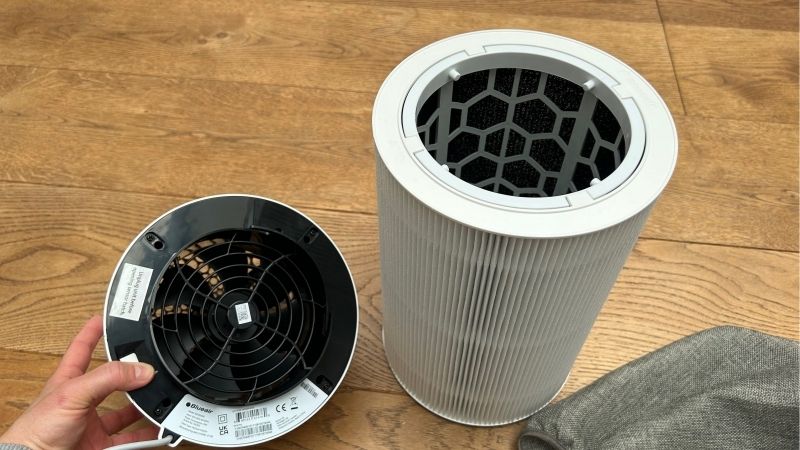
Blueair relies on proprietary HEPASilent technology combining mechanical polypropylene fibers with an electrostatic charging chamber. This hybrid system captures 99.97% of airborne particles down to 0.1 microns while permitting looser fiber weave, reducing motor strain and keeping power draw modest: Blue Pure Max models draw roughly 17 to 46 watts at top speed.
Ongoing filter replacement costs represent a mandatory hidden expense that buyers must account for prior to purchase. Authentic replacement filters cost between mid-range and premium tiers every six to twelve months, meaning lifetime operational expenses quickly surpass the initial retail investment.
Room Size and Spatial Fit: Calculating Air Changes per Hour
Sizing an air purifier correctly depends on calculating room volume rather than relying on generalized marketing claims. Always measure your actual room dimensions before ordering to ensure the machine delivers at least 4.8 air changes per hour (ACH) for allergy relief or 2 ACH for basic background clearing.
A compact model suited for 219 sq ft (20 m²) cannot effectively process the air volume of a 600 sq ft (56 m²) open living room. Cylindrical units draw air from 360-degree intakes, requiring at least 12 inches (30 cm) of unobstructed perimeter clearance from walls or drapery to maintain intake velocity.
Real-World Energy Consumption and Noise Profiles
Acoustic output dictates whether an air purifier can reside comfortably in a nursery or master bedroom. Blueair’s published noise ranges run from a whisper-quiet 19 dB on the quietest settings to 53 dB at top speed on the largest Blue Pure Max, allowing unobtrusive 24-hour operation that prevents common overnight indoor particulate accumulation.
Essential for any objective Blueair review is noting how variable fan speeds influence daily electrical draw and frame vibration. With Blue Pure Max models drawing roughly 17 to 46 watts at top speed, these units draw modest power, though running on maximum boost over hard tile flooring benefits from a thin rubberized isolation mat underneath.
Top Six Blueair Air Purifiers for Modern Homes
Comparing individual models clarifies which hardware profile matches your specific floor plan and filtration demands. Within our comprehensive Blueair review lineup, we analyze six standalone units spanning ultra-compact personal desk models to high-capacity machines engineered for expansive open spaces.
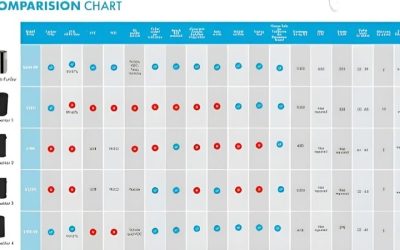
| Model | Coverage (4.8 ACH) | Smoke CADR | Noise Level | Power Consumption | Price Tier |
|---|---|---|---|---|---|
| Blue Pure 411i Max | 219 sq ft (20 m²) | 141 cfm (240 m³/h) | 18 – 46 dB | 2 – 10 W | Budget tier |
| Blue Pure 311i Max | 439 sq ft (41 m²) | 283 cfm (481 m³/h) | 23 – 50 dB | Up to 32 W | Mid-range tier |
| Blue Pure 211i Max | 674 sq ft (63 m²) | 435 cfm (739 m³/h) | 23 – 53 dB | Up to 46 W | Mid-to-premium |
| Protect 7470i | 418 sq ft (39 m²) | 270 cfm (459 m³/h) | 22 – 45 dB | 8 – 48 W | Premium tier |
| DustMagnet 5440i | 357 sq ft (33 m²) | 230 cfm (391 m³/h) | Varies by region | Varies by region | Premium tier |
| Blue Pure Mini Max | 107 sq ft (10 m²) | 69 cfm (117 m³/h) | 19 – 44 dB | Up to 10 W | Budget tier |
Figures follow Blueair’s current product pages where the maker lists them. The 411i Max row is the earlier 411i Max; the newer 411i+ Max is rated 167 cfm and 259 sq ft (see the ratings table below). Protect 7470i figures come from retailer spec listings, and DustMagnet 5440i noise and power differ between regional pages, so check the spec sheet for your market.
Blueair Blue Pure 411i Max: Compact Bedroom Cleaner
The Blue Pure 411i Max delivers 141 cfm (240 m³/h) smoke CADR, cleaning compact spaces up to 219 sq ft (20 m²) every 12.5 minutes at 4.8 ACH (the newer 411i+ Max is rated 167 cfm and 259 sq ft). Its cylindrical body stands 18.9 inches (48 cm) tall with a diameter of 10.6 inches (27 cm), making it a natural choice for bedside tables and studio corners.
Blueair’s rated noise output is an ultra-low 18 dB on sleep mode, producing near-silent background operation. The 411i Max adds Wi-Fi app control, an integrated air quality sensor with auto mode, and filter-life tracking in a compact tower.
As a drawback, it is sized for small rooms only, so it will not keep pace in a large kitchen-living area. The washable fabric pre-filter captures large dust and pet hair effectively, though the thin activated carbon layer struggles against severe chemical VOCs.
Blueair Blue Pure 311i Max: Balanced Everyday Air Purifier
Positioned as the ideal mid-sized option, the Blue Pure 311i Max produces 283 cfm (481 m³/h) smoke CADR, processing up to 439 sq ft (41 m²) at 4.8 ACH. Sized at 19 by 12.5 inches (48 by 32 cm), it fits neatly beside media consoles while cycling large living room air volumes quickly.
Integrated Wi-Fi allows seamless pairing with the Blueair companion smartphone app for scheduled cleaning, outdoor AQI tracking, and filter life monitoring. Its onboard particle sensor dynamically adjusts fan velocity, transitioning from a silent 23 dB daytime baseline up to 50 dB when purifying kitchen fumes.
A notable operational drawback centers on replacement filter expense, as genuine combination filters sit firmly in the mid-range tier every nine months. While the unit handles seasonal pollen and fine dust with ease, users must budget for mandatory ongoing consumables to sustain verified airflow throughput.
Blueair Blue Pure 211i Max: Heavy-Duty Open Living Purification
Engineered for sprawling great rooms, the Blue Pure 211i Max provides an immense 435 cfm (739 m³/h) smoke CADR, covering 674 sq ft (63 m²) at 4.8 ACH. Sized at 22.7 by 14.4 inches (58 by 37 cm), this substantial floor unit rapidly cycles stubborn wildfire smoke and pet dander through dual-layer media.
Power draw tops out at 46W at maximum speed, maintaining modest electrical running costs despite high cubic volume moving power. Blueair’s published noise range starts at 23 dB on the lowest setting, which makes it bedroom-friendly.
However, its broad 14.4-inch (37 cm) circular footprint commands significant floor space in smaller apartments, limiting subtle corner placement options. Weighing 16.2 pounds (7.3 kg), the unit lacks integrated caster wheels, requiring deliberate physical lifting when moving the machine between different rooms.
Blueair Protect 7470i: Premium Defense and Antimicrobial Safeguards
The Protect 7470i represents Blueair’s premium flagship engineering, delivering 270 cfm (459 m³/h) CADR across spaces up to 418 sq ft (39 m²) at 4.8 ACH. Encased in a refined matte tower measuring 27.2 by 11.8 inches (69 by 30 cm), it features SpiralAir 360-degree omnidirectional discharge louvers.
Advanced GermShield technology actively prevents bacterial growth on internal filters, while the LCD panel displays precise PM2.5 and VOC levels. As a notable drawback, replacement SmartFilters command steep premium pricing, making long-term operational upkeep considerably costlier than simpler manual lines.
Blueair DustMagnet 5440i: Dual Airflow and Furniture Integration

The DustMagnet 5440i delivers 230 cfm (391 m³/h) CADR tailored for 357 sq ft (33 m²) living spaces, featuring dual top and bottom air intake vents. Standing roughly 25 inches (about 65 cm) tall on slender legs, its Scandinavian side-table profile doubles functionally as an elegant bedside furniture piece.
Dual electrostatic pre-filters capture airborne dust before it settles on hard surfaces, while operating quietly; Blueair’s published noise and power figures differ between regional pages, so confirm them for your market. However, its specialized dual-filter design requires buying two filter blocks simultaneously, and the decorative top surface cannot safely hold open drink containers.
Blueair Blue Pure Mini Max: Ultra-Portable Personal Cleaning
Designed for personal cubicles and compact nurseries, the Blue Pure Mini Max outputs 69 cfm (117 m³/h) smoke CADR for spaces up to 107 sq ft (10 m²). Standing merely 11.4 inches (29 cm) tall with a featherweight 2.8-pound (1.3 kg) chassis, it packs effortlessly into luggage for temporary travel.
Drawing no more than 10W, the Mini Max runs quietly from 19 dB on low speed up to 44 dB on top setting. Its main drawback stems from modest airflow capacity, meaning it cannot clear open living areas or neutralize heavy chemical fumes due to its compact activated carbon pre-filter.
The Blue Signature Line and Other Current Models
Blueair’s lineup changes regularly, and several of the models featured at the top of this page belong to the newer Blue Signature family rather than the Blue Pure and Protect machines covered above. Here is how they fit into the range.
Blue Signature (large room)
The full-size Blue Signature is Blueair’s design-forward flagship for living rooms and open-plan spaces. Its listing claims coverage of up to 3,385 sq ft, and it pairs HEPASilent filtration with Wi-Fi app control and an automatic mode driven by an onboard air quality sensor. The low, rounded body is meant to sit in the room like furniture rather than hide in a corner, and Blueair offers accessories that turn it into a side table, though those are sold separately. Choose it if you want large-room airflow from a machine that looks good in a visible spot.
Blue Signature SP3i (medium room)
The SP3i scales the same design down for bedrooms, home offices, and medium living rooms, with a listed coverage of up to roughly 2,250–2,390 sq ft depending on the version. It keeps Wi-Fi control, auto mode, odor and smoke filtration, and AHAM verification, and its table-style design is aimed at buyers who want the Signature look without the size of the flagship.
Blue Signature Small (SP1i)
The smallest Signature model targets bedrooms, nurseries, and offices, with a listed clean-air rate of 1,190 sq ft per hour. It adds app control to a compact footprint, which makes it a step up in convenience from the manual Blue Pure Mini Max covered earlier.
Blue Pure 511i Max and Blue Pure 511
The 511 pair sits between the Mini Max and the 311 Max in size. The 511i Max adds Wi-Fi and auto mode, with a listed coverage of up to 1,138 sq ft, while the plain 511 is the simpler, non-connected version. Both are well suited to a small bedroom or dorm room where a quiet, low-cost machine matters more than smart features.
Blueair Classic Pro CP7i — Best Blueair for Large Rooms with Germ Control
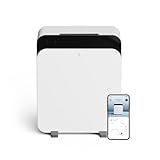
The Classic Pro CP7i is the large boxy unit in Blueair’s current range and the most powerful home model here. Blueair’s US spec sheet lists 393 cfm smoke, 387 cfm dust, and 441 cfm pollen CADR, with a recommended room size of 609 sq ft at 4.8 air changes per hour. Two Particle and Carbon filters sit on either side of a dual-fan design, and its HINS Pure visible-light feature switches on periodically to reduce germs trapped in the filter.
- CADR: 393 smoke / 387 dust / 441 pollen cfm (Blueair US rating)
- Room size: 609 sq ft at 4.8 ACH
- Noise and power: 24–55 dB, 2.6–58W
- Sensors and app: laser PM1, PM2.5 and PM10 sensing, Wi-Fi, Blueair app, Alexa
- Size: 23.6 x 19.7 x 9.9 in, about 32 lb; RealTrack filter-life tracking
Pros: highest CADR in the current Blueair home lineup; laser sensing for PM1 to PM10; two filters spread the load for longer life.
Cons: premium price and two filters to replace; heavy and boxy next to the cylindrical Blue Pure models.
Skip it if… your room is under about 450 sq ft; the Blue Pure 211i Max covers a similar space for much less.
Blueair Mini Restful — Best for a Bedside Table
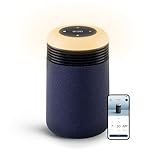
The Mini Restful combines a small HEPASilent purifier with a sunrise alarm clock, adjustable nightlight, and USB-C phone charging port. Its rated room size is small, so treat it as a personal bedside purifier rather than a whole-bedroom solution.
- CADR: 90 smoke / 80 dust / 93 pollen cfm
- Room size: 140 sq ft at 4.8 ACH
- Extras: sunrise light that brightens 15–30 minutes before the alarm, wake sounds, nightlight, USB-C port
- Size: 6.7 x 6.7 x 11.1 in, 2.4 lb; filter change about every 9 months
Pros: replaces an alarm clock and nightlight on a crowded nightstand; very light and compact.
Cons: low CADR for its price; app required for setup.
Skip it if… you only want cleaner air; the Blue Pure 511i Max moves more air for similar money.
HealthProtect 7440i and 7770i
Blueair now sells its Protect line under the HealthProtect name. The HealthProtect 7440i is the step-down sibling of the Protect 7470i covered above, and the 7770i is the larger model for bigger rooms. Both use a SmartFilter that Blueair rates for up to a year and GermShield, which runs the fan at low speed in standby to limit germ growth on the filter. Availability is patchy in 2026, so check that replacement SmartFilters are in stock before choosing one over a Blue Pure Max.
How Blueair Measures Room Size
The large square-footage numbers in Blueair listings, such as 3,235 sq ft for the 211i Max, describe how much floor area the machine can clean once per hour, assuming standard ceiling height. That is a useful comparison figure, but one air change per hour is too slow for allergy relief. The coverage figures in our comparison table above use a stricter 4.8 air changes per hour, the level commonly recommended for allergy and asthma sufferers.
As a quick rule, divide Blueair’s listed one-hour coverage by about five to estimate the room size that model can serve at allergy-level performance. A model advertised for 3,000 sq ft is therefore a strong fit for a room of roughly 600 sq ft, not an entire 3,000 sq ft house. If you are cleaning smoke from wildfires, or the room has high ceilings, size up further.
Blueair Review by Room Size: Which Model to Buy
Use the 4.8 air-changes-per-hour room size, not the one-hour figure in listing titles. These are Blueair’s published ratings; room sizes assume standard 8-foot ceilings.
| Model | Smoke CADR | Room size | Smart features | Best for |
|---|---|---|---|---|
| Blue Pure Mini Max | 69 cfm | About 107 sq ft | No | Desk or nursery |
| Mini Restful | 90 cfm | 140 sq ft | App, sunrise alarm | Nightstand |
| Blue Pure 411i Max | 141 cfm | 219 sq ft | Wi-Fi, auto | Small bedroom |
| Blue Pure 311i Max | 283 cfm | 439 sq ft | Wi-Fi, auto | Most bedrooms and living rooms |
| Blue Pure 211i Max | 435 cfm | 674 sq ft | Wi-Fi, auto | Open-plan rooms, smoke |
| Classic Pro CP7i | 393 cfm | 609 sq ft | Wi-Fi, laser PM1–PM10 | Large rooms, germ control |
Blueair Ratings: Retail Listings vs. the Maker’s Current Product Pages
Blueair has revised the ratings on its own product pages for several Blue Pure Max models. This review uses the maker’s current figures for the 211i Max and 311i Max, but some retail listings still carry the earlier AHAM-verified numbers (410 cfm and 635 sq ft for the 211i Max, 250 cfm and 387 sq ft for the 311i Max, 141 cfm and 219 sq ft for the earlier 411i Max), so you may see two sets of numbers for the same purifier. Use the maker’s current figure for the exact model name you are buying, because Blueair also sells “+” versions of some models with higher ratings. These are the figures shown on Blueair’s own Blue Pure Max product pages as of October 2026.
| Model | Smoke CADR | Room size at 4.8 ACH | Noise | Max power |
|---|---|---|---|---|
| Blue Pure 211i Max | 435 cfm | 674 sq ft | 23–53 dB | 46W |
| Blue Pure 311i Max | 283 cfm | 439 sq ft | 23–50 dB | 32W |
| Blue Pure 411i+ Max | 167 cfm | 259 sq ft | 19–46 dB | 20W |
| Blue Pure 511i Max | 153 cfm | 237 sq ft | 19–48 dB | 17W |
The newer ratings nudge each model up a size band: the Blue Pure 211i Max serves roughly 670 sq ft and the Blue Pure 311i Max roughly 440 sq ft at allergy-level air changes. That does not change which model fits which room in this review, but it does mean the 411i Max and 511i Max now overlap closely in room size, so choose between them on price and filter cost rather than coverage.
Best Blueair for bedrooms and small rooms (under 250 sq ft)
- Blue Pure Mini Max: 69 cfm smoke CADR · about 107 sq ft · 19–44 dB · up to 10W
- Mini Restful: 90 cfm smoke CADR · 140 sq ft · sunrise alarm · USB-C
- Blue Pure 411i Max: 141 cfm smoke CADR · 219 sq ft · 18–46 dB · Wi-Fi and auto mode
- Blue Pure 511i Max: Wi-Fi and auto mode · bedroom and dorm size · washable pre-filter
What to expect at this tier:
- Near-silent sleep modes around 18–21 dB
- Low filter costs, roughly $20–$40 per replacement
- Thin carbon layers that handle light odors only
- Auto mode only on the “i” (connected) models
Best Blueair for medium rooms (250–450 sq ft)
- Blue Pure 311i Max: 283 cfm smoke CADR · 439 sq ft · 23–50 dB · Wi-Fi, PM2.5 sensor
- DustMagnet 5440i: 230 cfm CADR · 357 sq ft · side-table design · two filters
- Protect 7470i / HealthProtect 7440i: about 270 cfm · roughly 410–420 sq ft · SmartFilter up to 1 year · GermShield
What to expect at this tier:
- Particle sensors and app control as standard
- Choice of Particle + Carbon, SmokeBlock, or AllergenBlock filters on Blue Pure Max models
- Filter costs of about $45–$65 for Blue Pure, more for HealthProtect SmartFilters
Best Blueair for large and open-plan rooms (450 sq ft and up)
- Blue Pure 211i Max: 435 cfm smoke CADR · 674 sq ft · 23–53 dB · up to 46W
- Classic Pro CP7i: 393 smoke / 441 pollen cfm · 609 sq ft · laser PM1–PM10 sensing · two filters
- Blue Signature (large): furniture-style design · Wi-Fi and auto mode · living-room placement
What to expect at this tier:
- Enough airflow for wildfire smoke days in a living room
- Larger, pricier filters, roughly $70–$90 for the 211i Max
- More floor space; plan 12 inches of clearance around 360-degree intakes
HEPASilent and the Ionizer: What to Know
HEPASilent combines mechanical filter media with an electrostatic charging stage. Incoming particles are given an electrical charge so they cling to the filter fibers more readily, which lets Blueair use a less dense filter that resists airflow less. The result is higher airflow at lower fan speeds, which is why Blueair machines tend to be quieter and more efficient than many purifiers that rely on dense media alone.
Two points are worth understanding before you buy. First, HEPASilent is Blueair’s own filtration system rather than a stand-alone True HEPA filter, so compare models on measured CADR rather than filter labels. Second, the ionizing stage is built into how the system works and, on most models, cannot be switched off. Blueair states that its machines meet ozone emission limits, and the ozone output from this type of charging is very low, but buyers who prefer purely mechanical filtration, or who are particularly sensitive to ionizers, may be better served by a True HEPA alternative with an ionizer that can be disabled.
Odors, Smoke, and VOCs: Where Blueair Is Weaker
Blueair excels at particles, including the fine particles in wildfire smoke. Odors and gases are a different job. Gas-phase pollutants such as cooking smells, cigarette odor, and volatile organic compounds from paint or new furniture are removed by activated carbon, and the amount of carbon matters. Most Blue Pure combination filters use a relatively thin carbon layer, which handles everyday household odors but saturates faster under heavy loads.
If odors are your main problem, consider the following:
- Choose a model from the higher tiers that advertises dedicated odor or smoke filtration, and replace the filter on schedule rather than stretching it.
- Run the purifier on a higher fan speed during and after cooking rather than relying on auto mode to catch up.
- Fix the source where possible with a range hood that vents outdoors, fresh-air ventilation, or letting new furniture off-gas in a ventilated space.
- Look at the alternatives below, several of which use thicker carbon filters.
Which Blueair Filter: Particle + Carbon, SmokeBlock, or AllergenBlock?
Every Blue Pure Max model (211i Max, 311i Max, 411i Max, 511i Max) accepts three filter types. All three keep HEPASilent particle capture and use the same washable fabric pre-filter; the difference is what they add.
- Particle + Carbon: the standard filter for everyday dust, pollen, pet dander and light household odors. Blueair rates it for 6–9 months.
- SmokeBlock: about twice the activated carbon of the standard filter, aimed at wildfire smoke, cigarette smoke, smog and stronger odors. It costs roughly $10–$20 more per filter.
- AllergenBlock: adds a treatment that Blueair says neutralizes over 90% of the irritating properties of trapped pollen and dust allergens. Choose it for allergy sufferers and pet owners.

Because the carbon layer is Blueair’s weak spot, switching a 211i Max to the SmokeBlock filter is the simplest upgrade for smokers’ homes, kitchens that open onto the living room, or wildfire regions.
Blue Pure 211+ vs. 211i Max: Is the Older Model Worth It?
The Blue Pure 211+ is discontinued but still sold, often at a discount. The 211i Max adds roughly 50 cfm of smoke CADR, Wi-Fi app control, PM1, PM2.5 and PM10 sensing with auto mode, and RealTrack filter-life tracking that replaces the 211+’s simple timer. The 211+ is a manual machine: you pick the fan speed yourself. Buy the 211+ only if it is deeply discounted and you are comfortable with manual control; otherwise, the 211i Max is the better long-term choice because new filters for current models are easier to find.
Blueair vs. Coway, Winix, and Levoit
Blueair competes most directly with three brands that dominate the mid-priced purifier market. Each takes a different approach, and the right choice depends on whether quiet operation, odor control, or smart features matter most to you.
Coway Airmega AP-1512HH Mighty — Best Blueair Alternative for Value
As an Amazon Associate we earn from qualifying purchases at no extra cost to you.

The Mighty is one of the longest-running mid-size purifiers on the market and a frequent benchmark for value. It uses a HEPA filter with a pre-filter and odor-reducing layer, an air quality monitor with a color indicator, and auto and eco modes that ramp the fan down or pause it when the air is clean. The listing claims coverage up to 1,748 sq ft on a one-air-change basis, and it includes a timer, a filter indicator, and a three-year warranty.
Compared with a Blueair 311i Max, it offers similar room coverage with a more conventional filtration approach and an ionizer you can switch off, but without Wi-Fi app control. It usually costs $200–$240.
Pros
- Proven design with auto and eco modes
- Ionizer can be turned off
- Three-year warranty listed
Cons
- No app control on this version
- Boxier look than Blueair’s designs
Winix 5510 — Best Alternative for Odors and Smoke

The 5510 is the newer, app-connected generation of the long-popular Winix 5500-2. It pairs a True HEPA filter with a high-deodorization carbon filter, which makes it a strong pick for kitchens, smokers’ homes, and pet odors where Blueair’s thinner carbon layer is weakest. The listing claims coverage of up to 1,881 sq ft in one hour, with auto mode and an air quality sensor.
It is less sculptural than a Blueair, but it is a practical choice for odor-heavy rooms. It usually costs $160–$200.
Pros
- True HEPA with a heavier carbon filter for odors
- App support and auto mode
- Strong value for a large-room purifier
Cons
- Utilitarian styling
- Separate HEPA and carbon filters add to running costs
Levoit Core 600S-P — Best Smart Alternative for Large Rooms

For open-plan spaces, the Levoit Core 600S-P is the closest smart-home rival to the Blueair 211i Max and Blue Signature. Its listing claims coverage of up to 2,933 sq ft, and it connects to the VeSync app for scheduling, auto mode, and filter tracking. The tall cylindrical design draws air in from all sides, similar to Blueair’s 360-degree intake models.
Choose it if you want large-room capacity with a full-featured app and do not mind a more conventional look. It usually costs $270–$320.
Pros
- Large-room capacity in a single unit
- Full-featured app with scheduling and auto mode
- 360-degree intake for flexible placement
Cons
- Large footprint for apartments
- Replacement filters are a notable ongoing cost
Coway Airmega Mighty2 — Best Ionizer-Free Alternative

The Mighty2 (AP-1512N) is the next generation of the Coway Mighty above, and its biggest change matters to Blueair shoppers: Coway removed the ionizer, so filtration is purely mechanical. It uses a single Max2 filter combining HEPA and activated carbon, adds a laser sensor that reads PM1, PM2.5 and PM10, and Coway lists 240 cfm smoke CADR, close to the Blue Pure 311i Max.
- CADR: 240 smoke / 242 dust / 249 pollen cfm
- Coverage: 1,800 sq ft per hour by Coway’s one-air-change rating, roughly 375 sq ft at 4.8 ACH
- Noise and power: 19–50 dB rated, up to 56W
- Filter: washable pre-filter plus Max2 HEPA and carbon filter, about 1 year
Pros: no ionizer and no ozone concern; larger carbon filter than the original Mighty; one filter to replace.
Cons: louder than a Blueair at similar airflow; plainer design.
Skip it if… quiet operation in a bedroom is your top priority; the Blue Pure 311i Max is quieter at a similar CADR.
How They Compare
| Model | Filtration | Listed coverage (one hour) | Smart control | Best for |
|---|---|---|---|---|
| Blueair Blue Pure 211i Max | HEPASilent, washable pre-filter | Up to 3,235 sq ft | Yes | Quiet large-room particle removal |
| Blueair Blue Pure 311i Max | HEPASilent, washable pre-filter | Up to 2,107 sq ft | Yes | Bedrooms and medium living rooms |
| Coway AP-1512HH Mighty | HEPA plus odor filter | Up to 1,748 sq ft | No | Value and proven reliability |
| Winix 5510 | True HEPA plus carbon | Up to 1,881 sq ft | Yes | Odors, cooking, and smoke |
| Levoit Core 600S-P | HEPA plus carbon | Up to 2,933 sq ft | Yes | Large open-plan rooms |
Long-Term Durability, Maintenance, and Buying Considerations
Assessing mechanical longevity protects your appliance investment against premature motor burnout or degraded sensing capabilities over years of continuous usage. This section covers component wear, routine upkeep, and the timing of filter purchases.
Optical Sensor Drift and Cleaning Routines Over Time
Built-in optical PM2.5 particle sensors rely on tiny infrared LED beams to detect incoming ambient dust concentration inside the intake channel. Over six to twelve months of steady operation, fine lint accumulation on the optical lens can cause sensor drift, prompting false air quality readings and erratic auto-modes.
Vacuuming the external sensor port every few months is a simple way to keep the readings steady. Keeping the washable fabric outer sleeve clean prevents pet fur from choking internal passages, protecting the induction fan motor from overheating under excess airflow drag.
Mechanical Longevity, Fan Motor Wear, and Warranty Scope
Blueair uses brushless fan motors designed for continuous operation, but independent long-term durability data is limited, so treat the warranty term as your main protection. Keep units out of direct sunlight, which can discolor plastic housings over time.
Blueair’s current Blue Pure Max product pages list a one-year warranty that extends to three years when you register the unit, and some other lines run longer, so confirm the term for your model. Blueair says its purifiers are CARB certified, meaning ozone output stays under the legal limit, but the always-on electrostatic stage is still a reason some buyers prefer purely mechanical filtration.
Wildfire Smoke Waves, Seasonal Pollen, and Filter Stock Timing
Wildfire smoke incursions across summer months trigger severe regional spikes in airborne PM2.5 concentrations, causing sudden consumer purifier rushes. Purchasing replacement filters ahead of late summer wildfire season prevents shipping delays and steep emergency markups when regional inventory evaporates.
Similarly, early spring pollen surges and winter closed-window respiratory viral waves generate predictable demand surges for high-CADR home units. Running units continuously on medium fan speed throughout damp winter months reduces suspended indoor droplets without creating distracting acoustic disturbance.
Filter Costs and Total Cost of Ownership
The purchase price is only part of what a Blueair costs. With continuous use, Blue Pure filters typically need replacing every six to nine months, and the filter indicator or app will tell you when. Genuine filter prices scale with the size of the machine:
| Model family | Genuine filter, typical price | Yearly filter cost if replaced every six months |
|---|---|---|
| Blue Pure 411 series and 511 | $20–$30 | $40–$60 |
| Blue Pure 311 Auto and 311i Max | $40–$55 | $80–$110 |
| Blue Pure 211+ and 211i Max | $60–$90 | $120–$180 |
Electricity adds comparatively little. A large model averaging around 15 watts while running around the clock uses roughly 130 kWh a year, which is about $20–$25 at typical residential rates. Over three years, a 211i Max owner can expect to spend as much on filters as on the purifier itself, or more, so factor that in when you compare a Blueair with a cheaper machine.
Genuine filters cost more than third-party compatible versions, but they are what the published CADR and certifications are based on. Compatible filters may fit physically while using different media, a different carbon load, or a weaker seal. If you try one, watch for changes in noise, airflow, and how quickly the room clears, and check whether your warranty terms address non-genuine parts.
Who Should Buy a Blueair, and Who Should Not
Blueair is a strong fit if you:
- Have seasonal allergies, dust sensitivity, or pets and want fast particle removal
- Need a purifier in a bedroom or nursery where low noise is essential
- Care about how the machine looks in a living space
- Want low energy use for 24-hour operation
- Prefer simple controls, or an app on the smart models
Consider another brand if you:
- Mainly need to remove cooking smells, tobacco smoke, or chemical odors
- Want purely mechanical filtration with no ionizing stage
- Are on a tight long-term budget and want the lowest filter costs
- Need a single machine to cover a very large open floor at allergy-level air change rates
Final Recommendation: Which Blueair Fits Your Home?
Summarizing our final thoughts in this Blueair review, selecting the ideal model hinges entirely on matching room volume to verified CADR ratings. For standard bedrooms, the Blue Pure 411i Max or 311i Max provides an exceptional blend of low acoustic intrusion, modest power draw, and consistent particle clearance.
Larger open living concepts benefit most from the robust airflow delivery of the Blue Pure 211i Max, while the Protect 7470i caters to smart-home users. Remember that air purifiers complement rather than replace proper mechanical ventilation, outdoor fresh air exchanges, and routine domestic surface cleaning.
Always verify your actual square footage and budget for ongoing six-to-twelve month filter replacements before finalizing your retail decision. Investing in the correct capacity ensures your living environment maintains clean, breathable air across every seasonal change without unexpected operational hurdles.
Frequently Asked Questions
Are Blueair air purifiers worth the money?
For most allergy sufferers, pet owners, and anyone who wants a quiet bedroom purifier, yes. Blueair machines move a lot of air for their noise level and energy use, and the Blue Pure models in particular deliver strong particle removal at mid-range prices. The main caveat is ongoing filter cost, which should be part of your budget from day one.
Do Blueair purifiers produce ozone?
HEPASilent uses an electrostatic charging stage, which is a type of ionizer. Blueair states that its purifiers meet ozone emission limits, and the amount produced by this kind of low-level charging is very small. On most models, the charging stage cannot be switched off, so buyers who want to avoid ionizers entirely should choose a purely mechanical purifier.
Is HEPASilent as good as True HEPA?
HEPASilent reaches high particle capture by combining filter media with electrostatic charging, rather than relying only on very dense media. In practice, what matters is the measured Clean Air Delivery Rate for your room size. Compare CADR figures directly rather than filter labels when choosing between a Blueair and a True HEPA competitor.
How often should I replace a Blueair filter?
With continuous use, plan on roughly every six to nine months for Blue Pure filters, depending on the model, sooner during wildfire smoke events or in homes with several pets, and possibly later in a lightly used guest room. Smart models track filter life in the app, and other models use an indicator light.
Can I wash a Blueair filter?
The colored fabric pre-filter on Blue Pure models is washable and can be vacuumed or machine-washed on a gentle cycle, which helps catch pet hair and large dust. The main particle and carbon filter inside is not washable and must be replaced.
Which Blueair is best for a bedroom?
For a typical bedroom, the Blue Pure 411 series, the 511i Max, or the Blue Signature Small offer the best balance of size, noise, and cost. For a large primary bedroom, or if you want faster cleaning on lower, quieter fan speeds, step up to the Blue Pure 311i Max.
Should I run a Blueair purifier all the time?
Yes, continuous operation keeps particle levels consistently low, because pollutants are always entering the home. Blueair machines use little power on low and auto settings, so running them around the clock is inexpensive. Auto mode on sensor-equipped models will raise the fan speed when it detects a spike, such as during cooking.
Can I use third-party filters in a Blueair?
Many compatible filters fit, but performance can differ from genuine filters in media, carbon content, and sealing, and published CADR ratings apply to genuine filters. If you use them, monitor how well the room clears and check your warranty terms.
How long is the Blueair warranty?
Blueair’s current Blue Pure Max product pages list a one-year warranty that extends to three years when you register the purifier; other lines can differ, so check your model. Register within 60 days of purchase, buy from an authorized seller, and change filters with genuine Blueair filters on schedule, because the warranty does not cover filters and can be denied if they are skipped.
Which Blueair filter is best for wildfire smoke?
SmokeBlock is the best Blueair filter for wildfire smoke because it carries about twice the activated carbon of the standard Particle + Carbon filter. Pair it with a Blue Pure Max sized to the room, run the purifier on a higher speed during smoke events, and replace the filter earlier than the usual schedule if the air stays smoky for days.
How much electricity does a Blueair use?
Blue Pure Max models draw roughly 17 to 46 watts at top speed and far less on low settings. A purifier averaging around 15 watts and running around the clock uses about 130 kWh a year, which is roughly $20–$25 at typical residential rates.
What is the difference between the Blueair 411i Max and 511i Max?
Both are small-room smart purifiers with Wi-Fi, auto mode and filter-life tracking, and Blueair’s current pages rate them very close in size: 259 sq ft and 167 cfm for the 411i+ Max versus 237 sq ft and 153 cfm for the 511i Max. Pick the one with the lower price and filter cost at the time you buy.